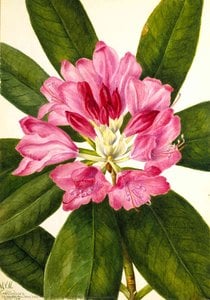
A Life Blossoming in Watercolor: The World of Mary Vaux Walcott
Mary Vaux Walcott, a name synonymous with the delicate beauty and scientific precision of North American wildflowers, was born into a world of quiet refinement in Philadelphia in 1860. Yet, from her earliest years, a vibrant artistic spirit pulsed within her—a gift nurtured by a simple set of watercolor paints at the tender age of eight. This wasn’t merely a childhood pastime; it was the genesis of a lifelong passion, a deep connection with the natural world that would ultimately define her extraordinary career and earn her the affectionate title “the Audubon of Botany.” Her story is not simply one of artistic talent, but also of remarkable resilience, unwavering curiosity, and a pioneering spirit that defied the societal expectations placed upon women in the late 19th century. The responsibility for caring for her father and two younger brothers fell heavily upon young Mary after the untimely death of her mother in 1880—a burden she carried with grace and determination, never allowing it to extinguish the flame of her creative spirit.The Allure of the Rockies: Nature as Muse and Subject
The landscapes of the Canadian Rockies became the very heart and soul of Mary’s artistic journey. These vast, rugged mountains weren't merely a backdrop for her paintings; they were an active laboratory, a place where she meticulously documented the intricate details of alpine flora alongside her brothers. They didn’t simply observe the landscape; they engaged with it deeply—studying mineralogy, charting glacial movements through detailed drawings and photographs, and immersing themselves in the subtle nuances of each wildflower species. This wasn't passive observation; it was a profound engagement with the scientific underpinnings of nature, driven by an insatiable curiosity and a desire to capture its essence with unparalleled accuracy. During these annual summer expeditions, Mary honed her skills as a botanical illustrator, initially at the request of botanists eager for precise depictions of rare and elusive species. Her approach was revolutionary for its time—she rendered plants to scale, showcasing their delicate structures, vibrant colors, and intricate details with an almost obsessive attention to detail. Unlike many floral paintings of the era, which often romanticized or stylized their subjects, Walcott’s work prioritized scientific accuracy alongside artistic expression, creating images that were both beautiful and profoundly informative. Her dedication extended beyond mere representation; she sought to capture not just the outward appearance of a flower but also its unique characteristics and ecological role.A Partnership Forged in Science and Art
In 1914, Mary’s life took an unexpected turn with her marriage to Charles Doolittle Walcott, then Secretary of the Smithsonian Institution—a man deeply committed to scientific exploration and a renowned paleontologist. This union wasn't simply a personal connection; it was a meeting of minds—two individuals united by a shared passion for understanding the natural world. Their marriage fostered a unique partnership where art and science intertwined seamlessly. They continued their annual expeditions to the Canadian Rockies, with Charles pursuing his geological research while Mary dedicated herself to her botanical paintings. These weren’t separate endeavors but complementary pursuits, each enriching the other—Charles's scientific observations providing context for Mary’s artistic interpretations, and Mary’s detailed illustrations offering a visual record of Charles’s discoveries. The Smithsonian Institution became a crucial platform for showcasing Mary’s work, culminating in the publication of *North American Wild Flowers* in 1925—a monumental five-volume collection featuring over 400 of her meticulously crafted illustrations, accompanied by insightful descriptions and scientific observations. This publication cemented her reputation as a leading botanical artist and earned her the enduring moniker “the Audubon of Botany,” acknowledging the parallel between her detailed floral studies and John James Audubon’s iconic depictions of birds.Key Achievements & Recognition
- Pioneering Botanical Illustration: Renowned for her scientifically accurate and artistically exquisite watercolor paintings of wildflowers, setting a new standard for botanical illustration.
- “The Audubon of Botany”: Affectionately known by this title, recognizing the significance of her work in botanical art and its parallels with Audubon’s legacy.
- *North American Wild Flowers* (1925): Publication of a five-volume collection showcasing over 400 of her illustrations, solidifying her reputation as a leading botanical artist.
- First Woman to Summit Mount Stephen: A testament to her adventurous spirit, physical endurance, and pioneering spirit in the field of mountaineering.
- Contributions to Glacial Geology: Documented glacial recession in the Canadian Rockies alongside her brothers, providing valuable data for climate change studies and contributing significantly to scientific understanding.
- Philanthropic Legacy: Bequeathed a substantial sum to the Smithsonian Institution to support scientific research and conservation efforts.
A Lasting Legacy
Mary Vaux Walcott’s influence extends far beyond the beauty of her paintings—she represents a unique synthesis of artistic skill, scientific observation, and adventurous spirit. Her work isn't simply a collection of pretty flowers; it’s a profound celebration of the natural world, revealing its intricate structures, capturing its delicate beauty, and highlighting its vital role in the ecosystem. Her illustrations continue to be valued by both art enthusiasts and botanists alike, serving as invaluable resources for identifying and studying North American flora. Beyond her artistic achievements, Walcott demonstrated a commitment to public service, advocating for improved conditions on Native American reservations and contributing to scientific understanding through her meticulous documentation of the Canadian Rockies. Her story serves as an inspiration—a reminder that passion, dedication, and a deep connection with nature can blossom into a life of remarkable achievement and leave a lasting legacy for generations to come.Pytania i odpowiedzi
Jak mogę znaleźć dzieła artysty Mary Vaux Walcott w konkretnej palecie barw?
Aby znaleźć prace artysty Mary Vaux Walcott w konkretnej palecie barw, skorzystaj ze strony Według palet kolorystycznych poświęconej temu artyście.
Które dzieła Mary Vaux Walcott są najczęściej oglądane?
Strona Statystyki odwiedzin artysty Mary Vaux Walcott przedstawia statystyki obliczone na podstawie dzieł tego artysty wymienionych w niniejsza strona.
Skąd pochodzi Mary Vaux Walcott?
Mary Vaux Walcott urodził się w Stany Zjednoczone.