A Life Immersed in Light and Landscape
Mary Agnes Yerkes, born August 9, 1886, in Oak Park, Illinois, was an artist whose life became a testament to the enduring power of passion and perseverance. Her dedication to capturing the fleeting beauty of the American West through Impressionistic landscapes cemented her place as a significant, though often overlooked, figure in early 20th-century art. Yerkes’s journey wasn't one of immediate acclaim or effortless success; rather, it was a path forged through formal training, personal hardship, and an unwavering commitment to her artistic vision. From a young age, she demonstrated a keen aptitude for the visual arts, nurtured by a supportive family who recognized and encouraged her talent. The untimely death of her father in 1908 profoundly impacted the family dynamic, but also spurred a remarkable act of support from her mother, who commissioned architect John S. Van Bergen to design a home specifically tailored to Mary Agnes' artistic pursuits. This residence, complete with an upstairs studio and integrated framing for murals, became a sanctuary where Yerkes could fully immerse herself in her craft—a space that would later be recognized by the Oak Park Preservation Trust as a landmark of artistic patronage. It was within these walls that the seeds of a lifelong dedication to art were firmly sown, providing both physical and emotional sustenance for the creative journey ahead.Formative Years and Artistic Development
Yerkes’s formal education laid a solid foundation for her future explorations in art. She pursued studies at Rockford College, focusing on art history and decorative design, before honing her skills at the Academy of Fine Arts and the prestigious School of the Art Institute of Chicago. There, she benefited from the guidance of prominent artists like Wellington Reynolds, John W. Norton, and Walter Marshall Clute, absorbing their techniques and philosophies while developing her own unique style. Early exhibitions at the Art Institute of Chicago showcased her versatility, with works appearing alongside those of fellow Chicago artists and within the esteemed American Watercolor Society. She even recalled a talented young man she went to school with at the Chicago Art Institute – Walt Disney, whom she described as "a skinny boy who always carried a pencil box around with him." However, life soon presented unforeseen challenges. In 1917, she married Navy Commander Archibald Nelson Offley ("Archie"), embarking on a life intertwined with the demands of naval service. This meant frequent relocations—Portsmouth, Virginia; San Diego, Vallejo, Long Beach, and San Francisco, California—before finally settling in San Mateo, California, in the 1930s. The onset of the Great Depression proved to be a pivotal moment, dramatically altering her professional prospects. A disheartening visit to Gump's department store revealed a stark lack of demand for art during that period, forcing Yerkes to adapt and redefine her artistic path.Plein-Air Painting and the Call of the West
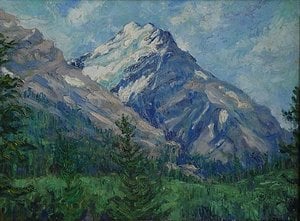
Undeterred by economic hardship, Yerkes turned towards *plein-air* painting as a means of continuing her artistic practice. This shift marked a profound turning point in her career, leading her to embrace the vast landscapes of the American West with unparalleled enthusiasm. Accompanied by her husband, Archie, she embarked on extensive travels throughout the 1930s and 40s in a specially modified 1920s Buick—a mobile studio equipped for camping and artistic exploration. Their journeys took them to some of the nation’s most breathtaking National Parks: Crater Lake, Mt. Rainier, Glacier, Yellowstone, Grand Teton, Rainbow Bridge, Arches, Mesa Verde, Joshua Tree, Death Valley, Grand Canyon, Organ Pipe Cactus National Monument, and Yosemite. Yosemite Valley held a particular significance for Yerkes, its majestic beauty and proximity to San Mateo making it a frequent subject of her work. It was in these wild spaces that she truly flourished, capturing the essence of the landscapes with vibrant colors and an Impressionistic sensibility—a style characterized by broken brushstrokes, emphasis on light and atmosphere, and a subjective interpretation of nature. Her paintings weren’t merely representations of scenery; they were emotional responses to the grandeur and serenity of the natural world. She sought not just to depict what she saw, but to convey how it *felt* to be immersed in such breathtaking beauty.Themes and Techniques
- Plein-Air Painting: Yerkes’s dedication to painting outdoors allowed her to capture the fleeting effects of light and atmosphere, a hallmark of Impressionism.
- American West & National Parks: The landscapes of the American West, particularly its National Parks, served as her primary source of inspiration. She sought to convey not just the visual appearance of these places but also their emotional impact.
- Impressionistic Style: Her paintings are characterized by broken brushstrokes, vibrant colors, and a focus on capturing the subjective experience of light and color.
- Mediums: Yerkes skillfully employed oil paints, pastels, and watercolors, demonstrating versatility in her artistic approach. Each medium allowed her to explore different textures and effects.
- Subject Matter: While landscapes dominated her oeuvre, she also painted portraits, figures, and still lifes, showcasing a broad range of artistic interests.
Legacy and Artistic Significance
Mary Agnes Yerkes continued painting with unwavering dedication well into her nineties, leaving behind a substantial body of work that reflects her lifelong passion for art and nature. Though she faced obstacles throughout her career, her commitment never wavered. Scott A. Shields, Ph.D., Associate Director/Chief Curator at the Crocker Art Museum, has aptly described her oils as “wonderful examples of California Impressionism,” recognizing her contribution to this important artistic movement. Yerkes’s legacy lies not only in her beautiful paintings but also in her enduring spirit—a testament to the power of art to sustain and inspire even in the face of adversity. Her work offers a glimpse into a bygone era, capturing the pristine beauty of the American West before it underwent significant changes. She stands as a reminder that artistic expression can thrive outside the confines of traditional institutions, fueled by personal conviction and a deep connection to the natural world. Yerkes passed away in San Mateo on November 8, 1989, at the remarkable age of 103, leaving behind a rich artistic heritage for future generations to discover and appreciate. Her paintings continue to resonate with viewers today, inviting them to experience the beauty and wonder of the American landscape through her uniquely Impressionistic vision.Pytania i odpowiedzi
Czy mogę sortować dzieła Mary Agnes Yerkes według koloru?
Strona Indeks barwny grupuje dzieła Mary Agnes Yerkes według kolorów.
W jaki sposób mogę zobaczyć wszystkie dzieła stworzone przez Mary Agnes Yerkes?
Każde dzieło Mary Agnes Yerkes dostępne w ta strona można przeglądać na stronie Wszystkie dzieła sztuki artysty.
Skąd pochodzi Mary Agnes Yerkes?
Mary Agnes Yerkes urodził się w Stany Zjednoczone.