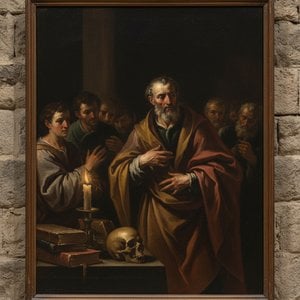
Marian Vayreda i Vila: A Catalan Voice Amidst Tradition and Nationalism
Marian Vayreda i Vila (1853-1903) stands as a singular figure in Catalan cultural history—a soldier, writer, and artist who embodied the complexities of his time. Born in Olot, Girona, Spain, he navigated the turbulent currents of Carlism and emerging Spanish nationalism, leaving an indelible mark on both artistic expression and literary discourse. This biography delves into his multifaceted life and legacy, exploring his formative years, artistic pursuits, political convictions, and enduring contribution to Catalan identity.Early Life and Family Roots
Marian Vayreda’s ancestry traced back to noble Catalan families—specifically the Alt Garrotxa region—where his paternal lineage connected him to prominent landowners. His grandfather, Francesc Vayreda i Busquets, experienced firsthand the upheaval of the First Carlist War when their home was destroyed by bombardment, prompting a relocation to Girona. This familial history instilled in Marian a deep connection to Catalan traditions and fostered an awareness of regional identity—a sentiment that would permeate his artistic endeavors and political stances. He attended the Padres Escolapios college in Olot, preparing for a legal education but ultimately prioritizing artistic exploration. Marian Francesc Bartomeu Vayreda i Vila was descended to noble Catalan families. His paternal ancestors were related to the Alt Garrotxa town of Olot. During the legitimist siege in course of the First Carlist War, their home was set ablaze, which forced Marian’s grandfather Francesc to move to Girona. It is there that his son and Marian’s father, Francesc Vayreda i Busquets (1814-1870), fell in love with Maria Rosa Vila i Galí (1817-?). She was descendant to a far more prestigious local Vila Cavaller family, holding a number of estates and owning Cavaller de Vidrà, an iconic Catalan mansion. The couple married in 1840 and in 1844 they settled in the reconstructed family house in Olot. Francesc’s maternal uncle was municipal military commander and Francesc possibly took part in activities against the local trabucaires. He inherited estates co-possessed with his relatives and is referred to as “propietario rentista”. As the two families maintained good relations, Francesc temporarily administered Porqueres holdings of his junior Vila nephews and the Vila family periodically managed the Vayreda estates. Marian’s father had six children, three of them becoming recognized figures. Apart from Marian, Joaquím (1843-1894) was a painter, and Estanislau (1848-1901) was a botanist.The Artistic Awakening: Painting and Sculpture
Driven by a passion for visual arts, Marian Vayreda pursued formal training at l’Escola de Dibuix d’Olot, immersing himself in the techniques of Jean-Léon Gérôme—a Parisian instructor who championed the Art of Saint Sulpice. This artistic influence shaped his style and vision, favoring meticulous detail and a reverence for religious iconography. He established “El Arte Cristiano,” a workshop specializing in sculptural reproductions of saints, marking a pivotal moment in Olot’s artisan heritage. Collaborating with fellow artist Joan Carles Panyó, he championed innovation—introducing wood pulp paste as a modeling mate—a breakthrough that revolutionized the industry and secured its place as a symbol of Catalan craftsmanship. He was particularly interested in capturing the solemn beauty of religious scenes, reflecting his deep spiritual convictions. Marian Vayreda’s artistic training took place in Paris for two years. He took classes with Jean-Léon Gérôme. His style was characterized by painstaking realism and an unwavering dedication to portraying sacred subjects with profound emotion. The workshop “El Arte Cristiano,” founded by Marian and Joan Carles Panyó, became a cornerstone of Olot’s artistic identity—a testament to his commitment to preserving traditional Catalan artistry.Literary Contributions: “La Punyalada” and Catalan Identity
Beyond his artistic achievements, Marian Vayreda’s literary legacy resides in *La Punyalada*, published in 1904—considered one of Catalonia's finest novels. This gripping tale explored themes of political intrigue, social injustice, and Catalan nationalism, reflecting the anxieties and aspirations of a region grappling with modernization and imperial ambitions. Vayreda skillfully blended historical realism with psychological depth, crafting a narrative that resonated deeply within Catalan intellectual circles and solidified his reputation as a writer committed to preserving cultural heritage. The novel’s depiction of Catalan society during the tumultuous period of the Third Carlist War remains a powerful reminder of the importance of safeguarding regional traditions and confronting challenging political realities.Political Engagement: Carlism and Spanish Nationalism
Marian Vayreda’s involvement in politics stemmed from his familial ties to the Carlist movement—a conservative nationalist faction advocating for the restoration of the Bourbon monarchy. He actively participated in military campaigns during the Third Carlist War, demonstrating unwavering loyalty to his convictions. Simultaneously, he embraced emerging Spanish nationalism, recognizing the importance of forging a unified national identity amidst competing ideologies. This dual allegiance positioned him as a representative figure of Catalan cultural renaissance—a testament to the complexities of navigating historical forces and shaping artistic expression. He was considered a typical case of an identity located in-between Carlism and Spain’s peripheral nationalisms. Marian Vayreda’s mother's family was strongly Carlist for many years. Growing up at the Cavaller de Vidrà estate, Marian learned about their traditional beliefs. From age 15, he read *La Esperanza*, a newspaper that supported Carlism. Carlism was a political movement in Spain. It supported a different branch of the royal family for the throne. It also wanted to keep traditional ways of life and regional laws, called *”,Pytania i odpowiedzi
Gdzie i w którym roku urodził(a) się Marian Vayreda I Vila?
Marian Vayreda I Vila urodził się w Olot w 1853.
W jaki sposób mogę zobaczyć wszystkie dzieła stworzone przez Marian Vayreda I Vila?
Każde dzieło Marian Vayreda I Vila dostępne w ta strona można przeglądać na stronie Wszystkie dzieła sztuki artysty.
Czy mogę przeglądać dzieła Marian Vayreda I Vila według słów kluczowych?
Aby znaleźć dzieła artysty Marian Vayreda I Vila o konkretnej tematyce, skorzystaj ze strony Według słów kluczowych, która grupuje prace według słów kluczowych.