Mabel May Woodward: A Life in Impressionism
Early Life and Education
- Born in Providence, Rhode Island in 1877, Mabel May Woodward came from a stable and affluent family who prioritized her artistic education.
- She began her formal studies at the Rhode Island School of Design in 1896, graduating with highest honors.
- Woodward continued her training at the Art Students League of New York in 1898, studying under Kenyon Cox and Frank Duveneck.
- Further artistic development occurred at the Ogunquit School of Art in Maine with Arthur Wesley Dow and Charles Woodbury.
Artistic Development and Influences
- Influenced by the Impressionists, particularly William Merritt Chase and Frank Dumond, Woodward embraced a colorful palette and bold brushstrokes.
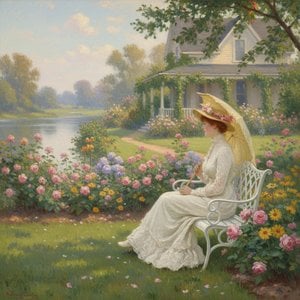
- Her early work focused on portraits of women and girls set in outdoor gardens – a series known as “old-fashioned girls in gardens.” These paintings prioritized capturing light and color over psychological depth.
- Summers spent in Ogunquit, Maine significantly shaped her style, leading to a focus on beach scenes and airy landscapes.
Career and Teaching
- Woodward dedicated over twenty years to teaching at the Rhode Island School of Design.
- She originated a unique class called the “action class,” where students studied the human figure as a dynamic machine rather than a static object.
- Her painting practice flourished during her summer vacations, allowing for dedicated time to explore landscapes and beach scenes.
- She was an active member of the art community, serving as the first woman president of the Providence Art Club.
Major Themes and Style
- Key themes in Woodward’s work include the effects of light and color, family life, leisure activities, and New England coastal landscapes.
- Her style is characterized by vibrant canvases, bold impasto brushstrokes, and a focus on capturing fleeting moments of beauty.
- She skillfully depicted the play of light and shadow in her beach scenes, often featuring families and children enjoying the seaside.
Historical Significance and Rediscovery
- During the 1920s and 1930s, Woodward was one of Rhode Island’s most recognized artists.
- Following her death in 1945, her work fell into relative obscurity as the art world favored French Impressionism.
- Interest in American Impressionism revived later in the 20th century, leading to a rediscovery of Woodward’s paintings.
- Her works have since gained recognition and sold for significant prices, with some reaching six-figure sums.
- Exhibitions like “Neglected American Impressionists” (1972) and a retrospective at the Providence Art Club (1992) helped to reestablish her legacy.