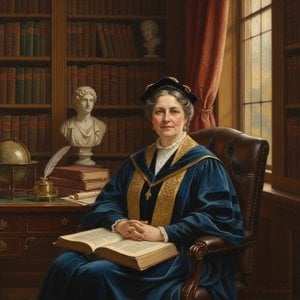
A Life Etched in Portraits: The World of Lowes Cato Dickinson
Lowes Cato Dickinson, born in Kilburn, London, in 1819, was a figure deeply embedded within the artistic and social currents of Victorian England. Coming from a family intimately connected to the art world—his father, Joseph Dickinson, being a respected lithographer and publisher on Bond Street—Dickinson’s path seemed preordained. Yet, his journey wasn't merely one of inheritance but of active engagement with the evolving aesthetic sensibilities and progressive social movements of his time. One of eleven siblings, he received his early education at Topsham School and Dr Lord's School in Tooting, grounding him in a solid foundation before fully immersing himself within the family business following his father’s death in 1849. He then joined forces with his brothers, Gilbert Bell Dickinson and William Robert Dickinson, to continue the legacy of Dickinson Brothers on Bond Street, a firm that quickly became synonymous with quality art publishing and photography. This early exposure wasn't simply about commerce; it was an apprenticeship in visual culture, shaping his eye for detail and composition—qualities that would define his later work as a portraitist.The Pre-Raphaelite Circle and the Call of Social Reform
Dickinson’s artistic development took a significant turn with a three-year sojourn in Italy around 1850. This period proved formative, exposing him to the masterpieces of the Renaissance and influencing his evolving style. He absorbed the stylistic innovations championed by Dante Gabriel Rossetti and John Ruskin—a fervent desire for truth to nature and emotional intensity—principles that would permeate his subsequent artistic endeavors. Upon his return to England, he found himself drawn into the orbit of the Pre-Raphaelite Brotherhood, though not formally affiliated with it. Nevertheless, Dickinson cultivated correspondence with prominent members of this influential group, solidifying his position within its intellectual landscape. This association wasn’t solely driven by aesthetic considerations; it was intertwined with a burgeoning awareness of social responsibility. He became deeply involved in the Christian socialist movement—a collective striving to infuse moral values into societal reform—collaborating on projects like the establishment of the Working Men's College alongside figures such as Charles Kingsley and Thomas Hughes. This institution, dedicated to providing accessible education to working-class individuals, stood as a testament to Dickinson’s conviction that knowledge could catalyze positive change within society. The presence of Ford Madox Brown at Dickinson Brothers further underscored his connection to this vibrant artistic and intellectual milieu.A Portraitist of Victorian Society
Lowes Cato Dickinson distinguished himself as a remarkably skilled portrait painter during the Victorian era—a period characterized by social stratification and burgeoning industrialization. His technique was particularly noteworthy: he eschewed grand historical narratives or dramatic allegories, instead focusing on capturing the essence of his subjects—the influential individuals who shaped British society. He meticulously rendered facial expressions and subtle shading, prioritizing psychological insight over mere visual representation. This approach allowed him to convey personality and character with remarkable accuracy—a hallmark of his oeuvre. Dickinson’s prolific output spanned from 1848 to 1891, producing a substantial body of work that reflects the diverse social strata of Victorian England. Among his subjects were Queen Victoria herself, members of Parliament, scientists like Arthur Cayley and James Clerk Maxwell, and prominent Christian socialists such as Charles Kingsley and Thomas Hughes—individuals who embodied the moral values championed by Dickinson’s movement. His portraits are celebrated for their sensitivity to detail and their ability to capture the inner life of his sitters.Notable Achievements and Legacy
Dickinson's contribution to British art is undeniable, marked by a singular dedication to portraying individuals with profound empathy and artistic precision. He achieved considerable renown during his lifetime, securing commissions from dignitaries and intellectuals alike—a testament to his reputation as one of the era’s foremost portraitists. His magnum opus remains the 1868 cabinet portrait of Mr. Gladstone—captured within the hallowed halls of Downing Street—a work that exemplifies his mastery of technique and his ability to convey both dignity and intellect. Furthermore, Dickinson's involvement in the founding of the Working Men's College cemented his legacy as a champion of social reform and educational accessibility. His enduring influence is evident in the annual Lowes Dickinson Award presented by the college—recognizing student excellence—and in the establishment of a travel scholarship bearing his name. Dickinson’s papers, meticulously archived at Princeton, Oxford, and Cambridge Universities, continue to inspire scholars studying Victorian art history and social thought. He remains remembered not merely as an artist but as a humanist who sought to illuminate the human condition through the medium of portraiture—a figure whose work continues to resonate with audiences today.Pytania i odpowiedzi
Ile dzieł Lowes Cato Dickinson można przejrzeć w katalogu?
Możesz przeglądać 76 dzieł sztuki dzieł autorstwa Lowes Cato Dickinson na stronie Wszystkie dzieła.
Gdzie mogę zobaczyć profil kolorystyczny twórczości Lowes Cato Dickinson?
Genom Palety artysty Lowes Cato Dickinson to strona prezentująca profil kolorystyczny całego dorobku twórczego tego artysty.
Czy mogę przeglądać dzieła Lowes Cato Dickinson według kolorów?
Prace Lowes Cato Dickinson można przeglądać według kolorów na stronie Indeks kolorystyczny artysty.