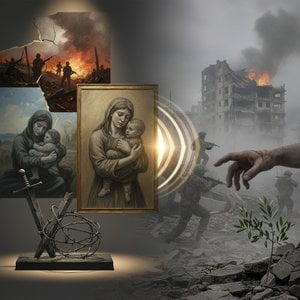
Leslie Cole (1910–1976): British War Artist Documenting WWII’s Realities With Unflinching Realism, From Malta To Bergen-Belsen
Leslie James Cole, born in Swindon, United Kingdom, in 1910, was an artist whose life became inextricably linked with the tumultuous events of the Second World War. Though his name may not be as instantly recognizable as some of his contemporaries, Cole’s contribution to documenting the realities of conflict – and its devastating aftermath – is profoundly significant. His work stands as a powerful testament to human resilience in the face of unimaginable horror, offering a visual record that continues to resonate with viewers today. Cole's artistic journey began with formal training at Swindon Art School from 1927 to 1932, followed by studies at Birmingham College of Art and culminating in a diploma from the Royal College of Art in 1937, where he specialized in mural decoration, fabric painting, and lithography. This diverse foundation equipped him with a versatile skillset that would prove invaluable during his time as an official war artist. Even before the outbreak of war, Cole demonstrated a commitment to both artistic practice and education, beginning his teaching career at Hull College of Art – a dedication he would continue throughout his life.Early Artistic Development & Formal Training
Cole’s formative years were marked by a passion for visual arts nurtured through rigorous academic instruction. Swindon Art School provided him with foundational skills in draughtsmanship and composition, while Birmingham College of Art honed his understanding of color theory and artistic technique. However, it was the Royal College of Art that truly cemented his artistic vision, particularly his specialization in mural decoration and fabric painting – disciplines that would later prove crucial to his role as a war artist. His professors recognized Cole’s talent for capturing emotion and conveying narrative through visual mediums, shaping him into a meticulous observer and thoughtful creator. This dedication to mastering craft ensured he possessed the technical prowess necessary to translate complex ideas into compelling artworks.A Call To Service: Joining The RAF & Initial Artistic Aspirations
Despite initial challenges securing a position within the Royal Air Force due to medical concerns, Cole’s determination shone through. Recognizing his artistic aptitude and unwavering commitment to serving his country, he proactively pursued alternative avenues for creative expression. He embarked on independent expeditions accompanying trawlers involved in minesweeping – a courageous undertaking that showcased not only his practical skills but also his willingness to confront danger head-on. These early explorations instilled within him a profound appreciation for the natural world and fueled his desire to document its beauty alongside the grim realities of wartime experience. This spirit of adventure would later inform his approach to portraying the horrors of Bergen-Belsen, where he sought to convey both the physical devastation and the psychological impact on survivors.The War Artist’s Commission & Documenting Conflict
The outbreak of World War II irrevocably altered Cole's artistic trajectory. Despite initial rejection by Sir Kenneth Clark and the War Artists’ Advisory Committee (WAAC), Cole persisted in demonstrating his capabilities, securing a full-time commission in 1943 thanks to his unwavering resolve and impressive portfolio. This pivotal moment propelled him into the heart of wartime activity, allowing him to travel extensively across Europe and Asia – capturing scenes from Malta during its siege, Normandy alongside the Royal Marines, Cairo amidst inter-factional violence following German withdrawal, and further afield to Singapore, Burma, Borneo, and Java. Cole’s meticulous attention to detail—particularly his ability to convey emotion through realistic brushstrokes—was recognized by the WAAC as essential for documenting wartime experiences. He skillfully utilized lithography to capture immediacy and authenticity, producing powerful images that conveyed a sense of urgency and truthfulness.Bergen-Belsen: A Legacy Of Witness & Remembrance
Cole’s most enduring contribution to art history lies in his harrowing depictions of Bergen-Belsen concentration camp – an undertaking that demanded courage and compassion. His panoramic oil paintings documenting the scenes of unimaginable suffering—survivors, British troops, and captured German guards—stand as unflinching portrayals of one of history’s darkest chapters. Cole's masterful technique combined with profound empathy ensured his artwork transcended mere visual representation; it became a visceral testament to human resilience amidst despair. These paintings continue to inspire reflection on the importance of confronting uncomfortable truths and honoring those who endured unimaginable hardship. They serve as a poignant reminder that art can bear witness to history’s most devastating moments, fostering understanding and promoting remembrance.Notable Works & Collections
- Brigadier Ivan de la Bere, OBE, in Charge of Troops During the Siege Of Malta (1943): A detailed oil painting capturing wartime resilience and dignity.
- Night Scene In A Watch Office (1942): A dramatic WWII oil painting conveying vigilance and communication through realist-impressionistic style.
- Subedar Major Musank Khan (1945): A dignified portrait of a soldier, rendered with realistic detail and textured impasto.
- Bergen-Belsen Series: Panoramic oil paintings documenting the harrowing aftermath of liberation, held in significant collections like the Imperial War Museum.
Pytania i odpowiedzi
Skąd pochodzi Leszek Cole?
Leszek Cole urodził się w Wielka Brytania.
Jak znaleźć dzieła Leszek Cole o konkretnej tematyce?
Aby znaleźć dzieła artysty Leszek Cole o konkretnej tematyce, skorzystaj ze strony Według słów kluczowych, która grupuje prace według słów kluczowych.
Ile dzieł Leszek Cole można przejrzeć w katalogu?
Możesz przeglądać 65 dzieł sztuki dzieł autorstwa Leszek Cole na stronie Wszystkie dzieła sztuki.