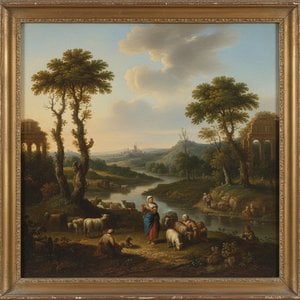
A Life Immersed in Light and Landscape
Karel Dujardin, a name resonating softly within the pantheon of Dutch Golden Age masters, was born in Amsterdam in 1626 – though some records suggest 1622. His life unfolded during a period of unprecedented artistic flourishing in the Netherlands, yet his path wasn’t one of immediate acclaim but rather a gradual unfolding of talent nurtured by careful study and extensive travel. Details surrounding his early years remain somewhat elusive, shrouded in the mists of time, however it is widely accepted that he received foundational training under Nicolaes Berchem, a painter celebrated for his idyllic landscapes populated with animals. This mentorship proved pivotal, instilling in Dujardin a deep appreciation for naturalism and a keen eye for capturing the subtle nuances of light and atmosphere. He diligently absorbed Berchem’s techniques—particularly his masterful use of color and composition—establishing a bedrock upon which he would build his own distinctive artistic vision.The Bentvueghels and Roman Influences
But Dujardin’s artistic journey wasn't confined to the studios of Amsterdam; he possessed an adventurous spirit that led him to Rome, where he became a member of the *Bentvueghels*, a society of predominantly Dutch and Flemish painters who embraced a bohemian lifestyle and often adopted satirical nicknames. In Rome, he was known as “Barba di Becco” or "Goat-Beard," a moniker likely referencing his distinctive facial hair, and it was here that his artistic voice truly began to mature. The Bentvueghels fostered an environment of intellectual curiosity and playful experimentation, encouraging members to challenge conventions and explore new perspectives. This influence is palpable in Dujardin’s oeuvre—particularly his landscapes infused with a Roman sensibility—where he skillfully blended Dutch traditions with Italianate aesthetics. He sought inspiration from the grandeur of classical ruins and the vibrancy of urban life, incorporating elements of these influences into his canvases with remarkable subtlety.Mastering Light and Detail: Artistic Style
Dujardin’s artistic style is characterized by meticulous detail and a remarkable ability to depict scenes of everyday life – rural landscapes brimming with animals, peasants engaged in their daily routines, and tranquil pastoral settings. He possessed an exceptional talent for capturing the play of light and shadow, imbuing his canvases with a sense of warmth and realism. Like Rembrandt before him, Dujardin prioritized accuracy and observation—he painstakingly rendered textures and colors to convey a profound understanding of the natural world. His paintings are populated by figures rendered with remarkable sensitivity, conveying emotion and psychological depth alongside physical likeness. Consider Woman Milking a Red Cow – the artist’s meticulous attention to detail captures not only the physicality of the cow but also the quiet dignity of the woman tending it, creating an image that resonates with both beauty and truth.Notable Works and Legacy
Among Dujardin's impressive body of work are masterpieces such as Farm Animals in the Shade of a Tree, which exemplifies his ability to portray rural life with breathtaking precision; Rest at an Italian Inn, where he seamlessly blends Dutch genre painting traditions with evocative Italianate settings; and The Regents of the Spinhuis and Nieuwe Werkhuis, Amsterdam (1669) – a monumental group portrait showcasing Dujardin’s skill in capturing individual likenesses within a larger composition. His paintings are held in esteemed collections worldwide, including the Mauritshuis Royal Picture Gallery in The Hague and the National Gallery in London, testament to their enduring appeal and artistic merit. He stands as a representative figure of an era that celebrated observation, craftsmanship, and the quiet moments of life—a legacy that continues to inspire artists today. His contribution solidified Dutch landscape painting's reputation for realism and psychological insight.Concluding Thoughts
Karel Dujardin’s art transcends mere representation; it embodies a profound engagement with the human condition and an unwavering devotion to capturing the beauty of the natural world. He wasn’t merely documenting his surroundings—he was transforming them into expressions of emotion and intellect, cementing his place as one of the most significant artists of the Dutch Golden Age.Pytania i odpowiedzi
Skąd pochodzi Karel Dujardin?
Karel Dujardin urodził się w Holandia.
Czy mogę odwiedzić wirtualne muzeum dzieł Karel Dujardin?
Zapraszamy na wirtualny spacer: strona Wirtualna Galeria 3D artysty Karel Dujardin prezentuje jego dzieła w galerii trójwymiarowej.
Czy mogę przeanalizować sposób użycia koloru przez Karel Dujardin we wszystkich jego/jej dziełach?
Genom Palety artysty Karel Dujardin to strona prezentująca profil kolorystyczny całego dorobku twórczego tego artysty.