The Dynamic Line: The Artistic Vision of Kang Kyung Koo
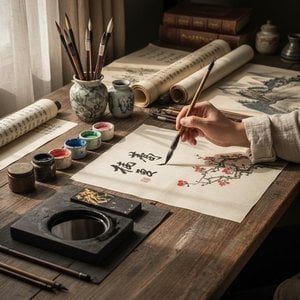
Born in Seoul in 1952, Kang Kyung Koo has emerged as a profound voice in contemporary Korean art, crafting a visual language that exists at the delicate intersection of tradition and modernity. His work is not merely a depiction of nature but an exploration of the very tension between the line and the plane. While much of Western modern painting has historically focused on revealing the flat, paneled surfaces of the foreground, Kang looks backward to the soul of Korean traditional painting, where the exquisite function of the dynamic line takes precedence. In his hands, the brushstroke becomes a living entity, capable of bridging the gap between ancient calligraphic principles and the expressive energy of modern neo-expressionism.
The evolution of Kang’s practice is marked by a deep fascination with movement and the physical performance of painting itself. His canvases often serve as stages for an embodied motion, where the black-inked brushwork fills the space with a rhythmic, almost dance-like vitality. This is particularly evident in his celebrated series, such as ‘Fire-Forest Fire’ and ‘The Forest’. In these works, the artist’s presence is felt through the intentional gaps between short, energetic lines, creating a sense of density and breath. Rather than adhering to rigid, traditional methods, Kang utilizes extravagant and colorful brushstrokes that move like a group dance, occupying the dominant position on the canvas and inviting the viewer into a state of sensory immersion.
Nature as an Abstract Symphony
For Kang Kyung Koo, the natural world—specifically the forest—serves as a primary vessel for spiritual and formal exploration. His approach to landscapes transcends mere representation; he seeks to capture the density of life through abstract forms. By utilizing materials such as ink on Korean paper mounted on wood panels, he maintains a tactile connection to his cultural heritage while pushing toward a more contemporary, abstract aesthetic. This synthesis allows him to explore themes of growth, decay, and the interconnectedness of all living things through the medium of light and shadow.
The artist's mastery lies in his ability to manipulate the viewer's perception of space. Through his meticulous use of ink and watercolor, he creates environments that feel both expansive and intimate. His work often reflects a profound meditation on the following elements:
- The Tension of Line: Using dynamic, sweeping strokes to define boundaries and create structural depth.
- Materiality: The use of traditional Korean paper and wood supports to ground his modern abstractions in historical texture.
- Rhythmic Motion: A focus on the "performance" of the brush, where each stroke carries the weight of a physical gesture.
- Organic Abstraction: Transforming the familiar imagery of forests and waterways into complex, layered compositions of color and form.
Legacy and Contemporary Significance
Throughout his prolific career, Kang Kyung Koo has achieved significant recognition both within South Korea and on the international stage. His solo exhibitions have graced prestigious venues such as the National Museum of Modern and Contemporary Art in Gwacheon, as well as various galleries in Daegu and Seoul. These exhibitions have showcased his ability to evolve, moving from early explorations of human figures and portraits toward the grand, sweeping landscapes that define his mature period. His recent exhibitions, such as DENSITY 숲 at Wooson Gallery, continue to demonstrate his enduring relevance in the contemporary art dialogue.
The historical significance of Kang’s work lies in his successful navigation of the "tension between tradition and modernity." He does not reject the past, nor is he trapped by it; instead, he uses the foundational principles of Korean ink painting to fuel a new, neo-expressionistic form. As his works continue to find homes in major collections and command attention at international art fairs, Kang Kyung Koo remains a vital figure, reminding us that the most profound art often arises from the harmonious struggle between what is inherited and what is newly discovered.