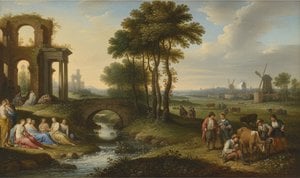
A Master of Mannerism: The Enigmatic World of Joachim Anthoniszoon Wtewael
Joachim Anthoniszoon Wtewael, a name perhaps less instantly recognizable than some of his Dutch Golden Age contemporaries, nevertheless occupies a fascinating and pivotal position in the history of 17th-century art. Born in Utrecht in 1566, Wtewael was a man of intriguing contrasts – a highly successful flax merchant and town councillor who simultaneously cultivated a career as a painter deeply rooted in the stylistic conventions of Mannerism. This duality is reflected in his work, which possesses a refined elegance and meticulous detail that sets it apart from the burgeoning naturalism that would soon dominate Dutch painting. He wasn’t swept up by the revolutionary currents shifting through the art world; instead, he remained steadfastly committed to an aesthetic characterized by elongated figures, graceful poses, and often, a subtle undercurrent of eroticism.
Early Life and Artistic Formation
Wtewael's artistic journey began within his family workshop. His father, Anthonis Jansz Wtewael, was a glass painter in Utrecht, providing Joachim with an initial grounding in the visual arts. However, it was his subsequent training in Haarlem, specifically under the influence of late Mannerist painters, that truly shaped his aesthetic sensibilities. This period instilled in him a love for intricate compositions, polished surfaces, and the dramatic use of light and shadow – hallmarks of Northern Mannerism. Unlike many artists who embraced the evolving trends towards realism, Wtewael consciously chose to preserve this earlier style, creating a body of work that feels both timeless and distinctly individual. His dedication to his craft was balanced by astute business acumen; he prospered as a flax merchant, allowing him financial independence and the freedom to pursue his artistic passions without relying solely on commissions. This economic stability also enabled him to participate actively in civic life as a town councillor, further demonstrating his multifaceted nature.
Themes and Techniques: A World of Myth and Sensuality
Wtewael’s oeuvre encompasses approximately one hundred paintings, drawings, and stained glass designs, revealing a remarkable versatility within the confines of his chosen style. He worked across various scales, from large-format canvases intended for public display to exquisitely detailed cabinet paintings on copper plates – the latter being particularly characteristic of his work. His subject matter is equally diverse, ranging from conventional religious scenes like the *Adoration of the Shepherds* (a motif he revisited multiple times) to elaborate mythological narratives. It’s within these mythological depictions that Wtewael truly shines, often imbuing them with a playful sensuality and a penchant for dramatic storytelling. Works such as *Mars and Venus Surprised by Vulcan*, *The Feast of the Gods*, and scenes from the Cupid and Psyche cycle demonstrate his mastery of complex compositions and his ability to populate them with elegantly rendered figures. Even when tackling biblical subjects, like *Lot and His Daughters*, Wtewael doesn’t shy away from exploring the more provocative aspects of the narrative.
Legacy and Lasting Influence
Despite remaining somewhat outside the mainstream of Dutch Golden Age painting, Joachim Anthoniszoon Wtewael left a significant mark on his contemporaries and subsequent generations. His unique blend of Mannerist refinement and entrepreneurial spirit continues to captivate art enthusiasts today. While he didn’t found a large school of followers, his influence can be detected in the work of other Utrecht Caravaggisti – artists who embraced the dramatic chiaroscuro of Caravaggio but retained elements of Wtewael's sophisticated draftsmanship. Today, his paintings are held in prominent museum collections worldwide, including the Museum Catharijneconvent in Utrecht and the Centraal Museum, offering viewers a glimpse into the captivating world he created. His enduring appeal lies not only in the technical brilliance of his work but also in its ability to transport us to a realm where beauty, mythology, and sensuality intertwine – a testament to the power of an artist who dared to remain true to his own distinctive vision. Wtewael’s legacy is one of elegant defiance, a reminder that artistic innovation doesn't always require embracing the latest trends but can also be found in the masterful refinement of established traditions.
Exploring Wtewael’s World Today
For those seeking to delve deeper into the art of Joachim Anthoniszoon Wtewael, numerous resources are available. Online databases such as WahooArt.com offer a comprehensive collection of his works, allowing viewers to explore his paintings in detail and learn more about his life and artistic development. Museum visits, particularly to institutions like the Museum Catharijneconvent in Utrecht, provide an opportunity to experience the impact of his art firsthand. Wtewael’s cabinet paintings on copper are especially rewarding to view up close, revealing the astonishing level of detail and artistry he brought to these intimate works. Furthermore, scholarly articles and online resources like Wikipedia and the National Gallery of Art website offer valuable insights into his historical context and artistic significance. By engaging with these resources, art lovers can gain a deeper appreciation for this often-overlooked master of Dutch Mannerism and discover the enduring beauty of his enigmatic world.