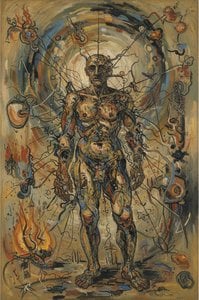
Jean-Marc Nahas: A Voice Carved from Conflict and Memory
Born in the tumultuous heart of Beirut, Lebanon, in 1963, Jean-Marc Nahas’s artistic journey is inextricably linked to the nation's long history of strife. Growing up amidst the Lebanese Civil War profoundly shaped his perspective, imbuing his work with a raw emotional intensity and a deep engagement with themes of war, displacement, and ultimately, resilience. This formative experience isn’t merely reflected in his subject matter; it’s woven into the very fabric of his artistic language – a deliberate simplification of form coupled with explosive bursts of color and dynamic movement.
Nahas's early life was marked by instability and displacement, experiences that propelled him to Paris at the age of seventeen. Seeking refuge and artistic training, he enrolled in the École Nationale Supérieure des Beaux-Arts (ENSBA) and Penninghen, institutions renowned for their rigorous curriculum and emphasis on traditional techniques. However, Nahas’s approach quickly transcended mere adherence to established methods. He sought mentorship from influential figures like Pierre Alechinsky, Vladimir Veličković, Ferit Iscan, and Albert Zavaro – artists who encouraged him to explore his own unique voice within the broader context of European modernism.
The Language of Emotion: Style and Technique
Nahas’s artistic style is immediately recognizable for its potent blend of abstraction and expressionism. His paintings are rarely representational in a literal sense; instead, they function as visual narratives—intimate portraits of the human condition rendered through simplified forms and intensely colored brushstrokes. He frequently employs a technique he describes as “writing,” likening his process to composing poetry or crafting a personal letter. This approach is evident in works like "Untitled" (2005), where bold lines, vibrant hues, and gestural textures coalesce to evoke a sense of urgency and emotional depth.
A key element of Nahas’s style lies in his deliberate simplification of form. He eschews elaborate detail, opting instead for a streamlined aesthetic that allows the raw emotion of the subject matter to take center stage. This reductionist approach is balanced by an energetic application of paint – rapid, rhythmic brushstrokes that convey movement and dynamism. Animal motifs frequently appear within his compositions, often depicted in moments of intense action or vulnerability, adding layers of symbolic meaning.
Themes of War and Displacement
The specter of war looms large throughout Nahas’s oeuvre, a direct consequence of his upbringing in Lebanon. However, his work transcends mere documentation of conflict; it delves into the psychological impact of violence on individuals and communities. He doesn't shy away from depicting the scars of trauma—the faces etched with sorrow, the bodies contorted by pain—but he also seeks to capture moments of hope and resilience. As he himself stated, “Unlike some of his fellow artists for whom the drawn-out conflict appears to have had little tangible impact on their artistic expression, for Jean-Marc, the scars of war run deep within his psyche, healed only by the cathartic practice of drawing.”
Furthermore, Nahas’s work frequently explores themes of displacement and exile. His move to Paris marked a significant shift in his life, yet the memories of Beirut—its beauty, its chaos, its enduring spirit—continue to resonate within his art. This duality – the tension between past and present, homeland and exile – is a recurring motif in his paintings.
Recognition and Legacy
Nahas’s work has garnered international recognition, with exhibitions held at prestigious galleries and museums around the world, including the Contemporary Art Platform in Kuwait City, the British Museum, and Bank Audi Foundation. His pieces are also part of private collections, solidifying his place as a significant contemporary artist. His retrospective exhibition at the Beirut Exhibition Center in 2013 served as a powerful testament to his artistic evolution and enduring impact.
Beyond individual achievements, Nahas’s work contributes to a broader dialogue about the role of art in confronting difficult historical realities. His willingness to engage with themes of war and displacement—with honesty and vulnerability—makes him a compelling voice within the contemporary art world. He continues to live and work in Beirut, drawing inspiration from his homeland while simultaneously navigating the complexities of a globalized artistic landscape.