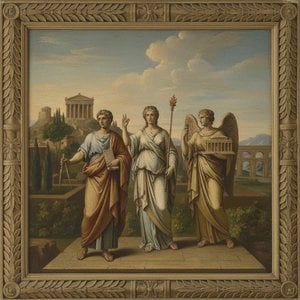
Jean Baptiste Despax: A Valenciennes Painter Bridging Rococo Elegance and Baroque Drama
Jean-Baptiste Despax (1709 – 1773) stands as a pivotal figure in French art history, embodying the stylistic convergence of Rococo’s refined grace and Baroque’s theatrical grandeur. Born in Valenciennes, France—a city renowned for its Huguenot heritage and burgeoning artistic milieu—Despax's life was marked by both personal tragedy and professional triumph, shaping his oeuvre into a testament to enduring beauty and profound emotional resonance. His formative years instilled within him an appreciation for meticulous observation and expressive technique, influences that would permeate his subsequent artistic endeavors.
Early Life and Artistic Training
Despax’s upbringing fostered a keen interest in the arts from a young age. Despite facing familial hardships following the untimely deaths of his parents—a circumstance that profoundly impacted his emotional landscape—he persevered in pursuing his artistic ambitions, securing patronage from influential figures who recognized his innate talent. His formal training commenced at the Académie Royale de Valenciennes, where he honed his skills under the tutelage of esteemed masters, absorbing the precepts of Baroque painting and mastering the subtleties of chiaroscuro—the dramatic interplay of light and shadow—a technique that would become synonymous with his distinctive style.
The Rococo Influence: Delicate Pastel Colors and Elegant Composition
Despax’s artistic sensibilities were decisively shaped by the prevailing aesthetic currents of Rococo, a movement characterized by its opulent ornamentation, pastel hues, and asymmetrical compositions. Artists like François Boucher and Jean Honoré Fragonard championed this style, prioritizing decorative splendor over strict realism—a preference that resonated deeply with Despax's creative vision. His paintings frequently depict scenes of aristocratic leisure—elegant gatherings bathed in soft light—infused with a palpable sense of romantic yearning and sensual delight. The meticulous rendering of textures—silk draperies shimmering with iridescent sheen, porcelain figurines exquisitely embellished—underscores his commitment to capturing the ephemeral beauty of Rococo’s idealized world.
Notable Works: Symbolism and Emotional Depth
Despax's artistic legacy rests upon a select collection of masterpieces that exemplify his stylistic prowess and thematic preoccupations. Among these stand out *Le Christ au jardin des oliviers* (Christ in the Garden of Oliviers), a monumental altarpiece commissioned for Saint John the Baptist Church in Genoa, Italy—a testament to his mastery of Baroque technique and his ability to convey profound spiritual contemplation. The painting’s central figure—Jesus contemplating the thorns of his crown—is enveloped in an aura of solemn majesty, illuminated by diffused light that casts dramatic shadows across the canvas—a masterful demonstration of chiaroscuro's expressive potential. Similarly, *Portrait d'Étienne* showcases Despax’s adeptness at capturing psychological nuance—the sitter’s gaze conveying both vulnerability and dignity—reflecting his profound understanding of human emotion.
Legacy and Historical Significance
Jean-Baptiste Despax’s contribution to French art history transcends mere stylistic innovation; he represents a crucial link between Rococo’s aristocratic elegance and Baroque’s dramatic fervor. His paintings continue to inspire admiration for their beauty, craftsmanship, and emotional depth—serving as enduring emblems of the Enlightenment's pursuit of sublime experience. Furthermore, Despax’s work stands as a poignant reminder of the human condition—a meditation on faith, mortality, and the transformative power of art—themes that resonate powerfully across generations. His legacy persists not only in museum collections but also in the collective memory of Valenciennes—where his paintings adorn prominent churches and public spaces—affirming his enduring influence on the city’s artistic heritage.
- *Le Christ au jardin des oliviers* (Saint John the Baptist Church, Genoa)
- *Portrait d'Étienne*
- *L'Annonciation*
- *La présentation au temple*
Source: Mutual Art Biography