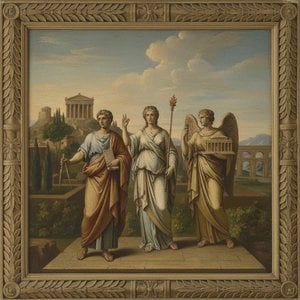
Jacques Réattu, born in the sun-drenched city of Arles in 1760, was a child of the Enlightenment era—a period brimming with intellectual curiosity and artistic innovation. His origins were somewhat unconventional; he was an illegitimate son of Guillaume de Barrême de Châteaufort, a painter himself, and Catherine Raspal, sister to Antoine Raspal, who would become Réattu’s first mentor. This familial connection proved pivotal in shaping his early trajectory, as Antoine Raspal initiated the young Jacques into the world of painting, laying the groundwork for a future steeped in artistic pursuit. In 1773, Réattu journeyed to Paris, enrolling in the royal academy of painting and sculpture with aspirations of becoming a celebrated “History Painter,” considered the most esteemed genre of the time. This ambition necessitated securing the prestigious Grand Prix de Rome, a fiercely competitive award that promised years of study in Italy—a cornerstone of any aspiring artist’s education. Though initial attempts proved unsuccessful, Réattu persevered, finally achieving his goal in 1790 with *Daniel Accusing Suzanne*, a work now housed at the École nationale supérieure des beaux-arts.
The Roman Interlude and Revolutionary Awakening
Winning the Grand Prix de Rome offered Réattu an invaluable opportunity to immerse himself in the classical traditions of Italy. However, his time in Rome was cut short by the escalating political unrest sweeping across Europe. Anti-French riots forced him to flee to Naples before he could complete the full four-year residency. This disruption, though unwelcome, proved formative. Upon his return to France, Réattu found himself amidst a nation undergoing radical transformation—the French Revolution had begun. The tumultuous events ignited a new passion within him, shifting his artistic focus towards themes of liberty, equality, and civic virtue. He settled briefly in Marseille before returning to Arles in 1796, where he acquired the Commanderie de Saliers, establishing a studio that would become synonymous with his evolving style.
A Painter of Revolutionary Ideals
The years following his return to Arles witnessed Réattu’s emergence as a painter deeply engaged with the spirit of the Revolution. He received commissions for large-scale decorative projects, most notably the interior of the Temple of Reason in Marseille. Here, he created eight monumental “grisaille” paintings—works executed in shades of gray mimicking bas-relief sculpture—depicting allegorical representations of revolutionary ideals. These works weren’t merely decorative; they were powerful statements reflecting the fervor and aspirations of a nation striving for change. *Prometheus Protected by Minerva*, completed during this period, stands as a testament to his evolving artistic vision—a dramatic interpretation of classical mythology infused with contemporary political resonance. The painting embodies the struggle for freedom and enlightenment, themes that would continue to permeate his oeuvre.
Later Years and Lasting Legacy
The early 19th century saw Réattu’s focus shift towards managing his estate, temporarily curtailing his artistic output. However, from 1819 onwards, he embarked on a prolific period of creativity, undertaking ambitious decoration projects for theaters and city halls in Marseille, Nîmes, and Lyon. Alongside grand allegorical compositions, he revisited historical subjects, demonstrating a continued mastery of form and narrative. In 1826, he began work on the interior of the church of Saint-Paul de Beaucaire—his first and only major religious commission—though his untimely death in 1833 prevented its completion. Jacques Réattu bequeathed to Arles a substantial body of work, including numerous unfinished pieces that offer invaluable insight into his artistic process. In recognition of his contributions, the town established the Musée Réattu at the site of his residence, ensuring his legacy would endure for generations to come.
Influences and Historical Significance
Réattu’s artistic development was shaped by a confluence of influences. His early training under Antoine Raspal instilled in him a foundational understanding of painting techniques. Later, he absorbed the classical principles espoused by Jean-Baptiste Regnault, his mentor at the Academy in Paris. However, it was the tumultuous events of the French Revolution that truly defined his artistic voice. He embraced Neoclassical ideals—emphasizing clarity, order, and moral virtue—but infused them with a distinctly Romantic sensibility, characterized by emotional intensity and dramatic flair. Réattu’s work occupies a unique position within the history of French art, bridging the gap between the Rococo elegance of the 18th century and the burgeoning Romanticism of the 19th. He stands as a compelling example of an artist who not only responded to the political and social currents of his time but actively sought to shape them through the power of his imagery. His paintings, imbued with themes of liberty, equality, and civic responsibility, continue to resonate today, offering a poignant glimpse into a pivotal moment in European history.
Zespół Redakcyjny WahooArt.com
Quiz wiedzy o sztuce
Do każdego pytania dotyczy tylko jedna poprawna odpowiedź.
Pytanie 1:
Jacques Réattu is best known for winning which prestigious award?
Pytanie 2:
In what city was Jacques Réattu born?
Pytanie 3:
Réattu's early painting lessons came from which artist?
Pytanie 4:
What event forced Réattu to temporarily leave Rome after winning the Prix de Rome?
Pytanie 5:
The town of Arles honored Réattu by naming what institution after him?
Explore the captivating portraits of Jacques-Émile Blanche, a master Impressionist who captured the essence of Belle Époque society in Paris and London. Discover his unique style & lasting legacy.
Explore the life & art of Charles Le Brun, master of French Baroque Classicism. Discover his royal commissions, influence on Versailles, and enduring legacy through detailed analysis & stunning artworks.
Explore the life & work of Nicolas Poussin, a master of French Classicism. Discover his allegorical paintings, Roman influences, and enduring impact on art history. Expert analysis & insights.