Sprzedawaj swoje dzieła
x

Henri Jean Guillaume Martin

1860 - 1860

Krótka nota biograficzna

  • Gift suitability: rocznica
  • Room fit: salon lub strefa dzienna
  • Born: 1860, Toulouse, Francja
  • Movements: impressionism
  • Topics explored:
    • landscape
    • french countryside
    • gardens and parks
    • saints
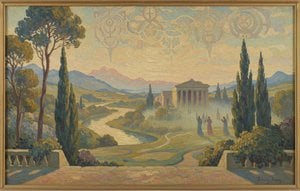
    • temples
  • Creative periods: mature period
  • Emotional tone: sielankowy
  • Copyright status: Public domain
  • Art period: – XIX wiek
  • Vibe: pełen spokoju
  • Mediums: olej na płótnie
  • Rozwiń…
  • Nationality: Francja
  • Lifespan: 0 years
  • Also known as: Henri-Jean Guillaume Martin
  • Color intensity:
    • zrównoważony
    • żywy i nasycony
  • Corpus themes:
    • impressionist light & color
    • italian renaissance
    • symbolism
    • italian renaissance echoes
    • rural french life
  • Top-ranked work: Le Bassin en Ete
  • Works on APS: 449
  • Top 3 works:
    • Le Bassin en Ete
    • La Tonelle de L'Angle Nord-Ouest du Parc de Marquayrol
    • Widok na Puy l’Eveque
  • Typical colors:
    • ciemne tony
    • barwy ziemi
  • Died: 1860

Quiz o sztuce

Do każdego pytania dotyczy tylko jedna poprawna odpowiedź.

Pytanie 1:
W którym mieście urodził się Henri Jean Guillaume Martin?
Pytanie 2:
Jaką szkołę sztuk pięknych ukończył Henri Martin?
Pytanie 3:
Który z tych artystów wywarł największe wpływy na Henri Martin?
Pytanie 4:
W którym roku Henri Martin otrzymał Grand Prix na Salonie Sztystów Francuskich?
Pytanie 5:
Gdzie Henri Martin ostatecznie osiadł i tworzył wiele swoich najsławniejszych dzieł?

A Toulouse Son: The Life and Art of Henri Jean Guillaume Martin

Henri Jean Guillaume Martin, born in the heart of Toulouse on August 5th, 1860, emerged as a pivotal figure in the transition from Impressionism to Symbolism and early Pointillism. His story is one of artistic conviction, nurtured by a supportive yet initially hesitant father—a cabinet maker who eventually yielded to his son’s fervent desire to paint. This early encouragement proved foundational, setting Martin on a path that would lead him through rigorous academic training and ultimately, to the embrace of innovative techniques and a deeply personal artistic vision. He began his formal studies at the Toulouse School of Fine Arts under Jules Garipuy in 1877, laying the groundwork for his future explorations. A scholarship then propelled him to Paris, where he honed his skills within Jean-Paul Laurens’ studio, absorbing diverse influences that would shape his unique style. Martin wasn't merely a student of technique; he was an observer of light, color, and the subtle nuances of human emotion—qualities that would become hallmarks of his mature work.

Academic Roots and Early Influences

Martin’s artistic journey began within the framework of academic training. He excelled at the École des Beaux-Arts in Toulouse, demonstrating a strong command of traditional techniques and a keen eye for composition. However, he wasn't content to remain solely within the confines of established conventions. His father, a cabinet maker, initially expressed reservations about his son’s chosen path, but recognizing Martin’s unwavering passion, he ultimately supported his artistic aspirations. This early familial encouragement proved crucial in fostering Martin’s confidence and determination. His studies were further enriched by a scholarship that allowed him to travel to Paris, where he enrolled at the prestigious École des Beaux-Arts under Jean-Paul Laurens. It was during this period that he began to absorb the diverse influences of the Parisian art scene, encountering works by artists ranging from Delacroix and Ingres to Millet and Courbet. Laurens’ studio provided Martin with invaluable experience in mastering traditional painting techniques, but it also exposed him to a broader range of artistic ideas and approaches.

A Journey to Italy: Renaissance Inspiration

In 1887, Martin received a coveted scholarship that enabled him to embark on an extended journey to Italy. This sojourn proved transformative, profoundly impacting his artistic development. Immersed in the works of Renaissance masters like Giotto and Masaccio, he developed a profound appreciation for composition, form, and the expressive power of color. He spent time studying the frescoes of the Uffizi Gallery in Florence and the paintings of Raphael in Rome, marveling at their masterful use of perspective, light, and shadow. However, Italy also sparked a shift towards a more luminous palette and a fascination with capturing fleeting moments of light—influences that would gradually distance him from strict academic conventions. He began to experiment with brighter colors and looser brushstrokes, seeking to emulate the atmospheric effects he observed in the Italian landscapes. This period marked a crucial turning point in his artistic evolution, laying the foundation for his later embrace of Pointillism.

The Embrace of Pointillism and Symbolism

Upon his return to Paris in 1889, Martin began experimenting with Pointillism, a technique pioneered by Georges Seurat and Paul Signac. He adopted this method not as an end in itself but as a means to achieve specific artistic effects—to create shimmering surfaces of light and color that evoked atmosphere and emotion. His early Pointillist works, such as *Fête de la Fédération au Champs de Mars, le 14 juillet 1790*, are characterized by their meticulous application of tiny dots of paint, creating a dazzling visual effect. Simultaneously, Martin remained deeply engaged with the Symbolist movement, drawn to its emphasis on subjective experience and the exploration of hidden meanings. He collaborated with other Symbolist artists, including Puvis de Chavannes, decorating public spaces such as the Hôtel de Ville in Paris and the Sorbonne University. This dual engagement—with Pointillism and Symbolism—defined his artistic identity for much of his career.

Mature Works and Recognition

Martin’s mature work is characterized by a remarkable ability to capture the essence of light and atmosphere. His landscapes, particularly those depicting Brittany and Collioure, are bathed in a radiant glow, evoking a sense of tranquility and poetic reverie. He wasn't interested in merely replicating nature; he sought to convey its emotional impact—the feeling of warmth on the skin, the scent of salt air, the stillness of a summer afternoon. His technique, while rooted in Pointillism, evolved into something more fluid and expressive. He employed small, carefully placed brushstrokes of vibrant color, allowing them to blend optically and create shimmering effects of light and shadow. This approach lent his paintings a unique luminosity and depth, drawing viewers into the scenes he depicted. Beyond landscapes, Martin also excelled at portraiture and allegorical compositions, often imbuing his subjects with a sense of melancholy and mystery. He received numerous accolades throughout his career, including a gold medal at the 1889 Salon for *Paolo Malatesta e Francesca da Rimini nell'Inferno*, solidifying his reputation as one of France’s leading artists. In 1900, he was awarded the Grand Prize at the Exposition Universelle, and in 1917, he was elected a member of the Académie des Beaux-Arts.

Legacy and Influence

Henri Jean Guillaume Martin died on November 12, 1943, leaving behind a rich legacy of paintings that continue to captivate audiences today. His innovative use of Pointillism, combined with his profound understanding of light, color, and emotion, established him as a pivotal figure in the transition from Impressionism to Symbolism. His works are held in prestigious museums worldwide, including the Musée d’Orsay in Paris and the Musée des Beaux-Arts de Bordeaux, ensuring that his artistic vision will continue to inspire generations of artists and art lovers alike. Martin's paintings serve as a reminder of the power of art to evoke emotion, capture beauty, and explore the depths of human experience.