A Chronicler of Berlin’s Soul: The Life and Art of Heinrich Zille
Rudolf Heinrich Zille, affectionately known as “Pinselheinrich” – Brush Heinrich – to the people of Berlin, wasn't merely an artist; he was a visual historian, a compassionate observer, and a satirical chronicler of a city undergoing seismic change. Born in 1858 in Radeburg, Germany, Zille’s life mirrored the burgeoning industrialization and social upheaval that defined late 19th and early 20th-century Berlin. His family's relocation to the capital in 1867 proved pivotal, immersing him in a world of stark contrasts – opulent growth alongside grinding poverty. This duality would become the defining characteristic of his artistic vision. Initially apprenticed as a lithographer in 1872, Zille’s early training instilled in him a mastery of line and form that would serve as the foundation for his later work. Though his father envisioned a more conventional trade – perhaps butchery – young Heinrich's passion for draughtsmanship was undeniable, nurtured by an encouraging teacher who recognized his burgeoning talent. This dedication to art, however, wasn’t immediate; it evolved from necessity after losing his job in 1910, with the encouragement of Max Liebermann, allowing him to fully embrace his artistic calling.The “Milljöh” and a City Revealed
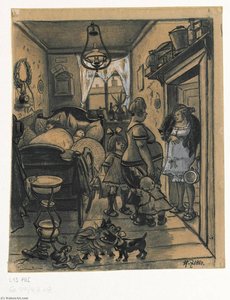
Zille's enduring legacy rests upon his ability to capture the essence of Berlin’s "Milljöh" – a uniquely German term encompassing the everyday life, atmosphere, and social fabric of the city, particularly within its working-class neighborhoods. He didn’t romanticize or idealize; instead, he presented an unvarnished portrayal of tenement buildings ("Mietskaserne"), crowded streets, and the lives of those struggling to survive within them. His drawings weren't simply depictions of poverty; they were empathetic studies of human resilience, humor, and dignity in the face of hardship. Beggars, prostitutes, laborers, and their children populated his world, rendered with a keen eye for detail and an often-biting wit. He portrayed recognizable stereotypes, yes, but always with a sense of understanding, avoiding caricature that descended into cruelty. Zille’s preferred mediums – lithography, pencil sketches, and occasional woodcuts – lent themselves perfectly to this intimate style. His masterful use of hatching and cross-hatching created texture, depth, and a palpable sense of atmosphere in his monochromatic works, drawing the viewer directly into the heart of Berlin's underbelly. He meticulously observed the nuances of human interaction, capturing fleeting expressions and gestures that revealed both vulnerability and strength.Recognition and Artistic Evolution
For years, Zille’s work found its audience primarily through publications like the satirical German weekly *Simplicissimus*, where his drawings resonated with a growing readership eager for social commentary. The sharp wit of his dialogue, often incorporating the distinctive Berlin dialect, added another layer of authenticity to his depictions. This exposure gradually brought him wider recognition, culminating in an invitation from Max Liebermann to join the Berlin Secession in 1903 – a watershed moment that aligned him with a group of artists challenging traditional artistic norms. The Secession provided a platform for Zille’s work and solidified his position within the avant-garde art scene. His ability to blend realism with subtle humor, combined with his keen understanding of urban life, made him a popular figure among both critics and the public. In 1921, the National Gallery purchased several of his drawings, a significant validation of his artistic merit. This recognition continued with a professorship at the Academy of the Arts in 1924, cementing his status as a respected figure within the German art world. Even popular culture embraced Zille’s characters and stories; *Die Verrufenen* (The Disreputable), a film adaptation of his work, was released in 1925, further extending his reach beyond the confines of galleries and museums.Beyond the Surface: A Complex Legacy
Heinrich Zille's artistic output wasn’t limited to social realism; a lesser-known facet of his oeuvre reveals a series of erotic drawings depicting everyday life. These works, now housed in the Beate Uhse Erotic Museum in Berlin, offer a glimpse into a more private and playful side of the artist, demonstrating his willingness to explore the full spectrum of human experience. These images, often portraying intimate moments within the context of the working-class environment he so meticulously documented, provide a fascinating counterpoint to his more overtly critical social commentary. However, it is his broader body of work that secures his place as a pivotal figure in German art history. Zille’s ability to capture both the humor and hardship of working-class life with empathy and skill provided invaluable insight into 19th and early 20th-century Berlin society. He gave voice to those often overlooked by mainstream society, offering a poignant and enduring portrait of a rapidly changing urban landscape.Lasting Impact
- Social Commentary: Zille’s work served as a potent form of social commentary, exposing the harsh realities of urban poverty and inequality.
- Artistic Influence: His distinctive style influenced subsequent generations of artists interested in depicting everyday life and social issues.
- Historical Documentation: Zille’s drawings provide invaluable historical documentation of Berlin during a period of rapid transformation.
- Cultural Icon: He remains a beloved cultural icon in Berlin, celebrated for his ability to capture the city's unique character and spirit.
Pytania i odpowiedzi
Czy mogę przeglądać dzieła Heinrich Zille według słów kluczowych?
Dzieła artysty Heinrich Zille można przeglądać według słów kluczowych na stronie Według słów kluczowych. Każde słowo kluczowe grupuje powiązane ze sobą dzieła.
Gdzie mogę znaleźć statystyki dotyczące dzieł Heinrich Zille?
Statystyki dotyczące dzieł artysty Heinrich Zille są dostępne na jego stronie Statystyki.
W jakiej epoce historycznej tworzył/a Heinrich Zille?
Heinrich Zille tworzył w okresie – Wiek XIX. Epoka ta osadza twórczość artysty w kontekście historycznym.
Gdzie i w którym roku urodził(a) się Heinrich Zille?
Heinrich Zille urodził się w Radeburg w 1858.
Gdzie można znaleźć dzieła Heinrich Zille pogrupowane według techniki?
Strona Wszystkie techniki grupuje dzieła Heinrich Zille według techniki wykonania.
Ile dzieł Heinrich Zille można przejrzeć w katalogu?
Możesz przeglądać 53 dzieł sztuki dzieł autorstwa Heinrich Zille na stronie Wszystkie dzieła sztuki.
Gdzie mogę zobaczyć dzieła Heinrich Zille w galerii 3D?
Możliwa jest wirtualna wizyta: strona Muzeum 3D artysty Heinrich Zille prezentuje dzieła twórcy w galerii trójwymiarowej.
Czy mogę przeglądać dzieła Heinrich Zille według spektrum kolorów?
Strona Indeks barwny grupuje dzieła Heinrich Zille według kolorów.