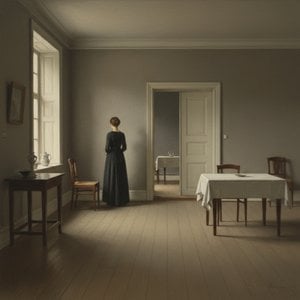
The Architect of Light and Stone: The Life of Heinrich Hansen
In the grand tapestry of nineteenth-century Danish art, few threads are woven as precisely and with as much structural elegance as those left by Heinrich Hansen. A master who breathed life into cold stone and silent halls, Hansen was not merely a painter of buildings, but a poet of perspective. Born in 1821 in Haderslev, his journey from the son of a Flensborg cloth dyer to a prestigious State Councillor and professor at the Royal Danish Academy of Fine Arts is a testament to a life dedicated to the meticulous observation of form and light. His early years as a journeyman painter provided him with a foundational respect for craftsmanship—a tactile understanding of materials that would later allow him to render the textures of marble, wood, and masonry with unparalleled realism.
Hansen’s arrival in Copenhagen in 1842 marked the beginning of a transformative era. Enrolling at the Royal Danish Academy of Fine Arts with the intent of becoming a decorative painter, he quickly demonstrated an aptitude for large-scale, prestigious commissions. His early collaboration on the opulent decorations of the Thorvaldsen Museum signaled his emergence as a vital talent capable of handling the weight of monumental artistic projects. This period was characterized by a relentless pursuit of technical mastery, evidenced by his silver medal in 1846 for live model painting, a feat that proved his ability to capture the organic vitality of life even as he moved toward the more rigid disciplines of architecture.
A Journey Through European Grandeur
The trajectory of Hansen’s career was profoundly altered by his travels, funded by the prestigious Reiersenske Fund. In 1847, a journey to Germany allowed him to refine his artistic vision and, crucially, to commit himself to the specialized discipline of architectural painting—becoming, in essence, the first true practitioner of this genre in Denmark. As he traversed Western Europe, including the sun-drenched landscapes of Italy, Hansen absorbed the profound legacies of the Old Masters. The dramatic chiaroscuro of Caravaggio and the atmospheric depth of Rembrandt became the silent instructors of his brush, teaching him how to use shadow to define volume and light to suggest the infinite reaches of a cathedral nave.
His travels were not merely observational but productive, resulting in works that captured the soul of European landmarks. A notable achievement from this era was his depiction of the Church of Our Blessed Lady of the Sablon, a piece so evocative of its setting that it was acquired for the Royal Collection. This period of wandering solidified his ability to translate the monumental scale of historical architecture into the intimate experience of a canvas, blending the precision of a draftsman with the soul of a romanticist.
Legacy in Perspective and Prestige
Upon his return to Denmark, Hansen’s influence permeated the very institutions that shaped the nation's artistic identity. Following the passing of Gustav Friedrich Hetsch in 1864, Hansen ascended to the position of professor of perspective at the Academy, a role he held with distinction for many years. His pedagogical impact ensured that the rigorous study of space, light, and ornamentation would continue through subsequent generations of Danish artists. Beyond the classroom, his work on significant historical sites—such as the monumental task of embellishing the burial chapel of King Christian IV at Rosende Cathedral alongside Wilhelm Marstrand—cemented his status as a guardian of Denmark's architectural heritage.
The significance of Heinrich Hansen lies in his unique ability to bridge the gap between the decorative and the profound. His oeuvre, ranging from the atmospheric A Side Chapel to the bustling energy of The Fish Market, showcases a versatile mastery over different scales of human experience. Through his eyes, we do not just see buildings; we feel the weight of history, the stillness of sacred spaces, and the enduring majesty of the built environment. He remains a cornerstone of Danish Academic Art, an artist who taught us that even the most silent stone holds a story waiting to be illuminated.