Guillaume II Coustou: Life and Legacy
Early Life and Training
- Guillaume Coustou II was born in Paris, France, in 1716. He came from a distinguished family of sculptors – the son of Guillaume Coustou I and nephew of Nicolas Coustou.
- His artistic training began within the family atelier, benefiting directly from the expertise of his father and uncle. This familial foundation instilled in him a strong understanding of sculptural techniques and traditions.
- In 1736, he won the prestigious Prix de Rome, granting him the opportunity to study at the French Academy in Rome until 1739. This period was crucial for his artistic development, exposing him to classical sculpture and Italian Baroque styles.
Artistic Development and Style
- Upon returning to Paris, Coustou seamlessly continued his father’s work, most notably completing the monumental Horse Tamers (Chevaux de Marly), a commission initially undertaken by Guillaume I but left unfinished due to illness.
- His style evolved throughout his career, demonstrating a transition from the late Baroque exuberance of his early works to the more restrained and emotionally evocative forms of emerging Neoclassicism.
- He skillfully blended dramatic narrative with classical ideals, creating sculptures that were both visually impressive and intellectually engaging.
Major Achievements and Notable Works
- Horse Tamers (Chevaux de Marly): Perhaps his most famous achievement, these dynamic bronze sculptures depict horsemen controlling powerful steeds, embodying strength and mastery.
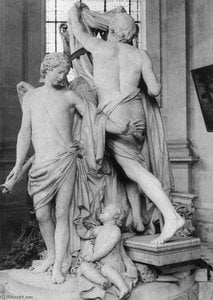
- Monument to the Dauphin: This elaborate sculptural ensemble for Sens Cathedral was a significant commission that showcased Coustou’s ability to handle complex iconography and large-scale projects. The design's detailed imagery was developed in collaboration with Charles-Nicolas Cochin.
- Vulcan: His morceau de réception (admission piece) for the Académie Royale de Peinture et de Sculpture, a seated Vulcan, exemplifies his Baroque sensibilities.
- Ganymede: This sculpture demonstrates Coustou’s embrace of early Neoclassical aesthetics, drawing inspiration from Roman sculptures like those of Antinous.
Influences and Legacy
- Coustou was profoundly influenced by his father and uncle, inheriting their technical skill and artistic sensibility. His time in Rome exposed him to the works of classical sculptors and Italian Baroque masters.
- He, in turn, influenced a generation of younger sculptors, including Claude Dejoux, Pierre Julien, and the Danish sculptor Johannes Widewelt, who studied under him.
- His work represents an important bridge between the Baroque and Neoclassical periods in French sculpture, contributing to the evolving artistic landscape of 18th-century Europe.
Historical Significance
- Guillaume II Coustou played a vital role in shaping the aesthetic direction of French sculpture during a period of significant artistic change.
- His ability to adapt his style and embrace new influences allowed him to maintain a successful career under different patronage systems.
- His sculptures continue to be admired for their technical virtuosity, dramatic power, and historical significance, solidifying his place as a notable figure in the history of French art.
Pytania i odpowiedzi
W jakim mieście i kraju urodził(a) się Guillaume Ii Coustou?
Guillaume Ii Coustou urodził się w Paris w France.
Gdzie mogę zobaczyć wszystkie dzieła autorstwa Guillaume Ii Coustou?
Wszystkie dzieła Guillaume Ii Coustou dostępne w niniejsza strona można przeglądać na stronie Wszystkie dzieła artysty.
Gdzie można znaleźć dzieła Guillaume Ii Coustou pogrupowane według słów kluczowych?
Aby znaleźć dzieła artysty Guillaume Ii Coustou o konkretnej tematyce, skorzystaj ze strony Według słów kluczowych, która grupuje prace według słów kluczowych.