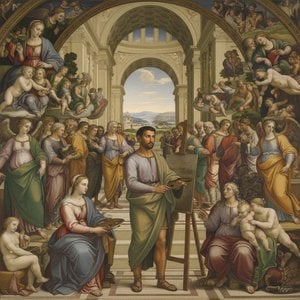
The Master of Ornament: The Life of Giovanni da Udine
In the vibrant heart of the Italian Renaissance, where the shadows of antiquity met the burgeoning brilliance of new humanism, Giovanni da Udine emerged as a pivotal figure in the decorative landscape of Rome. Born in Udine, Italy, this multifaceted artist—known also as Giovanni Nanni or Giovanni de' Ricamatori—carved out a legacy that was inextricably linked to the grandeur of the High Renaissance. While history often remembers the sweeping narratives of masters like Raphael, it was Giovanni who breathed life into the spaces between those stories, providing the intricate, ornamental soul that completed the era's most magnificent architectural triumphs.
As a dedicated student and trusted assistant to Raphael, Giovanni occupied a unique position within the artist's workshop. He became the primary custodian of the "decorative" elements in major Raphaellesque projects, specializing in the delicate and complex art of fresco and stucco grotesque decorations. His hands were responsible for the ethereal stucco work found in the Loggia di Raffaello in the Vatican and the lush, fruit-laden wreaths that adorn the loggia di psiche in the Villa Farnesina. Through his meticulous skill, he helped translate the rediscovered splendor of ancient Roman motifs into a contemporary language of elegance and prestige.
A Revival of Antiquity through Stucco and Fresco
The essence of Giovanni da Udine’s contribution lies in his role as a bridge to the classical past. Following the archaeological rediscoveries of sites like Nero's Domus Aurea, there was a fervent desire among Renaissance artists to recapture the grandeur of ancient Greece and Rome. Giovanni became a "new-founder" of the art of stucco, reviving techniques that had been lost since antiquity. His work was not merely about filling empty spaces; it was an intellectual pursuit of harmony, proportion, and the all'antica style.
His mastery extended beyond the architectural to the natural world, captured in his exquisite drawings of birds and fruit. These works, such as his Study of a Parrot and Other Birds, reveal a sensitive observer of life and movement. In these chalk studies, one finds a profound meditation on nature, where the vibrant plumage of a parrot or the delicate curve of a leaf is rendered with a precision that mirrors the complexity of his larger decorative schemes. This ability to blend the monumental with the minute allowed him to create immersive environments that felt both mythologically significant and tangibly alive.
Legacy and Artistic Significance
The historical significance of Giovanni da Udine resides in his ability to shape the visual atmosphere of the High Renaissance. His work on the Decoration of the Garden Loggia at Villa Madama stands as a testament to this achievement, embodying a period defined by the pursuit of knowledge and virtue through art. By weaving together intricate ornamental patterns with small, symbolic pictorial scenes, he helped establish the grotesque style as a cornerstone of European decorative arts.
Throughout his career, which saw him working across Rome and other influential centers, Giovanni remained a master of the subtle and the ornamental. His influence can be seen in the way subsequent generations approached ceiling designs and wall decorations, forever marked by his ability to transform plaster and pigment into a symphony of classical revival. He remains an essential figure for understanding how the Renaissance sought to clothe its architectural ambitions in the timeless beauty of the ancient world.
Pytania i odpowiedzi
W jakim mieście i kraju urodził(a) się Giovanni Da Udine?
Giovanni Da Udine urodził się w Udine w Włochy.
Czy istnieje chronologiczny opis twórczości Giovanni Da Udine?
Chronologiczne zestawienie twórczości Giovanni Da Udine można znaleźć na stronie Kronika, gdzie dzieła prezentowane są w kolejności ich powstania, podzielone na poszczególne etapy kariery.
Czy mogę przeanalizować sposób użycia koloru przez Giovanni Da Udine we wszystkich jego/jej dziełach?
Sposób wykorzystania koloru przez Giovanni Da Udine w pracach wymienionych na ta strona można przestudiować na stronie Genom Palety artysty.
W jakiej epoce historycznej tworzył/a Giovanni Da Udine?
Giovanni Da Udine tworzył w okresie Renesans. Epoka ta osadza twórczość artysty w kontekście historycznym.
Gdzie i w którym roku urodził(a) się Giovanni Da Udine?
Giovanni Da Udine urodził się w Udine w 1475.
Skąd pochodzi Giovanni Da Udine?
Giovanni Da Udine urodził się w Włochy.
Czy istnieje zestawienie wszystkich tematów, które malował Giovanni Da Udine?
Dzieła artysty Giovanni Da Udine można przeglądać według tematów na stronie Atlas tematów poświęconej temu artyście.