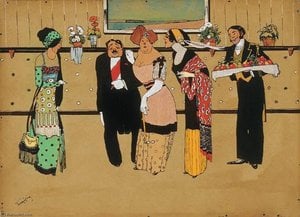
Geza Farago: A Hungarian Symbolist Visionary
Geza Farago (1877–1928) stands as one of the most prominent figures in early Hungarian poster art and a celebrated Symbolist painter. His artistic legacy transcends mere visual representation; it embodies a profound engagement with philosophical ideas and emotional depth, characteristics that define the Symbolist movement itself. Born in Budapest, Hungary, Farago’s formative years were marked by exposure to influential artistic mentors like Ferenc Újházy, who instilled in him foundational drawing skills. Following this initial training, he honed his craft at a textile factory, gaining practical experience alongside cultivating his artistic sensibilities.
A pivotal moment arrived in 1898 when Farago embarked on a transformative journey to Paris – a city that would become synonymous with Symbolism and artistic innovation. He enrolled in Colorassi’s evening classes, immersing himself in the intellectual currents of the time, and subsequently worked under Alfonz Mucha's tutelage for two years. This collaboration proved invaluable, exposing him to Mucha’s distinctive style—characterized by decorative elegance and stylized figures—which profoundly impacted Farago’s artistic approach. Exhibiting his work at the Paris Salon on multiple occasions solidified his reputation as a rising talent within the European art scene.
Returning to Hungary in 1902, Farago continued his artistic pursuits, collaborating with Adolf Fényes in Szolnok during two summers and delving into the vibrant atmosphere of Kecskemét’s artists colony. He embraced diverse mediums—poster design, caricature illustration, and theatrical stage setting—demonstrating versatility and a keen understanding of visual storytelling. Notably, he served as the stage designer for Budapest's Operetta Theatre for fifteen years, showcasing his ability to translate artistic vision into practical application.
Faragó’s stylistic evolution mirrored broader trends in Hungarian art during the early 20th century. Influenced by the French Nabis movement—particularly its emphasis on muted colors and expressive brushwork—he developed a distinctive aesthetic that blended decorative elements with psychological nuance. His celebrated posters, like “Slim Woman with a Cat” and “Paradise Lost,” exemplify this fusion of style and substance, capturing both visual beauty and emotional resonance. These works are recognized for their masterful use of contour lines, vibrant hues, and ornamental patterns—techniques that reflect the influence of Japanese woodcuts and contribute to the overall grandeur of his compositions.
His artistic output was showcased in prestigious exhibitions at the Nemzeti Szalon (National Salon), where his paintings garnered critical acclaim and cemented his position as a leading voice within Hungarian Symbolism. Furthermore, he achieved international recognition with a solo exhibition in Berlin in 1914. During World War I, Faragó dedicated himself to designing propaganda posters—a task that demanded both artistic skill and persuasive communication—further demonstrating his commitment to serving his nation during times of crisis. He was also a prolific caricaturist and costume designer, capturing the spirit of Hungarian society with humor and wit. Above all, he is remembered for his extraordinary posters, which remain enduring symbols of Art Nouveau’s decorative splendor and artistic ambition.