Early Life and Training (1774-1801)
George Chinnery, a name synonymous with the vibrant landscapes and captivating portraits of 19th-century India and China, was born in London on January 5, 1774. His lineage held a fascinating connection to the world of communication – his father, a skilled craftsman, pioneered the Gurney system of shorthand, a revolutionary method for rapid note-taking that would profoundly influence Chinnery’s artistic practice. This early exposure to efficient record-keeping instilled in him a meticulous eye and an appreciation for capturing details with remarkable speed. He received his formal artistic education at the Royal Academy Schools in London, where he honed the foundational techniques of classical art – perspective, anatomy, and color theory – providing him with the tools necessary to translate his observations into compelling visual narratives.
Life in Asia: India and China (1802-1852)
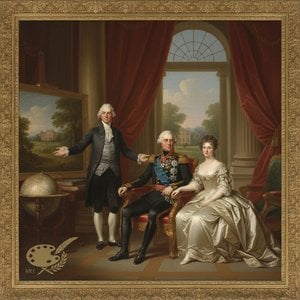
In 1802, Chinnery embarked on a transformative journey eastward, sailing to Madras (now Chennai), India. This marked the beginning of a decades-long sojourn that would define his artistic career and establish him as the preeminent Western painter within the British community in South India. He quickly gained recognition for his ability to capture the essence of both European and Asian subjects, skillfully blending classical techniques with the burgeoning influences of Orientalism. His time in Calcutta (Kolkata) proved particularly fruitful, earning him the title of “the leading artist” of the British settlement. During this period, he produced a prolific body of work, including portraits of prominent figures like Colonel James Achilles Kirkpatrick and his family – works that offer invaluable insights into the social dynamics and familial relationships within colonial society.
Facing mounting financial difficulties, Chinnery relocated to Macau in 1825. This move, driven by debt, didn’t signify a decline but rather a shift in focus. In Macau, he continued his artistic pursuits, primarily painting portraits of European merchants, Chinese residents, and the seafaring men who frequented the bustling port city. Notably, his style was closely imitated by the Cantonese artist Lam Qua, highlighting Chinnery's considerable influence on the local art scene.
A brief but significant visit to Hong Kong in 1846 provided Chinnery with a unique opportunity to document the newly established colony’s rapid development. He meticulously documented the city’s architecture, people, and burgeoning commercial activity through detailed pencil drawings and watercolors – a visual record of a pivotal moment in British expansion.
Artistic Style and Techniques
Chinnery's artistic legacy rests primarily on his masterful portraits, characterized by their remarkable sensitivity and attention to detail. He possessed an uncanny ability to capture not just likenesses but also the personalities and emotions of his subjects. His work is deeply rooted in Orientalist influences – a deliberate blending of European artistic conventions with the aesthetics and cultural nuances of Asia. However, unlike many of his contemporaries, Chinnery’s portrayals often transcend mere exoticization, revealing a genuine empathy and observational acuity that speaks to a profound understanding of his Asian subjects.
He primarily worked in oil paint and watercolor, employing both mediums with equal skill. A particularly noteworthy aspect of his artistic practice was his use of the Gurney shorthand system – a modified version of his father’s invention. This allowed him to quickly jot down notes on his sketches, providing invaluable contextual information about his subjects, their surroundings, and even fleeting observations. These shorthand notes have proven remarkably insightful for art historians seeking to understand Chinnery's creative process.
Furthermore, Chinnery’s style was subtly influenced by the artistic traditions of the regions he inhabited. He incorporated elements of Chinese landscape painting into his work, particularly in depicting the dramatic mountain ranges and lush vegetation of Southern China. This fusion of European and Asian influences created a distinctive visual language that set him apart from other Western artists working in Asia.
Major Achievements and Historical Significance
George Chinnery’s most significant achievement lies in his status as the only Western painter to establish a sustained presence in southern China between the early and mid-19th century. This unique position afforded him unparalleled access to a diverse range of subjects – from European merchants and Chinese officials to indigenous communities and rural life. As such, his paintings provide an invaluable historical record of this period, offering rare glimpses into the social, cultural, and economic dynamics of the region.
His portraits are not merely representations of individuals; they are windows into colonial society, revealing the complex relationships between Europeans and Asians during a time of profound change. The works depicting Colonel Kirkpatrick’s family, for example, offer poignant insights into the challenges and rewards of life within the British East India Company.
Chinnery's influence extended beyond his own artistic output. His style was widely imitated by local artists like Lam Qua, demonstrating his considerable impact on the development of Chinese art during this period. Moreover, his depictions of ordinary people – laborers, merchants, and farmers – provide a rare and intimate portrayal of everyday life in 19th-century India and China.
Interestingly, Chinnery’s work found its way into popular culture through James Clavell's novel Tai-Pan, where his character, Aristotle Quance, served as inspiration for the protagonist.
Death and Legacy (1852 - Present)
George Chinnery died in Macau on May 30, 1852, and was buried in the Old Protestant Cemetery. His legacy endures through substantial collections of his drawings housed at prestigious institutions worldwide – including the Victoria and Albert Museum, the British Museum, the Peabody Essex Museum, Birmingham Museum & Art Gallery, Hong Kong Museum of Art, Macau Museum, and Macau Museum of Art. Ongoing exhibitions continue to showcase his remarkable work, ensuring that his contributions to art history are recognized and appreciated by a wider audience.
Pytania i odpowiedzi
Gdzie i w którym roku urodził(a) się George Chinnery?
George Chinnery urodził się w Londyn w 1774 roku.
Gdzie mogę zobaczyć dzieła George Chinnery w porządku chronologicznym?
Dzieła George Chinnery można obejrzeć w porządku chronologicznym na stronie Chronologia dzieł artysty.
Jak zmieniała się twórczość George Chinnery na przestrzeni lat?
Kariera George Chinnery rozwija się etap po etapie na stronie Osiągnięcia artystyczne: jako pozioma oś czasu dzieł, pogrupowanych w rozdziały odpowiadające poszczególnym okresom twórczości.