Early Life and Aristocratic Roots
Frederick Calvert, born in Epsom, United Kingdom, in 1731, entered a world steeped in privilege and responsibility. He was the sixth Baron Baltimore, inheriting a title rich with colonial history—his family having been granted the charter for the Province of Maryland in the 17th century. However, unlike many aristocrats of his time content to manage estates from afar, Calvert possessed a keen artistic sensibility that drew him towards painting. While his lineage provided financial security and social standing, it was his own passion that fueled his dedication to capturing the beauty of the English countryside and maritime scenes. Details regarding his formal art education remain scarce; however, the quality and style of his work suggest either private tutelage or a period of self-directed study under the guidance of established artists. His early life undoubtedly shaped his perspective, offering access to landscapes that would later become central themes in his oeuvre.A Passion for Landscape and Maritime Painting
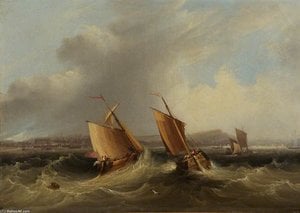
Calvert’s artistic focus quickly centered on landscape and maritime painting—genres gaining prominence during the 18th century as a reflection of Britain's growing naval power and increasing appreciation for natural beauty. He wasn’t merely documenting scenes; he was imbuing them with an atmospheric quality that resonated with the Romantic sensibilities beginning to emerge. His paintings, such as “Cowes, Isle Of Wight, View Of The River Medina,” showcase a meticulous attention to detail alongside a masterful use of light and shadow. These weren't simply topographical records but evocative portrayals of coastal life, capturing the bustling activity of harbors and the serene stillness of rivers. Shipping Scene With Lighthouse, for example, demonstrates his ability to convey drama through realistic depictions of maritime challenges—a sinking ship rendered with striking intensity against a backdrop of a looming lighthouse.Style and Influences
Calvert’s style is characterized by a blend of realism and atmospheric perspective. He wasn't striving for the idealized landscapes favored by some of his contemporaries; instead, he presented scenes as they were—often incorporating elements of everyday life and weather conditions. His work shares affinities with artists like Canaletto, known for their detailed cityscapes, and those associated with the English School of landscape painting. However, Calvert developed a unique voice through his focus on maritime subjects and his ability to capture the subtle nuances of light and atmosphere. View Of Greenwich, though less documented than other works, likely exemplifies this approach—a careful rendering of a significant location imbued with a sense of place and time.Legacy and Historical Significance
Frederick Calvert’s life was tragically cut short in 1771 at the age of forty. While his career spanned only a few decades, he left behind a body of work that offers valuable insight into 18th-century British art and society. His paintings provide not just aesthetic pleasure but also glimpses into the maritime world, coastal communities, and the landscapes that shaped the era. He wasn’t merely an aristocrat dabbling in art; he was a dedicated painter who contributed to the evolving landscape tradition of his time.- His paintings offer valuable historical documentation of 18th-century maritime life.
- Calvert's work reflects the growing appreciation for natural beauty and atmospheric perspective in British art.
- He bridged the gap between topographical recording and evocative landscape painting.
Pytania i odpowiedzi
Ile dzieł Frederick Calvert można przejrzeć w katalogu?
Możesz przeglądać 23 dzieł sztuki dzieł autorstwa Frederick Calvert na stronie Wszystkie dzieła sztuki.
W jaki sposób kariera Frederick Calvert jest podzielona na okresy?
Chronologiczne zestawienie twórczości Frederick Calvert można znaleźć na stronie Kronika, gdzie dzieła prezentowane są w kolejności ich powstania, podzielone na poszczególne etapy kariery.
Czy mogę przeglądać dzieła Frederick Calvert według palety kolorystycznej?
Aby znaleźć prace artysty Frederick Calvert w konkretnej palecie barw, skorzystaj ze strony Według palet kolorystycznych poświęconej temu artyście.