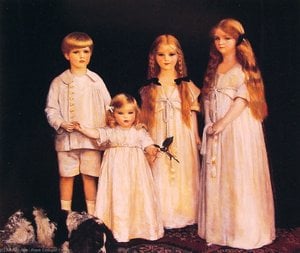
A Lingering Echo of Romanticism: The Life and Art of Frank Cadogan Cowper
Frank Cadogan Cowper, often affectionately dubbed “The Last Pre-Raphaelite,” occupies a remarkably unique position within the tapestry of British art. Born in 1877 amidst the tranquil beauty of Wickham, Northamptonshire, his life unfolded across an era of dramatic artistic shifts – yet he remained steadfastly devoted to the core tenets of beauty, narrative detail, and romantic sensibility championed by the Pre-Raphaelite Brotherhood. His father, Frank Cowper, a celebrated author and pioneer of yacht cruising, instilled in him a profound love for adventure and meticulous observation; simultaneously, his lineage—descending from the Rector of Wicken—rooted him deeply within a tradition of intellectual contemplation and spiritual resonance. This potent confluence of influences profoundly shaped both his life’s trajectory and the distinctive character of his artistic vision. From an early age, Cowper demonstrated an innate aptitude for art, embarking on formal training at St John's Wood Art School in 1896 before continuing his studies at the prestigious Royal Academy Schools until 1902 – a period that provided him with a robust foundation in technique and a deep appreciation for artistic history, setting the stage for his emergence as a significant figure within the art world.
Forging a Path Between Tradition and Modernity
Cowper’s early career was marked by remarkable success. His debut at the Royal Academy in 1899 immediately garnered attention, but it was “An Aristocrat Answering the Summons to Execution, Paris 1791” (1901) that truly cemented his reputation. This dramatic depiction of a scene from the French Revolution showcased not only his mastery of composition and meticulous detail but also his remarkable ability to evoke profound emotional responses within the viewer. The acclaim he received opened doors to further study; in 1902, he spent six months under the tutelage of Edwin Austin Abbey, absorbing invaluable insights into narrative painting techniques and decorative artistry – a period that significantly influenced the development of his storytelling abilities. A subsequent journey to Italy proved equally transformative, exposing him to the breathtaking masterpieces of the Renaissance and solidifying his commitment to classical ideals of beauty and form. Cowper’s artistic versatility extended beyond oils; he also excelled in watercolors and contributed substantially as a book illustrator, notably providing evocative illustrations for Sir Sidney Lee’s comprehensive edition of Shakespeare's works – demonstrating a willingness to adapt his skills across various mediums. He became known for his luminous color palettes, intricate details, and romantic sensibility that resonated deeply with audiences, distinguishing him from many of his contemporaries who were increasingly drawn towards abstraction and experimentation.
Themes of History, Literature, and the Human Condition
Throughout his prolific career, Cowper consistently gravitated toward subjects steeped in history, literature, and mythology – often exploring complex characters, dramatic narratives, and profound moral ambiguities. Paintings such as “Lucretia Borgia Reigns in the Vatican,” “La Belle Dame Sans Merci,” and “The Golden Bowl” exemplify his fascination with these themes, demonstrating a willingness to delve into the psychological depths of his subjects and explore the intricacies of human experience. He wasn’t merely illustrating stories; he was meticulously reconstructing them, imbuing each scene with layers of symbolism and emotional resonance. His unwavering commitment to narrative painting set him apart from many of his contemporaries who were increasingly embracing abstraction and modernism. In 1910, Cowper contributed significantly to a monumental mural project in the Houses of Parliament alongside other prominent artists like Byam Shaw and Ernest Board – further solidifying his position within the established art world. However, “Our Lady of the Fruits of the Earth” (1917) stands as perhaps his most celebrated achievement, achieving a record price of £469,250 at Christie’s in London in 2011—a testament to its enduring appeal and artistic merit. As art fashions evolved, Cowper skillfully adapted, accepting portrait commissions while continuing to produce his signature historical and literary pieces – demonstrating both pragmatism and an unwavering dedication to his artistic vision.
The Last Bastion of Pre-Raphaelite Ideals
Cowper’s distinctive style is instantly recognizable—characterized by a meticulous attention to detail, rich and luminous colors, and a romantic sensibility that echoes the works of Dante Gabriel Rossetti, John Everett Millais, and Edward Burne-Jones. He earned the title “The Last Pre-Raphaelite” not simply because he painted in a similar style, but because he remained steadfastly committed to the movement’s core principles—truth to nature, moral seriousness, and an emphasis on beauty – long after they had faded from mainstream popularity. His work represents a bridge between Victorian Romanticism and early 20th-century art, preserving a tradition of narrative painting and detailed realism in an era increasingly dominated by abstraction and modernism. He wasn’t merely imitating the Pre-Raphaelites; he was carrying their torch, adapting their techniques to his own unique vision and ensuring that their legacy would endure.
A Legacy of Beauty and Narrative
In his later years, Cowper retired from London and sought solace in the picturesque countryside of Gloucestershire, where he continued to paint until his peaceful passing in 1958. His final works retain the same technical skill, narrative power, and romantic sensibility that defined his earlier career – a testament to his enduring dedication.
- Cowper’s work offers a window into a bygone era.
- His unwavering commitment to narrative painting is a refreshing counterpoint to the abstract trends of his time.
- He remains an important figure for those who appreciate the beauty and craftsmanship of Victorian Romantic art.
Frank Cadogan Cowper's legacy extends beyond his paintings; it lies in his unwavering dedication to artistic ideals, his masterful technique, and his ability to transport viewers to worlds of romance, history, and imagination. His work continues to inspire and captivate audiences today, ensuring that the echoes of Romanticism will resonate for generations to come.