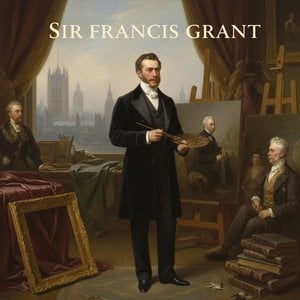
A Life Dedicated to Portraiture and the Academy
Sir Francis Grant, a name synonymous with refined portraiture and dedicated service to the British art establishment, emerged as one of the most sought-after artists of his era. Born in 1803 into a landed family in Perthshire, Scotland, young Francis initially seemed destined for a career in law. However, the allure of artistic expression proved too irresistible to resist. Though largely self-taught, he briefly studied under Alexander Nasmyth in Edinburgh, laying an early foundation before forging his own distinctive path. This path wasn’t immediately clear; Grant's initial successes came with sporting scenes, capturing the energy and vibrancy of rural life – subjects that would initially define his reputation. A pivotal moment arrived through his marriage, granting him access to the exclusive world of Melton Mowbray’s hunting set. There, he honed his skills under John Ferneley, a master of equestrian art, and began to specialize in depictions of horses and hounds – endeavors that showcased an exceptional eye for detail and composition.Early Artistic Explorations: Sporting Scenes and Impressionistic Beginnings
Grant's artistic journey commenced with landscapes and genre paintings, reflecting the Romantic spirit of his time. *Melton Breakfast* (1834), a celebrated depiction of a fox hunt, exemplifies this early style—characterized by bold brushstrokes and vibrant colors that convey movement and excitement. It immediately garnered acclaim for its dynamism and masterful rendering of light and atmosphere. However, Grant’s artistic inclinations soon steered him toward portraiture, recognizing the potential to capture not merely physical likeness but also the essence of his subjects' personalities and social standing – a pursuit that would ultimately elevate him to prominence. His formative years were marked by diligent observation and imitation of established masters, notably Alexander Nasmyth and John Ferneley, absorbing techniques and stylistic sensibilities that would inform his subsequent work. This dedication to craft demonstrated an uncommon seriousness for someone from a privileged background.The Equestrian Tradition: Mastering the Art of Horse Painting
Grant’s fascination with equestrian art blossomed during his association with John Ferneley, establishing him as one of Britain's foremost practitioners in this genre. Ferneley instilled in Grant a profound understanding of anatomy and perspective—skills crucial for accurately portraying horses and riders in motion. This influence is evident in numerous commissions depicting royalty and nobility engaged in hunting pursuits – works that stand apart for their technical precision and expressive quality. Paintings like *The Meeting of His Majesty's Staghounds on Ascot Heath* exemplify Grant’s ability to convey both the grandeur of the subject matter and the gracefulness of movement, capturing a moment frozen in time with remarkable fidelity. These paintings are not merely representations; they are embodiments of Victorian ideals – nobility, courage, and connection to the natural world.The Royal Portraitist: Capturing Queen Victoria’s Majesty
Grant achieved unparalleled renown when he was entrusted with painting portraits of Queen Victoria herself—a commission that solidified his position among Britain's most respected artists. His portrait of Lady Glenlyon (1842) became a watershed moment, establishing Grant as the quintessential Victorian portraitist. Unlike many contemporaries who prioritized superficial beauty, Grant sought to convey Victoria’s inner character and regal dignity – an ambition he accomplished with remarkable subtlety and sensitivity. He skillfully blended Neoclassical elegance with Romantic influences, creating images that were both aesthetically pleasing and psychologically astute. The resulting portrait captured not just Victoria's physical appearance but also her commanding presence and unwavering resolve—a testament to Grant’s artistic prowess and his ability to distill complex emotions into visual form.Legacy and Influence: Shaping the Future of British Art
Grant’s contribution extended beyond individual artworks; he profoundly impacted the trajectory of British art by serving as President of the Royal Academy from 1866 until his death in 1878. During his tenure, he championed innovative artistic endeavors—most notably the institution of major loan exhibitions—which broadened access to art and fostered dialogue between artists and audiences alike. This visionary leadership ensured that the Academy remained a beacon of creativity and intellectual curiosity throughout the Victorian era. Grant’s influence can be discerned in the works of subsequent generations of painters, who admired his meticulous technique and his unwavering commitment to portraying human subjects with depth and nuance—a legacy that continues to inspire artists today. His paintings remain treasured artifacts of Victorian culture – windows into a bygone age that offer enduring insights into the values and aspirations of his time. Grant’s artistic vision transcended mere representation; it sought to illuminate the human spirit, securing his place as one of Britain's greatest portraitists and shaping the landscape of British art historyPytania i odpowiedzi
Ile dzieł Franciszek Grant można przejrzeć w katalogu?
Możesz przeglądać 269 dzieł sztuki dzieł autorstwa Franciszek Grant na stronie Wszystkie dzieła.
Gdzie można zobaczyć wszystkie dzieła Franciszek Grant?
Wszystkie dzieła Franciszek Grant dostępne w niniejsza strona można przeglądać na stronie Wszystkie dzieła artysty.
Gdzie i w którym roku urodził(a) się Franciszek Grant?
Franciszek Grant urodził się w Perth and Kinross w 1803 roku.