Francisco Javier Gosé i Ribera: A Pioneer of Art Nouveau and Art Deco
Francisco Javier Gosé i Ribera (1876-1915) stands as a singular figure in the artistic landscape of early 20th century Spain, celebrated for his distinctive blend of Art Nouveau and Art Deco styles. Born in Alcalá de Henares, he embarked on an artistic journey fueled by intellectual curiosity and nurtured by formative influences that would shape his enduring legacy.Early Years and Artistic Formation
Gosé’s formal education began at the Escola de la Llotja in Barcelona, where he studied under the tutelage of Josep Luís Pellicer, a pivotal figure in Catalan Modernisme. Pellicer instilled in Gosé a profound appreciation for decorative arts and architectural design—principles that would permeate his subsequent artistic endeavors. His exposure to Els Quatre Gats, Barcelona’s bohemian café frequented by artists like Picasso and Miró, further solidified his connection to the avant-garde movement and fostered collaborations that broadened his creative horizons. An exhibition of his drawings in 1900 garnered considerable acclaim, establishing him as a promising talent within the burgeoning artistic community.Parisian Influences and Literary Contributions
Driven by ambition and an eagerness to immerse himself in European artistic currents, Gosé relocated to Paris in 1900. This pivotal move proved instrumental in propelling his career forward; he became a regular contributor to satirical magazines such as Le Rire and L’Assiette au Beurre, honing his skills in caricature and visual storytelling. These publications demanded precision and wit—qualities that Gosé expertly cultivated, reflecting the spirit of intellectual debate and social commentary characteristic of the era. His artistic output extended beyond illustration; he penned literary works exploring themes of psychology and philosophy, demonstrating a multifaceted intellect that transcended stylistic boundaries.Artistic Style: A Synthesis of Elegance and Geometric Precision
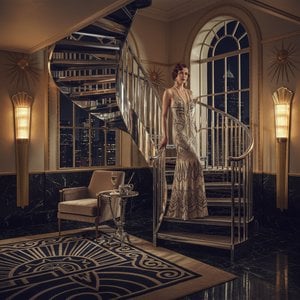
Gosé’s artistic style is instantly recognizable for its harmonious fusion of Art Nouveau and Art Deco aesthetics. While retaining the flowing lines and organic motifs emblematic of Art Nouveau—inspired by natural forms and decorative ornamentation—he incorporated geometric shapes and stylized perspectives reflective of Art Deco's fascination with industrial modernity. His canvases pulsate with intricate detail, meticulously rendered in muted palettes that convey a sense of understated grandeur. Recurring themes explored his work included portraits, landscapes, and fashion illustrations, each imbued with symbolic resonance and executed with remarkable technical virtuosity.Notable Works and Recognition
Gosé’s artistic achievements gained considerable recognition during his lifetime. His paintings reside in prestigious collections across Spain, Mexico, and Argentina, testament to the enduring appeal of his vision. Among his most celebrated pieces is ‘Noctámbulos / Conversación,’ a haunting Expressionist oil painting depicting two figures bathed in moonlight—a masterful demonstration of tonal gradation and compositional balance. Similarly impressive is ‘Arianne,’ showcasing Gosé’s adeptness at capturing feminine beauty with delicate brushstrokes and subtle color harmonies. His contribution to the colección Andrés Blaisten exemplifies the breadth of Latin American art, highlighting his influence on artists like Carlos Mérida and Casimiro Castro.Legacy and Historical Significance
Despite succumbing to tuberculosis in 1915—a tragic premature end—Francisco Javier Gosé i Ribera’s artistic legacy continues to inspire admiration and scholarly inquiry. His pioneering exploration of Art Nouveau and Art Deco styles cemented his place as a pivotal figure in the history of Spanish art, shaping the aesthetic sensibilities of an entire generation. He remains a testament to the transformative power of artistic experimentation and the enduring beauty of visual expression—a true visionary whose work transcends time and resonates with audiences worldwide.Pytania i odpowiedzi
Czy dostępna jest wirtualna wycieczka 3D po dziełach Francisco Javier Gosé?
Muzeum 3D artysty Francisco Javier Gosé to strona prezentująca dzieła artysty w wirtualnej, trójwymiarowej galerii.
Jakich kolorów Francisco Javier Gosé używał najczęściej?
Sposób wykorzystania koloru przez Francisco Javier Gosé w pracach wymienionych na ta strona można przestudiować na stronie Genom Palety artysty.
Jak znaleźć dzieła Francisco Javier Gosé o konkretnej tematyce?
Dzieła artysty Francisco Javier Gosé można przeglądać według słów kluczowych na stronie Według słów kluczowych. Każde słowo kluczowe grupuje powiązane ze sobą dzieła.