Filippo La Vaccara: An Archive of Images and Inspiration
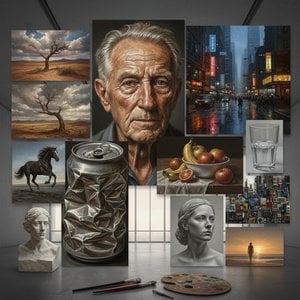
Born in Catania, Sicily in 1972, Filippo La Vaccara’s artistic journey is one deeply rooted in the evocative landscapes and layered histories of his homeland. His work, a captivating blend of photography, drawings, notes, and mixed media, isn't simply about representation; it’s an intensely personal archive—a meticulously curated collection of images, suggestions, and observations that serve as the very foundation for his artistic process. La Vaccara doesn’t aim to replicate reality but rather to distill its essence, capturing fleeting moments and intangible feelings through a deliberate and often enigmatic approach.
La Vaccara's formal training began at the Accademia di Belle Arti in Catania, where he honed his skills in sculpture before transitioning to painting. This early grounding in three-dimensional form undoubtedly informs his later work, particularly in the way he manipulates space and texture within his layered compositions. Crucially, however, it was a desire to move beyond traditional representation that propelled him toward his current distinctive style. His selection by Angela Vettese and Giacinto di Pietrantonio for the Advanced Course in Visual Arts at the Fondazione Antonio Ratti in Como in 1999 marked a pivotal moment, introducing him to a wider artistic community and solidifying his commitment to exploring new avenues of expression.
The Language of Observation
La Vaccara’s process is characterized by an almost obsessive attention to detail. He frequently employs photography as a primary source material, not merely documenting subjects but actively shaping them into evocative fragments. These photographs are then integrated with drawings—often loose and gestural—and accompanied by handwritten notes, creating a complex web of interconnected references. This layering reflects his belief that art is born from the accumulation of experiences and impressions, a continuous dialogue between observation and interpretation.
His work frequently draws inspiration from Sicilian culture and history, though he resists easy categorization or stylistic mimicry. Instead, he utilizes these influences as points of departure, transforming them into something uniquely his own. The Museo Delle Trame Mediterranee in Gibellina, where he was an artist-in-residence in 2002, provided a fertile ground for this exploration, allowing him to delve deeper into the region’s rich cultural heritage and its relationship with the sea.
Exhibitions and Recognition
La Vaccara's work has been exhibited both nationally and internationally, gaining recognition from prominent institutions. Key exhibitions include a solo show at Viafarini in Milan in 1998, curated by Francesca Pasini, which established his presence within the contemporary art scene. He’s also been featured at the Museo Riso in Palermo and the La Balade de Seprais in Switzerland, demonstrating a growing international profile. Awards such as the Premio Cairo in 2008 and a Pollock-Krasner Foundation prize in 2019 further underscore his artistic merit and dedication.
Recent exhibitions have showcased his evolving style, including solo shows at the Ex Museo del Cinema in Siracusa (2018) and Viaggio intorno al quadro at the Cantieri Culturali alla Zisa in Palermo (2019), both curated by Mercedes Auteri. These events highlight his continued exploration of themes related to perception, memory, and the relationship between art and its environment.
A Contemporary Archive
Today, Filippo La Vaccara continues to live and work in Milan, diligently expanding his archive of images and inspirations. His work speaks to a contemporary sensibility—a fascination with the ephemeral, a deep appreciation for detail, and a profound understanding of how memory shapes our perception of the world. His art is not simply displayed; it’s presented as an ongoing project, inviting viewers to become active participants in its creation.
La Vaccara's work can be found online at filippolavaccara.it and is featured on platforms such as Artnet and MutualArt, solidifying his position as a significant voice in contemporary art.