A Life Etched in Resilience: The World of Fedir Krychevsky
Fedir Hryhorovych Krychevsky, a name resonating with the spirit of Ukrainian early modernism, was born into a world of shifting identities and burgeoning artistic expression. Born in 1879 in Lebedyn, Ukraine—then part of the Russian Empire—his origins were uniquely complex: his father, a Jewish doctor who embraced Orthodox Christianity, married a Ukrainian woman. This confluence of cultures would subtly yet profoundly shape Krychevsky’s artistic vision, imbuing it with a sensitivity to both tradition and innovation. His initial training at the Moscow School of Painting, Sculpture and Architecture laid a foundational groundwork, but it was his subsequent studies at the prestigious Saint Petersburg Academy of Arts that truly honed his skills, culminating in 1910. However, Krychevsky understood that true artistic growth demanded immersion in the wider European landscape; thus, he embarked on an extensive journey through Germany, Austria, France and Italy in 1911-1912, absorbing the currents of Secessionist aesthetics and the masterpieces of Western art.Blending Influences: The Formation of a Unique Artistic Voice
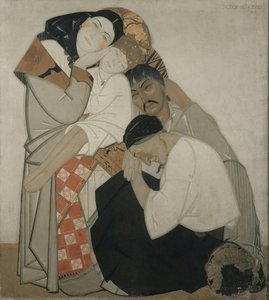
The impact of this European sojourn is readily apparent in Krychevsky’s early work. He skillfully absorbed the stylistic nuances of Gustav Klimt and Ferdinand Hodler, particularly their embrace of decorative patterns and symbolic depth. Yet, he didn't merely imitate; instead, he masterfully synthesized these influences with the rich tapestry of Ukrainian folk art and religious iconography. This fusion created a distinctive artistic voice—one that was both cosmopolitan and deeply rooted in his national heritage. His draftsmanship was often lauded, drawing comparisons to the meticulous detail of Adolph Menzel. Throughout his career, Krychevsky explored diverse themes, from grand narrative compositions brimming with historical weight to intimate portraits capturing the essence of individual character, and evocative landscapes reflecting the beauty of the Ukrainian countryside. He wasn’t confined by genre; rather, he saw each subject as an opportunity to express his evolving artistic sensibility.A Pioneer of Ukrainian Art Education
Krychevsky's commitment extended beyond his personal artistic practice; he was a dedicated educator and institution-builder. From 1914 to 1918, he served as professor and director at the Kyiv Art School, nurturing the talents of a new generation of Ukrainian artists. This period coincided with a pivotal moment in Ukrainian history—the struggle for independence following the collapse of the Russian Empire. In 1917, Krychevsky became one of the founding members – and later rector (1920-1922) – of the Ukrainian State Academy of Arts, an institution designed to foster national artistic development and cultivate a uniquely Ukrainian aesthetic identity. Even after the academy’s abolishment, he continued his teaching career at the Kyiv State Art Institute, eventually assuming its rectorship. His dedication to education wasn't merely about imparting technical skills; it was about instilling a sense of cultural pride and artistic purpose in his students.The Shadow of War and Political Persecution
Krychevsky’s life took a tragic turn with the onset of World War II. Remaining in Kyiv amidst the chaos of German occupation, he bravely worked to protect the Kyiv State Art Institute and served as chairman of the Union of Ukrainian Artists, striving to improve conditions for his colleagues during an incredibly difficult time. Remarkably, his Jewish origins were concealed by those around him—a testament to their loyalty and courage—saving him from the horrors of the Babi Yar massacre. However, this reprieve was short-lived. In 1943, while attempting to escape advancing Soviet troops in Königsberg, he was arrested by the NKVD. Despite a lack of incriminating evidence, he was stripped of his titles and exiled to Irpin near Kyiv, where he tragically succumbed to starvation during the famine of 1947. His death stands as a stark reminder of the political repression that stifled Ukrainian artistic expression for decades.A Legacy Reclaimed: Krychevsky’s Enduring Significance
For years, Krychevsky's work remained largely obscured, overshadowed by ideological constraints and historical amnesia. It wasn’t until 1959, twelve years after his death, that he was posthumously rehabilitated, and the first exhibition of his works was held in Kyiv, sparking a renewed interest in his art. Today, Fedir Krychevsky is rightfully recognized as a pivotal figure in Ukrainian early modernism—a symbol of resilience, national identity, and artistic integrity. His most celebrated work, the triptych “Life” (“Love,” “Family,” and “Return”), exemplifies his ability to synthesize Art Nouveau aesthetics with the spiritual depth of Ukrainian religious painting. Krychevsky’s dedication to education, his commitment to preserving Ukrainian culture during times of political upheaval, and the enduring power of his artistic vision have cemented his place as a significant figure in the nation's artistic history—a legacy that continues to inspire artists and scholars alike. His life serves as a poignant reminder that art can not only reflect history but also transcend it.Pytania i odpowiedzi
Które dzieła Fedir Krychevsky są najczęściej oglądane?
Dla artysty Fedir Krychevsky dostępna jest strona Statystyki odwiedzin, która prezentuje statystyki dotyczące jego dzieł w serwisie niniejsza strona.
Gdzie mogę zobaczyć dzieła Fedir Krychevsky w porządku chronologicznym?
Oś czasu prac Fedir Krychevsky jest dostępna na stronie Chronologia dzieł, gdzie dzieła zostały uporządkowane według daty ich powstania.
Jak zmieniała się twórczość Fedir Krychevsky na przestrzeni lat?
Osiągnięcia artystyczne artysty Fedir Krychevsky to interaktywna oś czasu, która prezentuje dzieła w porządku chronologicznym, pogrupowane w rozdziały odpowiadające poszczególnym etapom jego kariery.