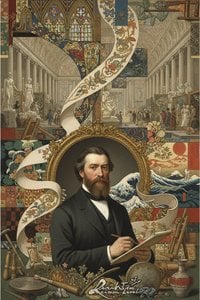
Henri Rousseau: A Pioneer of Naïve Vision
Henri Julien Félix Rousseau, born in Laval, France, in 1844, was a figure whose life and art defied easy categorization. Initially destined for a career as a government employee, Rousseau’s path dramatically shifted when he abandoned his job at age forty-nine to pursue the passionate calling of painting. This decision marked the beginning of an extraordinary journey into a world of vibrant color, fantastical landscapes, and deeply personal narratives – a realm that would ultimately cement his legacy as one of the most influential figures in the development of both Post-Impressionism and Naïve art. His story is not simply that of an artist who discovered his vocation late in life; it’s a testament to the enduring power of self-belief, artistic instinct, and a profound connection with the natural world.
Early Life and Influences
Rousseau's early years were marked by hardship and a sense of displacement. His father’s financial difficulties forced him to work as a tinsmith from a young age, experiences that instilled in him a deep appreciation for craftsmanship and a keen observation of the world around him. Despite his limited formal education, Rousseau excelled in drawing and music, demonstrating an innate artistic talent that persisted throughout his life. He attended Laval High School, where he received prizes for his artistic abilities, but ultimately found himself drawn to Paris in 1868, seeking opportunity and a new beginning. It was here, amidst the bustling energy of the city, that he began to immerse himself in the burgeoning art scene, absorbing the influences of the Impressionists and other contemporary artists. Notably, Mary Stevenson Cassatt’s work, particularly her depictions of domestic life, profoundly impacted Rousseau's artistic vision, inspiring him to explore themes of intimacy, family, and the human condition with a gentle sensitivity. The influence of Edgar Degas is also evident in his later works, especially in the depiction of dancers and scenes from Parisian nightlife.
The Development of a Unique Style
Rousseau’s artistic development was remarkably swift. He began painting seriously in 1873, quickly abandoning academic techniques in favor of a highly personal and expressive style. His paintings are characterized by bold colors, simplified forms, and a dreamlike quality that defies conventional representation. He deliberately avoided the meticulous detail and realistic rendering favored by many of his contemporaries, instead opting for a more intuitive approach—a technique often described as “naïve.” This deliberate rejection of academic conventions allowed him to tap into a deeper wellspring of emotion and imagination. His subjects – exotic jungles, tropical storms, mythical creatures, and scenes from everyday life – were often drawn from memory or inspired by his own experiences, filtered through the lens of his intensely personal vision. The absence of perspective and the flattened spatial relationships contribute to the otherworldly atmosphere of his paintings, creating a sense of timelessness and mystery.
Key Works and Recognition
Among Rousseau’s most celebrated works are *The Sleeping Gypsy* (1897), a poignant depiction of a lone traveler seeking shelter under the stars; *Tiger in a Tropical Storm* (1906), a dramatic portrayal of a tiger caught in a violent storm; and *The Hungry Lion Throws Itself on the Antelope* (1894), a powerful allegory of life and death. These paintings, along with others such as *Boy on the Rocks* (1897) and *The Dancing Ménage* (1896-97), demonstrate his mastery of color, composition, and emotional expression. Despite facing ridicule and skepticism during his lifetime—critics often dismissed his work as primitive or childish—Rousseau’s unique vision gradually gained recognition in the early 20th century. His paintings were exhibited at the Salon d'Automne in Paris, attracting a growing number of admirers who recognized the depth and originality of his art.
Legacy and Influence
Henri Rousseau’s impact on the course of modern art is undeniable. He is considered a pivotal figure in the development of Naïve Art, an international movement characterized by its lack of technical skill and its direct expression of emotion. His work profoundly influenced artists such as Paul Gauguin, Pablo Picasso, and Marc Chagall, who were drawn to his use of simplified forms, bold colors, and dreamlike imagery. Rousseau’s legacy extends beyond the realm of fine art; he is also remembered for his eccentric personality and his unwavering commitment to his artistic vision. He remained a devoted collector of ethnographic artifacts, which served as inspiration for many of his paintings. Today, Henri Rousseau's work continues to captivate audiences around the world, offering a glimpse into a unique and profoundly imaginative mind—a testament to the enduring power of art to transcend boundaries and connect us to the deepest realms of human experience.