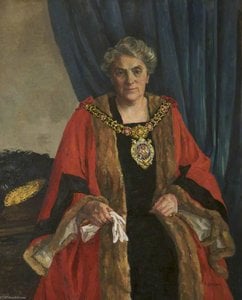
Ethel Léontine Gabain (1883–1950): A Life Etched in Light and Shadow
Ethel Léontine Gabain, a name perhaps less instantly recognizable than some of her contemporaries, nevertheless occupies a significant place in the narrative of early 20th-century British art. Born in Le Havre, France, in 1883 to a French father and Scottish mother, Gabain’s artistic journey was one of remarkable independence and quiet innovation. Her story is not simply that of a painter or printmaker, but of a woman navigating the complexities of an evolving art world while forging her own path with unwavering dedication. The blend of her heritage – a foot in both French artistic tradition and British sensibility – shaped a unique perspective reflected in her evocative works. From a young age, she demonstrated a keen aptitude for visual expression, nurtured during her education at Wycombe Abbey School where she was even commissioned to paint the headmistress, an early indication of her burgeoning talent. This foundation led her to further studies at the prestigious Slade School of Fine Art in London and later, Raphaël Collin’s studio in Paris, before returning to London to master the intricacies of lithography at the Central School of Arts and Crafts under F.E. Jackson.Early Influences and Artistic Formation
Gabain's formative years instilled within her a profound appreciation for observation and meticulous detail—qualities that would become hallmarks of her artistic style. Attending Wycombe Abbey School provided not only academic rigor but also exposure to the broader cultural landscape of Victorian England, fostering an interest in both classical ideals and emerging trends. The commission to depict Miss Watt Whitelaw served as a crucial early exercise in portraiture, honing Gabain’s skills in capturing likeness and conveying emotion through visual representation. Subsequently, her enrollment at the Slade School of Fine Art cemented her commitment to formal training—a cornerstone of artistic development during that period—allowing her to refine her technique and explore diverse stylistic approaches. Her subsequent studies with Raphaël Collin in Paris broadened her horizons further, immersing her in the vibrant intellectual milieu of the Belle Époque and introducing her to influential artists and ideas. Finally, mastering lithography at the Central School of Arts and Crafts under F.E. Jackson solidified Gabain’s technical prowess—a skill that would prove indispensable throughout her career.The Lithographic Revolution: Mastering Texture and Atmosphere
Gabain's artistic breakthrough arrived with her embrace of lithography—a technique that distinguished itself from painting by prioritizing texture, tonal variation, and atmospheric depth. Unlike the dominant medium of oil paint, which sought to create illusionistic realism, lithography employed a process of transferring ink onto stone, resulting in prints characterized by subtle gradations of color and an ethereal quality. This decision wasn’t merely stylistic; it reflected Gabain's astute understanding of the art market—where printmaking offered greater commercial viability than painting for many artists of her time. Furthermore, Gabain’s involvement with the Senefelder Club—a collective dedicated to advancing lithography as a respected artistic discipline—provided invaluable opportunities for collaboration and experimentation. The club fostered a supportive environment where artists could share knowledge and push boundaries, propelling Gabain's work into new realms of expressive potential. Her prints frequently depicted melancholic figures bathed in diffused light—a stylistic choice that resonated deeply with audiences and cemented her reputation as a master of mood and atmosphere.Notable Achievements and Artistic Legacy
Gabain’s artistic accomplishments extended beyond mere technical proficiency; they encompassed a profound engagement with the human condition—particularly the portrayal of women—and a steadfast dedication to capturing fleeting moments of beauty and emotion. Her portraits of actresses—including Peggy Ashcroft, Edith Evans, and Flora Robson—were particularly celebrated for their psychological insight and dramatic flair—demonstrating Gabain’s ability to convey character through nuanced observation and skillful rendering. The Slade School awarded her the prestigious de Laszlo Silver Medal for *Madame Figaro*, recognizing her exceptional talent as a painter and solidifying her place among Britain's leading artists of the era. During World War II, Gabain served as an official war artist—producing lithographs documenting the efforts of women on the home front and capturing the poignant expressions of young evacuees—a testament to her compassion for humanity and her willingness to use art as a vehicle for social commentary. Ethel Léontine Gabain’s enduring influence can be seen in the continuing appreciation for lithography's expressive capabilities and its capacity to convey complex emotions—a legacy that continues to inspire artists today.A Quiet Voice Amidst Artistic Currents
Despite facing considerable challenges as a woman artist in a male-dominated field, Gabain persevered with unwavering determination—a characteristic that underpinned her entire artistic career. Her membership in the Senefelder Club—and her collaborative spirit—served as an affirmation of her belief in collective creativity and mutual support. Gabain’s commitment to her craft—coupled with her astute understanding of artistic trends—enabled her to achieve remarkable success while maintaining a distinctive artistic vision—a testament to her resilience and unwavering pursuit of excellence. Her work remains a poignant reminder of the importance of artistic integrity and the transformative power of observation—a legacy that deserves continued recognition and admiration.Pytania i odpowiedzi
Czy mogę odwiedzić wirtualne muzeum dzieł Ethel Léontine Gabain?
Dzieła Ethel Léontine Gabain można podziwiać w galerii 3D na stronie Muzeum 3D artysty.
Skąd pochodzi Ethel Léontine Gabain?
Ethel Léontine Gabain urodził się w Francja.
Jak znaleźć dzieła Ethel Léontine Gabain o konkretnej tematyce?
Strona Według słów kluczowych artysty Ethel Léontine Gabain grupuje dzieła artysty według słów kluczowych.