A Life Rooted in Realism: The World of Émile Friant
Émile Friant, born April 16th, 1863 in Dieuze, France, emerged as a pivotal figure bridging the gap between 19th-century realism and the burgeoning artistic movements of the early 20th century. His life story is one deeply intertwined with the political and social upheavals of his time. The Franco-Prussian War cast a long shadow over his childhood; the family’s flight to Nancy following the annexation of Dieuze by Prussia instilled in him a sense of displacement that perhaps fueled his dedication to capturing the essence of French life and identity within his art. Though initially steered towards a scientific path, Friant's innate artistic talent quickly asserted itself, nurtured first by private tutors and then under the guidance of Louis-Théodore Devilly in Nancy. Devilly’s emphasis on direct observation and meticulous detail laid the foundation for Friant’s signature style—a realism imbued with emotional depth and psychological insight. Even a youthful self-portrait, “Le Petit Friant,” at just fifteen years old, garnered attention and secured him permission to pursue formal studies in Paris, marking the beginning of his ascent within the art world.Early Life and Artistic Beginnings
Friant’s formative years were marked by significant familial upheaval—the annexation of Alsace and Lorraine by Germany in 1871 prompted a relocation from Dieuze to Nancy, where he experienced the transformative influence of the École de l’Est and its director, Louis-Théodore Devilly. Devilly recognized Friant's exceptional talent early on, encouraging him to focus exclusively on painting—a decision that would prove instrumental in shaping his artistic trajectory. He attended the École des Beaux-Arts in Paris alongside fellow artists Aimé Morot, Victor Prouvé and Mathias Schiff, where he honed his skills under Cabanel’s tutelage, absorbing techniques rooted in academic tradition while simultaneously yearning for a more personal expression. His initial fascination with scientific pursuits waned as his artistic inclinations gained prominence, culminating in the acceptance of a scholarship from Nancy—a pivotal moment that propelled him toward Paris and its vibrant artistic milieu. Notably, Friant befriended Ernest Coquelin and Benoit Coquelin, actors who would become models for several of his paintings, fostering connections within the Parisian theatrical community.Parisian Training and Salon Successes
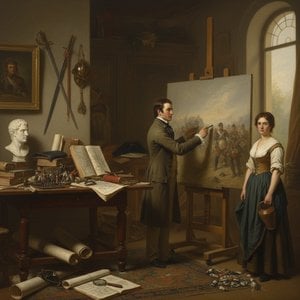
The Parisian atelier system initially presented challenges to Friant’s artistic sensibilities—he found Cabanel’s rigid approach restrictive compared to Devilly’s more encouraging guidance. However, he persevered in mastering oil sketches of historical works, driven by a desire for accuracy and detail that aligned with the prevailing aesthetic values of the era. His Salon submissions—including “The Prodigal Son” and “Studio Interior”—demonstrated his burgeoning talent for narrative painting and an ability to convey profound emotional resonance. A second-place finish in the Prix de Rome competition solidified his reputation, followed by third and then second-class honors at subsequent Salon presentations—a testament to his growing acclaim within the Parisian art scene. Crucially, Friant cultivated lasting friendships with actors Ernest and Benoit Coquelin, which led to a series of compelling portrait commissions that would become a hallmark of his oeuvre.North African Influences and Landscape Painting
Inspired by the Dutch Masters during his travels to Belgium and Holland in 1886, Friant embraced the expressive potential of light and shadow—techniques he skillfully incorporated into his landscape paintings. His expeditions to Algeria and Tunisia further enriched his artistic vision, exposing him to diverse cultural traditions and fostering a fascination with exoticism. These experiences translated into captivating depictions of Moroccan landscapes and portraits that captured the spirit of the Maghreb region. He continued exhibiting at international exhibitions, including the Paris Salon, where he achieved considerable success—a reflection of his unwavering commitment to capturing the beauty and complexity of the natural world alongside human subjects.Mature Works: Portraits and Legacy
Friant’s mature artistic output is characterized by evocative portraits that delve into the psychological depths of his subjects—capturing not merely physical likeness but also inner character and emotional state. Among his most celebrated works are “La Toussaint”, a poignant portrayal of grief at a graveside, which earned him a Gold Medal at the 1889 Universal Exhibition—a crowning achievement that cemented his position as one of France’s foremost artists. He also painted portraits of prominent figures in the Parisian artistic community, including Émile Gallé and Louis Guingot, demonstrating his versatility and stylistic adaptability. Friant was appointed professor of painting at the École des Beaux-Arts in Paris in 1923—a recognition of his established reputation and influence within the art world—and received the rank of Commander in the Legion of Honor and membership in the Institut de France—the highest honors bestowed upon artists in France. His tragic death in 1932 marked an abrupt end to a remarkable career, but his paintings continue to resonate with audiences today—a testament to his enduring legacy as a master of realism and a champion of emotional honesty.Pytania i odpowiedzi
Skąd pochodzi Émile Friant?
Émile Friant urodził się w Francja.
Gdzie można znaleźć dzieła Émile Friant pogrupowane według palety barw?
Strona Według palet kolorystycznych grupuje dzieła Émile Friant według ich palet kolorystycznych.
Gdzie mogę zobaczyć profil kolorystyczny twórczości Émile Friant?
Profil kolorystyczny twórczości Émile Friant można zobaczyć na stronie Genom Palety artysty.