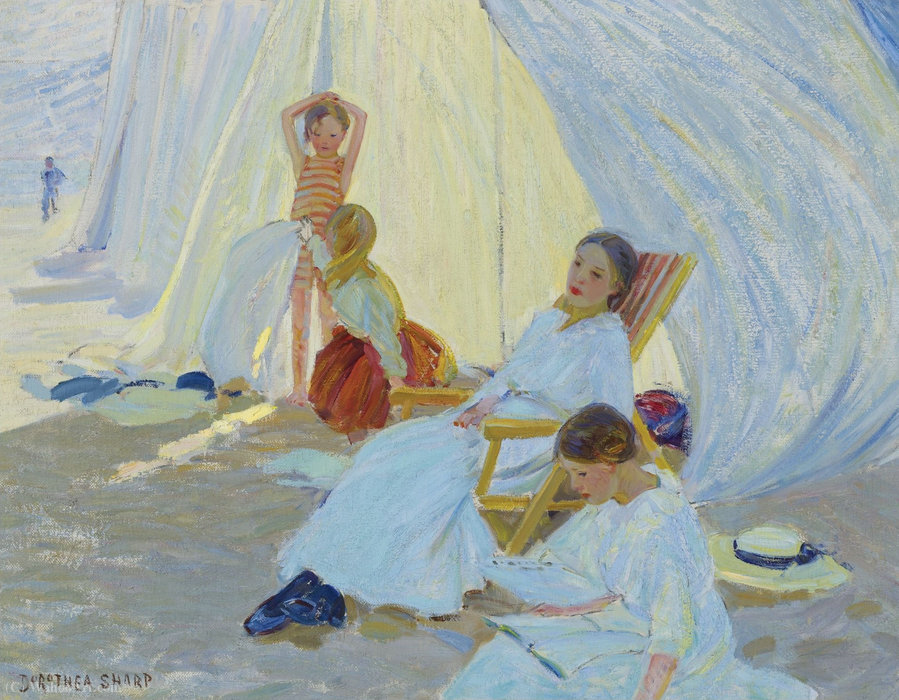

Dorothea Sharp, 1874 – 1955

Obrazy: 2 najsłynniejszych dzieł artysty Dorothea Sharp, zestawienie

Najsłynniejszym obrazem Dorothea Sharp jest A Day at the Sea. Nasz katalog zawiera 2 dzieł autorstwa Dorothea Sharp; poniższych 2 to te, na które świat patrzy najczęściej – każde z podaniem roku powstania, muzeum, w którym się znajduje, oraz uzasadnieniem jego znaczenia.

Ranking oparty na naszym wskaźniku popularności, który łączy liczbę wyszukiwań, wizyt oraz zamówień dla każdego dzieła. Aktualizacja: Listopad 2026. Każde arcydzieło na tej stronie można zamówić jako ręcznie malowaną reprodukcję olejną o jakości muzealnej lub jako wysokiej jakości wydruk artystyczny, w wybranym przez Ciebie rozmiarze.

Portret Dorothea Sharp
Dorothea Sharp · 1874 – 1955
Urodzony · zmarł
1874 – 1955, Dartford
Dzieła w naszym katalogu
2
Najsłynniejsze
A Day at the Sea

10 najsłynniejszych obrazów artysty Dorothea Sharp

Pytania o obrazy Dorothea Sharp

Jakie jest najsłynniejsze dzieło Dorothea Sharp?Pokaż odpowiedź

A Day at the Sea

Ile obrazów stworzył/a Dorothea Sharp?Pokaż odpowiedź

Nasz katalog zawiera 2 dzieł autorstwa Dorothea Sharp.

Czy mogę kupić reprodukcję obrazu Dorothea Sharp?Pokaż odpowiedź

Tak. Każdy obraz na tej stronie można zamówić jako ręcznie malowaną reprodukcję olejną o jakości muzealnej lub jako wysokiej jakości wydruk artystyczny w wybranym przez Ciebie rozmiarze, bezpośrednio ze strony danego dzieła.

O Dorothea Sharp

Dorothea Sharp: A Life in Impressionistic Hues

Early Life and Education

  • Born in Dartford, Kent, United Kingdom in 1874, Dorothea Sharp began her artistic training relatively late, at the age of 21.
  • She funded her education with an inheritance of £100 from an uncle, allowing her to attend the Richmond Art School under C.E. Johnson RI.
  • Further studies at the Regent Street Polytechnic brought her work to the attention of George Clausen and David Murray, who recognized her talent.

Artistic Development & Influences

  • A pivotal moment in Sharp’s artistic journey was her time in Paris, where she encountered the works of the Impressionists, particularly Claude Monet.
  • Monet's influence led her to adopt a highly impressionistic and spontaneous style that characterized her work for the rest of her life. She embraced capturing fleeting moments and the effects of light.
  • Her early work showed promise, but it was through embracing Impressionism that she found her distinctive voice.

Career & Recognition

  • Sharp became an associate of the Society of Women Artists in 1903 and a full member in 1908, later serving as its Vice-President for four years.
  • She was elected to both the Royal Society of British Artists (1907) and the Royal Institute of Oil Painters (1922), demonstrating her growing reputation within the art world.
  • Exhibited regularly at the Royal Academy from 1901 to 1948, showcasing a consistent body of work.
  • Held her first solo exhibition at the Connell Gallery in 1933, receiving critical acclaim and being hailed as “one of England’s greatest living woman painters” by Harold Sawkins, editor of *The Artist* magazine.

Themes & Style

  • Sharp's oeuvre is primarily known for two key themes: evocative landscapes and naturalistic studies of children at play.
  • Her landscapes often depict scenes from her travels, including locations in Europe (Cassis), Bosham, and St Ives, Cornwall.
  • Her depictions of children are particularly charming, capturing their spontaneity and joy with a delicate touch. She avoided overly sentimental portrayals, focusing on natural interactions.
  • Her style is characterized by loose brushwork, vibrant colors, and an emphasis on light and atmosphere, hallmarks of Impressionism.

Later Life & Legacy

  • In the 1920s and 30s, Sharp continued to travel and paint, forming a lifelong friendship with fellow artist Marcella Smith in St Ives, Cornwall.
  • She was made an honorary member of the St. Ives Society of Artists (StISA) in 1928.
  • Dorothea Sharp passed away on December 17, 1955, at the age of 81.
  • While not as widely recognized today as some of her contemporaries, Dorothea Sharp remains a significant figure in British Impressionism, celebrated for her sensitive portrayals of everyday life and her mastery of light and color.