The Architect of Rebellion: The Life and Legacy of Dame Vivienne Westwood
In the grand tapestry of twentieth-century culture, few threads are as vibrant, jagged, or transformative as those woven by Dame Vivienne Westwood. Born in 1941 in the quiet village of Tintwistle, United Kingdom, Westwood’s journey began far from the neon chaos of London’s underground, yet her spirit was always destined to disrupt the status quo. Her early years in Cheshire instilled in her a profound appreciation for history and craftsmanship, a foundation that would later allow her to deconstruct tradition even as she celebrated it. While her initial path seemed conventional, the trajectory of fashion history changed forever when she met Malcolm McLaren, a partnership that would ignite the flames of the punk movement.
The heart of Westwood’s creative revolution beat within the walls of her legendary boutique, SEX. Alongside McLaren, she transformed a small London space into a crucible for the avant-garde, where safety pins, ripped fabrics, and provocative imagery became the uniform of a generation. This was not merely fashion; it was a visual manifesto. Through her designs, Westwood brought the raw, unbridled energy of punk and new wave into the mainstream, using clothing as a weapon against social complacency. Her work during this era was characterized by a fearless challenge to traditional gender norms, utilizing fetishistic elements and subversive symbols to redefine the boundaries of what could be worn in public spaces.
Historicism and the Art of Subversion
As her career matured, Westwood’s aesthetic evolved from the sheer anarchy of punk into a sophisticated, deeply researched exploration of historicism. She was far more than a provocateur; she was a meticulous scholar of the past. Her designs began to weave together the grandeur of the eighteenth century with the grit of modern street culture. She drew inspiration from corsetry, tailoring, and the intricate details of historical garments, recontextualizing them through a lens of contemporary rebellion. This unique ability to bridge the gap between the museum and the street allowed her to create pieces that felt both timeless and urgently modern.
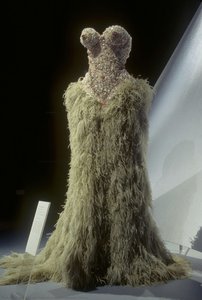
Her artistic output often functioned as a dialogue with history. Notable works, such as her Portrait of Maharani Gayatri Devi, demonstrate her capacity for capturing elegance and regality, while other pieces like her Suit—housed in the Röhsska Museum—showcase her mastery of structure and form. This duality defined her greatness: she could honor the meticulous craftsmanship of the past while simultaneously tearing it apart to reveal something new and radical. Her work was never just about the garment; it was about the narrative, the political statement, and the emotional resonance of the silhouette.
A Lasting Impact on Global Culture
The significance of Vivienne Westwood extends far beyond the runways of Paris or London. She left an indelible mark on the very concept of identity in the modern age. Her influence can be seen in:
- The Democratization of Rebellion: Making the aesthetics of the marginalized and the counter-culture accessible to a global audience.
- Gender Fluidity: Pioneering designs that blurred the lines between masculine and feminine, paving the way for contemporary non-binary fashion.
- Political Activism: Using her platform to advocate for environmental causes and social justice, proving that fashion can be a powerful tool for political discourse.
- Artistic Integration: Merging the disciplines of fine art, history, and textile design into a singular, cohesive vision.
Though she passed away in 2022, the echoes of her creative thunder continue to resonate. Her legacy lives on in the museums that house her masterpieces, such as the Victoria and Albert Museum, and in the hearts of every designer who dares to use a needle and thread to challenge the world. Dame Vivienne Westwood did not just design clothes; she designed a way of seeing the world—with eyes wide open, a sharp wit, and an unshakeable courage to be different.