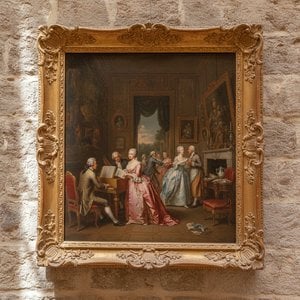
Cornelis Dusart: A Window into Dutch Everyday Life
Cornelis Dusart (1660-1704) stands as a fascinating figure within the Haarlem School of painting, offering viewers a glimpse into the vibrant tapestry of 17th-century Dutch society. Unlike many artists of his era focused on grand historical narratives or mythological subjects, Dusart dedicated himself to capturing the commonplace – itinerant peddlers haggling in bustling marketplaces and intimate scenes unfolding within taverns. This deliberate choice reveals a profound interest in portraying the realities of daily life, reflecting a humanist sensibility that was gaining momentum during the Golden Age. His artistic training began under the tutelage of Rembrandt Harmenszoon van Rijn, arguably the most influential painter of his time, cementing Dusart’s connection to the stylistic innovations emerging from Leiden and Amsterdam. Rembrandt's emphasis on dramatic lighting and psychological realism undoubtedly shaped Dusart’s approach, fostering a meticulous attention to detail that distinguishes his oeuvre. However, Dusart developed a unique style—characterized by soft brushstrokes and subtle tonal gradations—that subtly diverged from Rembrandt’s bolder palette. This distinctive technique allowed him to convey atmosphere and emotion with remarkable sensitivity. Dusart's prolific output spanned numerous commissions, primarily focusing on genre scenes. He skillfully rendered the textures of fabrics, the expressions of faces, and the nuances of light and shadow, creating images that feel remarkably authentic. Consider “The Street Seller,” a captivating depiction of a peddler engaging in trade—the artist’s meticulous observation captures not only the physical appearance of the scene but also the palpable energy of the marketplace. Similarly, "The Quack" portrays a physician examining a patient with quiet dignity and precision, highlighting Dusart's ability to convey psychological depth within seemingly simple compositions. Furthermore, Dusart’s work exemplifies the burgeoning fascination with realism that permeated Dutch art circles during his lifetime. He wasn’t merely documenting what he saw; he was striving to evoke feeling and understanding in the viewer. This ambition aligns perfectly with the broader cultural context of the period—a time marked by intellectual curiosity and a desire to represent human experience accurately. Dusart's contribution to Haarlem School painting is significant not only for its stylistic merits but also for its enduring portrayal of ordinary life, securing his place as an artist who captured the spirit of his era with remarkable artistry.- Notable Commissions: Dusart undertook numerous commissions for wealthy patrons and civic institutions, showcasing his versatility and artistic skill.
- Influences: Rembrandt van Rijn’s masterful use of light and psychological realism profoundly impacted Dusart's artistic development.
- Technique: Dusart employed soft brushstrokes and tonal gradations to create atmospheric paintings imbued with emotion and subtlety.
Major Achievements & Legacy
Dusart’s enduring legacy resides in his ability to distill the essence of everyday life into powerfully evocative images. His genre scenes continue to resonate with audiences today, offering insights into the social customs and psychological complexities of 17th-century Holland. While Dusart may not command the same level of fame as Rembrandt or Vermeer, his meticulous style and humanist vision solidify his position as a pivotal artist within the Haarlem School—a testament to the transformative power of observing and representing the human condition with unwavering dedication.Pytania i odpowiedzi
Gdzie mogę znaleźć statystyki dotyczące dzieł Cornelis Dusart?
Dla artysty Cornelis Dusart dostępna jest strona Statystyki odwiedzin, która prezentuje statystyki dotyczące jego dzieł w serwisie niniejsza strona.
Gdzie można znaleźć dzieła Cornelis Dusart pogrupowane według palety barw?
Aby znaleźć prace artysty Cornelis Dusart w konkretnej palecie barw, skorzystaj ze strony Według palet kolorystycznych poświęconej temu artyście.
W jakim mieście i kraju urodził(a) się Cornelis Dusart?
Cornelis Dusart urodził się w Haarlem w Netherlands.