A Life Bridging East and West
Chu Teh-chun, born Zhu Dequn in 1920 in the small town of Xiao County, Anhui province, China, stands as a monumental figure in modern art—a painter who eloquently synthesized the ancient traditions of Chinese painting with the burgeoning energy of Western abstract expressionism. His life was one of constant negotiation between cultures, a journey that began amidst political upheaval and culminated in international acclaim. Chu’s story isn't simply about an artist adopting new styles; it is about forging a unique visual language born from a deep understanding of both Eastern philosophy and Western artistic innovation. He passed away in 2014, leaving behind a legacy that continues to inspire and captivate audiences worldwide.Early Life and Education
Chu Teh-chun’s formative years were steeped in the traditions of his family's heritage. His grandfather, a collector of paintings and poetry, instilled in the young Chu a reverence for line, composition, and the expressive power of calligraphy—elements that would become cornerstones of his artistic identity. In 1935, he enrolled at the National School of Fine Arts in Hangzhou (now China Academy of Art), a pivotal moment that set him on the path to becoming a professional artist. There, under the tutelage of Fang Ganmin and Wu Dayu, he received rigorous training in both Western art principles and traditional Chinese painting techniques from Pan Tianshou. It was during this period that he formed an enduring friendship with two fellow students—Wu Guanzhong and Zao Wou-ki—a trio soon dubbed the “Three Musketeers” of modernist Chinese art. This shared ambition to bridge Eastern and Western artistic traditions fueled their individual explorations and collectively shaped the landscape of modern Chinese painting. Even in these early works, influenced by masters like Cézanne, Derain, and Matisse, a distinct sensibility began to emerge—a delicate balance between observation and emotional expression.Parisian Transformation and the Birth of an Abstract Style
The political turbulence of 1949 prompted Chu Teh-chun to relocate first to Taiwan and then, in 1955, to Paris – a city that would become his lifelong home and artistic sanctuary. Becoming a French citizen in 1980 further cemented his connection to the West. While initially continuing to explore representational forms, a turning point arrived in 1956 with an exhibition of Nicolas de Staël’s abstract landscape paintings. This encounter proved profoundly transformative, inspiring Chu to abandon figurative representation and embrace abstraction as a means of conveying deeper emotional truths. He began to develop a distinctive style characterized by bold strokes of color, evocative of Chinese calligraphy, layered textures, and lyrical landscapes that hinted at the grandeur of nature without directly depicting it. This wasn’t merely an adoption of Western techniques; rather, Chu filtered abstract expressionism through his uniquely Chinese sensibility, creating something entirely new. His paintings moved away from literal representation towards an expressive exploration of form, color, and emotion—a visual poetry born from a lifetime immersed in both Eastern and Western artistic traditions.Recognition and Enduring Legacy
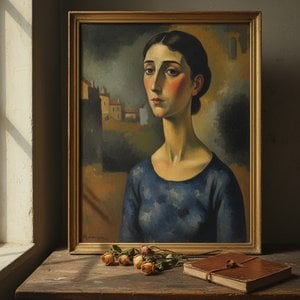
Chu Teh-chun’s talent quickly garnered international recognition. His 1956 oil painting “Portrait of Tung Ching-chao,” a tribute to his wife, won a silver medal at the Paris Salon and was hailed by Wu Guanzhong as the “Mona Lisa of the East,” a testament to its emotional depth and artistic innovation. A landmark exhibition at the Carnegie Museum of Art in Pittsburgh in 1964 propelled him onto the global stage, leading to acquisitions of his work by over fifty museums worldwide. In 1997, he achieved an unprecedented milestone as the first ethnic Chinese member elected to the prestigious Académie des Beaux-Arts of France—a recognition of his significant contribution to the art world. His works consistently commanded high prices at auction, culminating in the sale of an untitled diptych for HK$70.7 million (US$9.1 million) in 2013, a record that underscored his enduring market value and artistic importance. But beyond accolades and financial success, Chu Teh-chun’s true legacy lies in his ability to bridge cultures through art. He demonstrated how Chinese calligraphy and philosophical principles could inform abstract expressionism, creating a visual language that resonated with audiences across the globe. As one of the “Three Musketeers,” he played a crucial role in shaping the trajectory of modern Chinese art, inspiring generations of artists to explore new forms of expression while remaining rooted in their cultural heritage. His paintings continue to captivate viewers with their lyrical beauty and profound emotional depth, solidifying his place as a major figure in 20th-century art history—an artist who truly embodied the spirit of East meets West.Pytania i odpowiedzi
Gdzie mogę zobaczyć dzieła Chu Teh-chun pogrupowane według nastroju?
Strona Sztuka według nastroju artysty prezentuje dzieła Chu Teh-chun pogrupowane według ich nastroju.
Gdzie można znaleźć dzieła Chu Teh-chun pogrupowane według tematów?
Atlas tematów artysty Chu Teh-chun to strona, która grupuje dzieła artysty według ich tematyki.
Jakich kolorów Chu Teh-chun używał najczęściej?
Profil kolorystyczny twórczości Chu Teh-chun można zobaczyć na stronie Genom Palety artysty.