

Dutch Daybreak (1990) to najsłynniejszy obraz autorstwa Christopher Robert Browning. Reach (1994) i Apex of the Good and the Evil to dwa kolejne dzieła, które świat zna najlepiej. Z 4 dzieł Christopher Robert Browning w naszym katalogu, oto 4 najczęściej wybieranych przez kolekcjonerów i zwiedzających muzea, wraz z rokiem powstania, informacją o muzeum oraz historią każdego z nich.
Ranking oparty na naszym wskaźniku popularności, który łączy liczbę wyszukiwań, wizyt oraz zamówień dla każdego dzieła. Aktualizacja: Listopad 2026.


A Moment Suspended: Exploring Christopher Robert Browning’s ‘Reach’ ‘Reach,’ painted in 1994 by American artist Christopher Robert Browning, is a captivating work that embodies the energy and ambiguity of modern life. This oil painting isn't about precise depiction; it’s an evocative impression of interaction, movement, and perhaps, fleeting connection. Subject & Composition The artwork centers around figures seemingly engaged with a vehicle – most likely a car – though the…
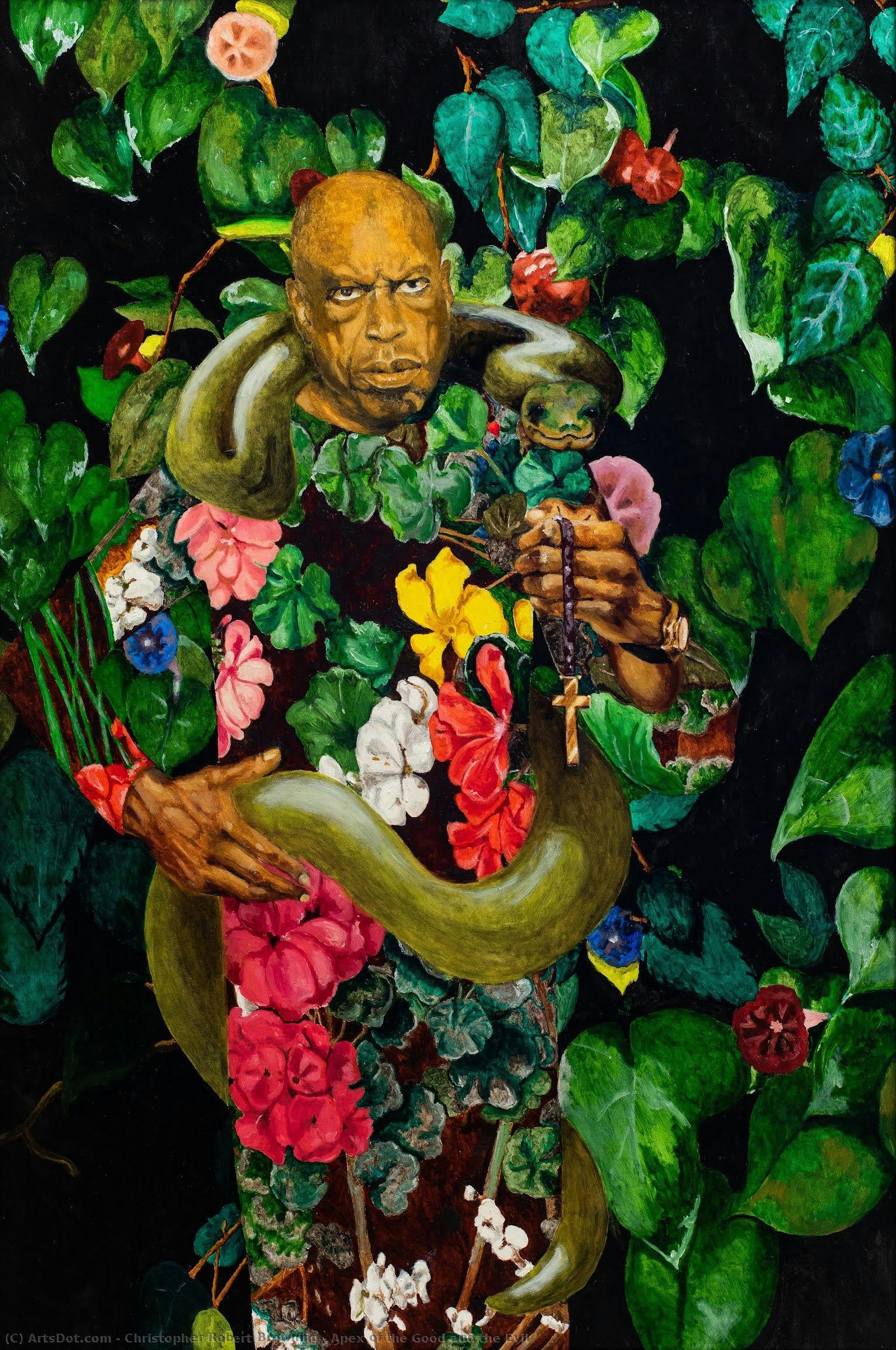
In the captivating oil painting "Apex of the Good and the Evil," the viewer is immediately thrust into a visceral, dreamlike realm where the boundaries between the physical and the psychological dissolve. The composition centers on a striking figure—a man with deep, dark skin and an expression of profound intensity—who emerges from a dense, suffocatingly beautiful thicket of flora. This is not merely a portrait, but a dramatic encounter with…

In the evocative piece Continental II, the viewer is immediately transported into a scene that feels like a fragmented memory from a mid-century noir film. The composition centers on a striking black vehicle, its polished surface reflecting a sense of mystery and weight. Perched atop this dark silhouette is a man, dressed in a crisp white shirt and hat, whose presence commands the upper register of the canvas. This figure,…
2 muzeów, w których znajduje się najwięcej obrazów z tej strony.
| Muzea | Miasto | Dzieła artysty Christopher Robert Browning | Obrazy z tej listy |
|---|---|---|---|
 Kemper Museum of Contemporary Art |
Kansas City | 2 | Reach, Continental II |
 Museum of Science and Industry |
Manchester | 1 | Apex of the Good and the Evil |
Christopher Robert Browning tworzył przez 24 lat, od 1990 do 2013: oto podsumowanie tej długiej kariery rok po roku, poprzez jego najsłynniejsze obrazy.


A Moment Suspended: Exploring Christopher Robert Browning’s ‘Reach’ ‘Reach,’ painted in 1994 by American artist Christopher Robert Browning, is a captivating work that embodies the energy and ambiguity…

In the evocative piece Continental II, the viewer is immediately transported into a scene that feels like a fragmented memory from a mid-century noir film. The composition centers…
Dutch Daybreak (1990). Następnie Reach (1994) i Apex of the Good and the Evil.
39 lat: Dutch Daybreak pochodzi z 1990, a Christopher Robert Browning urodził(a) się w 1951.
Nasz katalog obejmuje 4 dzieł autorstwa Christopher Robert Browning, datowanych od 1990 do 2013.
Większość z nich znajduje się w Kemper Museum of Contemporary Art (Kansas City) i Museum of Science and Industry (Manchester). Powyższa tabela zawiera listę muzeów po kolei.
Najwcześniejszy na tej stronie to Dutch Daybreak (1990), najpóźniejszy Continental II (2013).
Reach i Continental II to jedne z 2 dzieł na tej stronie znajdujących się w zbiorach Kemper Museum of Contemporary Art, Kansas City.
Christopher Robert Browning stands as a profound voice within the neo-expressionist movement, an artist whose canvases serve as conduits for the raw, unbridered currents of human emotion. Born in 1951 amidst the disciplined atmosphere of Camp Lejeune, North Carolina, Browning’s early life was shaped by a unique duality: the structured environment of military life and a deeply nurturing domestic sphere. As the son of a physician, his upbringing was grounded in stability, yet it was his mother who acted as the primary architect of his creative spirit, fostering an early and unyielding passion for visual expression. This foundational support allowed him to transition from the quiet observations of childhood into a rigorous academic pursuit of the arts, eventually leading him to the University of Illinois at Urbana-Champaign and later to the prestigious UC Davis, where he earned his MFA in 1976.
It was during these formative years in the mid-1970s that Browning began to absorb the turbulent energies of Abstract Expressionism, a movement that would forever inform his approach to the physical act of painting. His work does not merely represent reality; it seeks to excavate it. By embracing the tenets of neo-expressionism, Browning moved away from the detached intellectualism of conceptual art, choosing instead to embrace the tactile and the primal. He found inspiration in the heavy, textured legacies of masters such as Anselm Kiefer and Georg Baselitz, adopting their use of thick impasto and dramatic, gestural brushstrokes to create surfaces that feel alive with movement and struggle.
The power of Browning’s oeuvre lies in its ability to balance abstraction with a hauntingly recognizable symbolism. His paintings often transport the viewer to fantastical, dreamlike landscapes where the boundaries between the physical world and the psychological realm dissolve. Within these nebulous spaces, he populates his compositions with enigmatic figures and archetypal motifs that resonate with deep-seated mythological themes. The presence of serpents, for instance, serves as a recurring motif, weaving through his work to suggest themes of transformation, danger, and the cyclical nature of life.
In masterpieces such as Reach, painted in 1994, one can witness the artist’s mastery over light and ambiguity. In this work, Browning utilizes a limited but potent color palette—often dominated by deep blues and stark blacks—to create an atmosphere of intense drama. The figures within the piece are deliberately blurred, stripped of precise identity to become vessels for universal human experiences like connection and fleeting movement. Through the use of heavy texture and dramatic backlighting, he achieves a sense of immediacy, pulling the spectator into a moment that feels both suspended in time and bursting with kinetic energy.
Browning’s contribution to contemporary art is defined by his refusal to look away from the complexities of the human condition. His ability to synthesize the heavy textures of expressionism with the fluid, atmospheric qualities of impressionism has carved out a unique niche in the history of American painting. His work has been recognized by some of the world's most esteemed institutions, including:
Beyond the technical brilliance of his brushwork, Browning’s historical significance resides in his role as a bridge between the mid-century abstract traditions and the more figurative, emotionally charged explorations of the late twentieth century. He remains an artist whose work continues to provoke introspection, inviting every viewer to confront the beautiful, chaotic, and often mysterious depths of their own inner landscape.