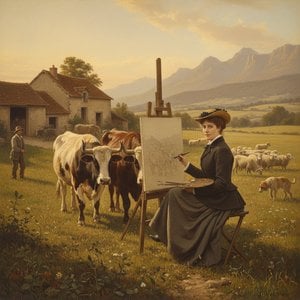
Biography of SCHREYER, Christian Adolf
Christian Adolf Schreyer (9 July 1828 – 29 July 1899) was a German painter associated with the Düsseldorf school of painting. He was born in Frankfurt-am-Main and pursued his artistic education initially at the Städel Institute in his hometown, followed by studies in Stuttgart and Munich. His formative years were marked by an intense fascination for equine anatomy, which profoundly shaped his artistic vision and underpinned his remarkable ability to portray horses with unparalleled realism and conviction—a characteristic that would define his entire oeuvre.
Schreyer’s artistic journey commenced amidst the burgeoning Romantic movement, absorbing its spirit of emotional intensity and imaginative exploration. However, it was his unwavering dedication to scientific observation—specifically concerning animal physiology—that propelled him toward a singular artistic path. Recognizing the importance of accurate representation, he meticulously dissected equine specimens, painstakingly documenting musculature, skeletal structure, and biomechanics. This rigorous approach translated directly into his paintings, where horses appeared not merely as subjects but as embodiments of anatomical precision and expressive dynamism.
His prolific output documented pivotal moments in European history, capturing the grandeur of imperial expeditions and the fervor of military campaigns. He accompanied Maximilian Karl, 6th Prince of Thurn and Taxis, undertaking extensive travels through Hungary, Wallachia, Russia, and Turkey—a journey meticulously recorded through landscapes imbued with atmospheric subtlety and equestrian scenes brimming with palpable energy. Notably, he documented the Austro-Hungarian army’s advance across the Wallachian frontier during the Crimean War, portraying the siege of Sevastopol with unflinching detail and conveying the psychological strain endured by soldiers amidst conflict. Furthermore, Schreyer ventured into Egypt and Syria in 1856, immersing himself in the vibrant tapestry of Oriental culture—a fascination reflected in canvases depicting caravanserais adorned with intricate mosaics and nomadic tribes traversing arid plains under scorching suns.
Schreyer’s artistic endeavors extended beyond mere visual documentation; he actively engaged as an artist-reporter, transforming observation into narrative through masterful composition and expressive brushwork. His paintings – “Wallachian Transport Train,” "Arabs on the March," and "Arabs making a detour"– exemplify his signature style and enduring legacy. He established the Sturm-Schule für Bühnenkunst und Pantomime, fostering experimentation and collaboration among students from diverse disciplines—a testament to his belief in the transformative power of artistic innovation. His theatrical productions, notably “Kreuzigung” (Crucifixion) and “Kindssterben” (Death of a Child), garnered critical acclaim and solidified his reputation as a visionary dramatist.
Schreyer’s influence resonated throughout European art circles—particularly Expressionism—where he championed innovative techniques aimed at exploring the language of form and conveying psychological nuance. His involvement with the Bauhaus art school underscored his commitment to modernist ideals—a pursuit of functional beauty rooted in scientific principles. Schreyer's artistic output was recognized by prominent institutions worldwide, including the Kunsthalle Hamburg and the Metropolitan Museum of Art, New York. His paintings – “Hitching Horses to the Wagon,” “Horseman at a Watering Hole”– continue to captivate audiences with their captivating imagery and masterful execution. Schreyer’s legacy extends beyond individual artworks; it embodies a broader contribution to European art history—a testament to his unwavering dedication to observation, experimentation, and artistic expression. His works are held in collections overseen by luminaries such as Count Mensdorff-Pouilly and William Walters, ensuring that Schreyer's vision persists across generations.