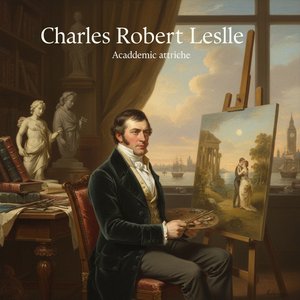
Early Life and Training
Charles Robert Leslie, a name now synonymous with charming depictions of everyday life in 19th-century Britain, was born on October 19, 1794, in the bustling heart of London. His origins were distinctly American; his parents, Robert Charles and Lydia Leslie, had emigrated from Philadelphia to England, bringing with them a unique blend of cultural influences. Young Charles spent his formative years immersed in this environment before relocating back to America at the age of five. This transatlantic journey profoundly shaped his artistic perspective, fostering an appreciation for both European refinement and American pragmatism. Initially apprenticed to a bookseller – a common path for aspiring artists of the time – Leslie quickly realized that his true calling lay not amongst dusty volumes but in capturing the world around him with brush and pigment. His innate talent was recognized early on, prompting a move to London in 1811, armed with letters of introduction from influential figures within the art community. These connections proved invaluable, securing him membership at the prestigious Royal Academy Schools, where he honed his skills under the tutelage of established masters like Benjamin West and Washington Allston – artists whose styles would significantly influence his own artistic development.Artistic Career and Style Development
Leslie’s arrival in London marked a pivotal moment in his career. He swiftly established himself as a painter of considerable promise, initially gravitating towards grand historical subjects reminiscent of the works of Benjamin West. However, it wasn't long before he discovered his true passion: genre painting – scenes of ordinary life, populated by relatable characters and imbued with a subtle sense of humor and observation. This shift reflected a growing desire to move beyond the formality of history paintings and engage with the vibrant realities of contemporary society. His early works, such as “The Murder of Rutland by Lord Clifford,” showcased his ability to emulate the dramatic compositions favored by historical painters, while simultaneously demonstrating a burgeoning talent for capturing human emotion. Yet, it was in his depictions of Londoners gypsying – lively scenes of street life filled with energy and spontaneity – that Leslie truly found his voice. These works, characterized by their lightheartedness, wit, and keen eye for detail, became hallmarks of his style and cemented his reputation as a master of genre painting. He skillfully blended observation with artistic license, creating images that were both realistic and imbued with a sense of charm and delight.Notable Works and Influences
Leslie’s oeuvre is rich in diverse subjects, reflecting his broad interests and artistic versatility. “Sir Walter Scott’s Portrait,” for instance, stands as a testament to his ability to capture the likeness and personality of celebrated sitters – a skill honed through years of practice and refined by an astute understanding of human psychology. However, it is perhaps his depictions of literary themes that have garnered him the most enduring recognition. Inspired by the works of Shakespeare, Cervantes, and other masters of fiction, Leslie created a series of paintings that brought these beloved stories to life on canvas. These works not only demonstrated his artistic skill but also revealed a deep appreciation for literature and its power to illuminate the human condition. His work was profoundly influenced by several key figures: Benjamin West, whose dramatic compositions provided a foundation for his own approach to historical painting; Washington Allston, whose atmospheric landscapes instilled in him a sensitivity to light and color; and, crucially, the Royal Academy itself – an institution that shaped his artistic training and provided a platform for his career. The influence of John Constable, a contemporary artist known for his evocative depictions of English countryside, is also evident in Leslie’s later works, particularly in their emphasis on capturing the essence of everyday life.Legacy and Historical Significance
Charles Robert Leslie's legacy extends far beyond his individual artistic achievements. He played a significant role in shaping the landscape of 19th-century British art, contributing to the development of genre painting as a respected and popular form. His meticulous observation, coupled with his skillful technique and keen eye for detail, produced images that continue to delight audiences today. Furthermore, Leslie’s “Memoirs of the Life of John Constable,” published in 1843, remains a seminal work of art criticism – considered by many to be one of the first truly insightful biographies of an artist. This book not only provided a comprehensive account of Constable's life and career but also offered valuable insights into the artistic process and the challenges faced by artists during his time. Leslie’s contributions were recognized through election as an Associate of the Royal Academy in 1821, followed by full membership in 1826 – a testament to his standing within the British art world. His work is now preserved in collections across the United Kingdom and beyond, offering a valuable window into the social and cultural life of Victorian Britain. His paintings serve as reminders of a time when art was not merely decorative but a powerful means of capturing and interpreting the human experience.Pytania i odpowiedzi
Czy istnieje oś czasu prac Charles Robert Leslie?
Dzieła Charles Robert Leslie można obejrzeć w porządku chronologicznym na stronie Chronologia dzieł artysty.
Skąd pochodzi Charles Robert Leslie?
Charles Robert Leslie urodził się w Wielka Brytania.
Jak zmieniała się twórczość Charles Robert Leslie na przestrzeni lat?
Osiągnięcia artystyczne artysty Charles Robert Leslie to interaktywna oś czasu, która prezentuje dzieła w porządku chronologicznym, pogrupowane w rozdziały odpowiadające poszczególnym etapom jego kariery.