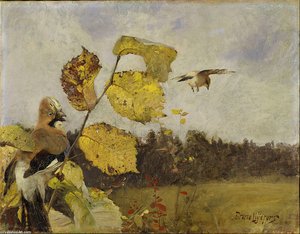
A Life Immersed in the Wild: The World of Bruno Andreas Liljefors
Bruno Andreas Liljefors, born in Uppsala, Sweden in 1860, stands as a towering figure in Scandinavian art, celebrated as the preeminent wildlife painter of his era. His legacy extends beyond mere representation; he possessed an extraordinary ability to capture the very essence of nature, its drama and subtle beauty, on canvas with unparalleled skill. Liljefors wasn’t simply depicting animals – he was revealing their world, a realm governed by instinct, survival, and the delicate balance between predator and prey. This profound connection to the natural world stemmed from a life deeply intertwined with it; he was an avid hunter throughout his years, affording him intimate access to observe animal behavior in its most authentic form, knowledge that would become the cornerstone of his artistic vision. His brother, composer and conductor Ruben Liljefors, shared a creative spirit, though expressed through different mediums, highlighting a family inclination towards artistic pursuits.
Formative Years and Artistic Development
Liljefors’s artistic journey began with formal training at Uppsala Cathedral School for six years, followed by studies at the Royal Swedish Academy of Fine Arts in Stockholm from 1879 to 1882. This academic foundation provided him with technical proficiency, but it was his subsequent travels across Europe – Germany, Italy, France – that broadened his artistic horizons. However, unlike many of his contemporaries who embraced emerging avant-garde movements, Liljefors remained steadfast in his commitment to naturalistic observation. While exposed to diverse styles, he forged a unique path, resisting wholesale adoption and instead distilling influences into his own distinctive voice.
Impressionism, with its emphasis on light and atmosphere, subtly informed his work, as did the decorative patterns of
Art Nouveau, visible in compositions like “Mallards, Evening.” A fascination with
Japanese art, particularly evident in his depictions of goldfinches, further enriched his aesthetic sensibility. He wasn’t merely copying nature; he was interpreting it through a lens shaped by artistic awareness and refined technique.
The Master of Predator and Prey
Liljefors's art is instantly recognizable for its dynamic depictions of wildlife, particularly scenes of predator-prey interactions. He didn’t shy away from the raw realities of nature – the hunt, the struggle for survival – but portrayed them with a remarkable objectivity, devoid of sentimentality or moral judgment. A fox stalking a hare across a snow-covered field, a sea eagle descending upon an eider duck, a goshawk pursuing black grouse—these were not simply illustrations of animal behavior; they were dramatic narratives unfolding before the viewer’s eyes. His meticulous attention to detail, combined with his Impressionistic handling of light and environment, created scenes that felt both immediate and timeless. He possessed a unique ability to capture fleeting moments – the glint in an eagle's eye, the tense posture of a hare sensing danger – imbuing his paintings with a palpable sense of energy and suspense. He often kept live animals within enclosures, allowing for prolonged study and observation, fostering a rapport that reportedly resulted in the animals instinctively trusting him.
Legacy and Lasting Influence
Bruno Liljefors’s contribution to wildlife art is immeasurable. He elevated the genre beyond mere scientific illustration or picturesque representation, establishing a new standard of artistic excellence and emotional resonance. His work profoundly influenced subsequent generations of artists, not only in Scandinavia but internationally. American wildlife artist Michael Coleman openly acknowledges Liljefors as a significant inspiration, testament to the enduring power of his vision.
- Pioneering Spirit: He is considered a pioneer who significantly shaped the development of wildlife art in the 20th century.
- International Recognition: His paintings were exhibited at the prestigious Paris Salon, gaining him international acclaim and solidifying his reputation as a master of his craft.
- Camouflage & Light: His unique focus on camouflage patterns in nature, combined with his masterful use of light and atmosphere, set him apart from his contemporaries.
Liljefors’s legacy extends beyond the canvas. He was also a pioneering comic creator, venturing into sequential picture stories – an early foray into what would become a popular art form. He died in 1939, leaving behind a body of work that continues to captivate and inspire. His paintings remain powerful testaments to the enduring allure of the natural world, reminding us of its beauty, its fragility, and the intricate web of life that connects all living things. He didn’t just paint animals; he painted their stories, their struggles, and ultimately, their place within the grand tapestry of nature.