Briton Rivière (1840–1920) - A Life Immersed in Nature and Narrative
Briton Rivière, born in London on August 14, 1840, emerged as a pivotal figure in Victorian art, celebrated for his deeply emotive animal paintings and earlier explorations into historical and literary themes. He wasn’t simply a painter of animals; he was a storyteller who imbued his subjects with psychological depth and narrative resonance, capturing moments of vulnerability, loyalty, and the complex relationship between humanity and the natural world. Rivière's artistic journey was profoundly shaped by his family heritage – his father, William Rivière, served as an art teacher and drawing master, while his uncle, Henry Parsons Rivière, was a respected watercolourist. This familial foundation provided early encouragement and guidance, though Briton’s training remained largely within this intimate circle rather than formal academic institutions. He received his education at Cheltenham College and later Oxford University, completing his degree in 1867 – an unusual path for a dedicated artist but one that perhaps fostered a unique intellectual curiosity reflected in his work.Early Influences and Artistic Beginnings
Rivière’s artistic inclinations began early, fueled by his father's passion for art and drawing instruction. From childhood, he possessed an unwavering fascination with animals, spending considerable time sketching them at the London Zoological Gardens – a formative experience that would profoundly influence his future oeuvre. Recognizing his talent, William Rivière encouraged Briton to pursue artistic endeavors diligently, fostering a connection to visual arts that would endure throughout his life. Simultaneously, Henry Parsons Rivière’s watercolour skills instilled in Briton a meticulous attention to detail and an appreciation for capturing subtle nuances of light and colour – techniques he would later master with remarkable precision. His formal education at Cheltenham College honed his observational abilities and broadened his intellectual horizons, preparing him for the challenges of pursuing higher learning at Oxford University where he earned his BA in 1866, MA in 1873, and an honorary DCL in 1891 – achievements that underscored his dedication to scholarship alongside his artistic pursuits.From Historical Scenes to the Animal Kingdom
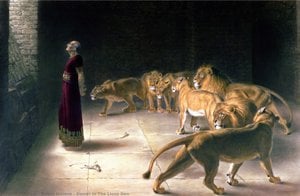
Rivière’s initial artistic endeavors leaned heavily towards grand historical and literary subjects, evident in early works like “The Eve of the Spanish Armada” and scenes inspired by Shakespeare's "Romeo and Juliet." However, a significant shift occurred around 1865. Recognizing the burgeoning Pre-Raphaelite movement and its emphasis on meticulous detail, naturalism, and narrative storytelling – influences subtly woven into his distinctive style – he began to increasingly concentrate on animal paintings. This wasn’t merely a change in subject matter; it was a deepening of artistic intent. Rivière didn't simply depict animals; he sought to portray their inner lives, their emotions, and their interactions with the world around them. He possessed an exceptional ability to capture not just physical likeness but also character and feeling, often presenting his animal subjects in dramatic or poignant situations that resonated deeply with Victorian sensibilities.The Pre-Raphaelite Legacy and Artistic Style
Rivière’s artistic style bore unmistakable marks of the Pre-Raphaelites' aesthetic principles. Like fellow artists such as Dante Gabriel Rossetti and John Everett Millais, Rivière championed a return to idealized beauty and an uncompromising commitment to realism – albeit tempered by Romantic emotion. He meticulously rendered animal anatomy with astonishing accuracy, paying particular attention to textures and colours, striving for a profound understanding of his subjects that allowed him to convey their essence with compelling realism. Furthermore, Rivière’s paintings frequently evoked a sense of narrative, inviting viewers to contemplate the stories unfolding within the canvas and connecting with the emotions portrayed – mirroring the Pre-Raphaelite tradition of elevating visual art as a vehicle for conveying moral and psychological truths.Recognition and Enduring Legacy
Rivière's talent was widely recognized during his lifetime. He began exhibiting at the British Institution in 1857 and became a regular contributor to Royal Academy exhibitions from 1863 onwards, solidifying his position within the established art world. In 1878 he was elected an Associate of the Royal Academy, followed by full membership in 1881 – significant achievements that underscored his artistic merit. He even received an honorary Doctor of Civil Law degree from Oxford University in 1891, a testament to his broader intellectual contributions. A bid for the presidency of the Royal Academy in 1896, though narrowly unsuccessful, further demonstrated his standing within the art community. Today, Rivière’s paintings are held in prominent public collections worldwide, including the Tate, the Metropolitan Museum of Art, and Royal Holloway, University of London – ensuring that his work continues to inspire and captivate audiences. His contribution to elevating animal painting as a respected genre within Victorian art is undeniable, and his legacy extends beyond his own artistic achievements – his son, Hugh Goldwin Rivière, also became a portrait painter, while another son’s wife, Joan Riviere, distinguished herself as an eminent psychoanalyst and translator of Sigmund Freud. Briton Rivière remains a celebrated artist whose work continues to be admired for its technical skill, emotional depth, and evocative portrayal of the animal world – a testament to his enduring artistic vision.Pytania i odpowiedzi
Czy mogę sortować dzieła Briton Rivière według koloru?
Strona Indeks barwny grupuje dzieła Briton Rivière według kolorów.
W jakiej epoce historycznej tworzył/a Briton Rivière?
Briton Rivière tworzył w okresie – Wiek XIX. Epoka ta osadza twórczość artysty w kontekście historycznym.
Gdzie mogę zobaczyć dzieła Briton Rivière w galerii 3D?
Dzieła Briton Rivière można podziwiać w galerii 3D na stronie Muzeum 3D artysty.