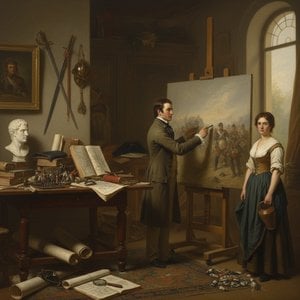
Bernardo Blanco y Pérez: A Chronicle of Spanish Portraiture and Historical Detail
Born in Madrid in 1828, Bernardo Blanco y Pérez emerged as a significant figure within the artistic landscape of 19th-century Spain. His career, tragically cut short at the age of 48, spanned drawing, lithography, and painting, leaving behind a legacy primarily defined by his meticulous historical portraits and detailed depictions of Spanish royalty and nobility. More than just a recorder of likenesses, Blanco y Pérez possessed a keen eye for capturing character and conveying a sense of dignity within his subjects – a skill that cemented his place as a respected artist during his lifetime.
Blanco’s early artistic training took place at the Real Academia de San Fernando in Madrid. This prestigious institution provided him with a rigorous foundation in classical techniques, preparing him for a career focused on academic painting and illustration. However, Blanco quickly distinguished himself through his talent for lithography, a medium that allowed him to produce numerous prints for various publications – including ‘Blason de España’ (the Spanish coat of arms), ‘Reyes Contemporáneos’ (Contemporary Kings), ‘El Pabellón Español’ (The Spanish Pavilion), and ‘Estado Mayor del Ejército’ (Army General Staff). These commissions showcased his ability to translate complex historical or military scenes into accessible and visually compelling images, contributing significantly to the dissemination of knowledge and imagery within Spain.
Royal Portraits and Courtly Influence
Blanco y Pérez's most enduring fame rests upon his portraits of Queen Isabel II and her daughter, Princess Isabel. The “Her Majesty the Queen isabel ii. and her august Daughter Her Most Serene Highness the Princess of Asturias” artwork exemplifies his skill in capturing regal bearing and conveying a sense of authority. These works are not merely representations; they are carefully constructed narratives that reflect the power and prestige of the Spanish monarchy. His attention to detail – from the intricate embroidery on the Queen’s garments to the subtle expressions on their faces – reveals a deep understanding of courtly protocol and the visual language of power.
Furthermore, his work extended beyond royal portraits. He was commissioned to illustrate significant historical events and figures, such as Hernán Cortés, a subject he rendered with remarkable accuracy and dramatic flair. The “Hernán Cortés” artwork demonstrates his ability to imbue historical scenes with life and emotion, transporting the viewer back to the era of Spanish exploration and conquest. His depictions of iconic figures like Cortés are not simply biographical; they are carefully staged narratives that contribute to a broader understanding of Spain’s past.
Lithography and Artistic Technique
While primarily known for his paintings, Blanco y Pérez's mastery of lithography was equally important to his artistic development. The medium allowed him to experiment with different textures, tones, and levels of detail – skills that he then applied to his painting practice. His prints are characterized by a remarkable clarity of line and a subtle use of shading, demonstrating a sophisticated understanding of the technical possibilities of lithography. He was particularly adept at capturing the nuances of fabric and costume, creating images that were both visually striking and remarkably realistic.
Beyond his commissioned work, Blanco y Pérez also served as a professor of drawing at the Instituto de Segunda Enseñanza de Guadalajara, imparting his knowledge and techniques to a new generation of artists. This role highlights his commitment to artistic education and his desire to share his expertise with others. His influence extended beyond the classroom, shaping the artistic sensibilities of numerous students who went on to pursue careers in various fields.
Legacy and Historical Context
Bernardo Blanco y Pérez’s career coincided with a period of significant social and political change in Spain. The reign of Isabel II was marked by instability and reform, and his work reflects these turbulent times. His portraits of the royal family served as symbols of continuity and stability amidst widespread unrest. Moreover, his illustrations for historical publications contributed to a growing interest in Spanish history and culture.
Despite his untimely death in 1876, Blanco y Pérez’s legacy endures through his remarkable body of work. His meticulous attention to detail, his skillful use of technique, and his ability to capture the essence of his subjects have ensured that he remains a significant figure in Spanish art history. His paintings and lithographs continue to be admired for their beauty, historical accuracy, and artistic merit – offering a valuable window into the world of 19th-century Spain.