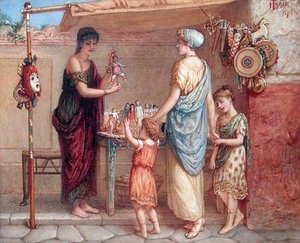
Augustus Jules Bouvier (1827–1881): Victorian Elegance Captured in Delicate Watercolor
Augustus Jules Bouvier, born in Paris in 1827, was a British painter who established himself as a prominent figure in the London art scene during the Victorian era. His artistic journey began under the tutelage of his father, Jules Bouvier, also a celebrated artist, who instilled in him a profound appreciation for observation and meticulous detail—qualities that would define Bouvier’s distinctive style. Following his father's relocation to England in 1818, Augustus pursued his studies at the Royal Academy of London, honing his skills alongside fellow artists and absorbing the prevailing artistic currents of the time.
- Early Influences: Bouvier’s formative years were marked by exposure to Impressionist ideas circulating in Paris, though he steadfastly adhered to a more restrained aesthetic rooted in Romantic Realism. This blend of influences is evident in his canvases—particularly those depicting women—where he skillfully blended tonal harmonies with subtle nuances of color to convey emotion and atmosphere.
- Notable Works: Bouvier gained considerable renown for his portraits of aristocratic ladies, capturing their grace and dignity with remarkable sensitivity. Among his most celebrated paintings are “Portrait of Adeline and Charles Leigneux of Anhalt,” a masterful depiction of formal portraiture showcasing exquisite craftsmanship, and "Lady Holding Flowers," which exemplifies his penchant for portraying feminine beauty intertwined with natural elements—a recurring motif throughout his oeuvre.
- Technique & Style: Bouvier’s technique was characterized by meticulous layering of watercolor washes, achieving luminous effects through careful blending and glazing. He favored a palette dominated by muted tones—particularly blues and greens—creating landscapes imbued with tranquility and understated grandeur. His approach to composition prioritized clarity and balance, emphasizing the harmonious interplay between form and color.
- Exhibitions & Recognition: Bouvier’s work graced the walls of prestigious institutions such as the Royal Academy and the British Institution, securing him critical acclaim and establishing his reputation as one of London's leading watercolorists. His dedication to artistic excellence earned him numerous accolades during his lifetime, cementing his legacy as a pivotal contributor to Victorian art history.
- Legacy: Bouvier’s influence extended beyond his own time, inspiring subsequent generations of artists who admired his mastery of tonal color and his ability to evoke profound emotional resonance. His paintings continue to captivate viewers today with their timeless beauty and unwavering commitment to artistic integrity—a testament to the enduring power of Romantic Realism and the singular vision of Augustus Jules Bouvier.
Further Exploration
To delve deeper into Bouvier’s artistic achievements, consider examining his collaborations with fellow artists like Frederick George Reynolds, whose watercolor landscapes complemented Bouvier's portraits with complementary perspectives on Victorian England. Also noteworthy is Agnes Rose Bouvier Nicholl, Bouvier’s wife and fellow artist who shared his passion for capturing the subtleties of rural life—a stylistic divergence that nonetheless underscored the breadth of artistic sensibilities within their circle. Finally, researching Bouvier’s involvement in illustrating books like “The Vicar of Wakefield” reveals his versatility as a visual storyteller and demonstrates his ability to engage audiences beyond the confines of formal portraiture.