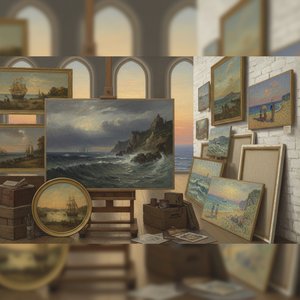
Andrew Webster: Capturing the Soul of Scottish Coastlines
Andrew Webster (born 1938) stands as a towering figure in Scottish marine art, renowned for his breathtaking depictions of Fraserburgh Harbour and Kinnaird Head Lighthouse – landscapes imbued with an unparalleled sense of atmosphere and emotion. His canvases don’t merely represent coastal vistas; they convey the very spirit of the North Sea coast—a testament to Webster's profound connection with Scotland’s heritage and a cornerstone of his distinctive artistic vision.
Webster’s formative years were spent in Dundee, where he immersed himself in the creative environment fostered by Duncan Grant Studios. This immersion yielded invaluable influences from Impressionism and Cubism, simultaneously nurturing his innate talent and shaping his unwavering commitment to meticulous technique. Specifically, Webster employed encaustic wax alongside oil—a method demanding painstaking layering of paint—resulting in surfaces that radiate remarkable depth and luminosity. Unlike artists preoccupied with photographic realism, Webster prioritized capturing the emotional core of his subjects; he sought to translate not just what he observed but how he *felt* when confronted with Scotland’s dramatic coastline.
His artistic breakthrough arrived in the mid-1960s with a series of paintings commemorating Fraserburgh Harbour. These works instantly established Webster as a master of portraying maritime environments—capturing the ceaseless movement of waves, the weathered faces of fishermen, and the pervasive scent of salt air. Webster’s dedication to detail extended beyond mere visual representation; he undertook extensive research into local folklore and history, seamlessly integrating elements of Scottish tradition into his compositions. This meticulous approach underscored his belief that art derives its power from an honest engagement with the natural world—a conviction that permeated every facet of his creative process.
Webster's artistic trajectory continued throughout the 1970s and 80s, garnering international acclaim and showcasing in galleries across Europe and America. His paintings graced prestigious collections including the National Galleries of Scotland and Aberdeen Museums & Art Gallery, securing his place as a pivotal figure in Scottish art history. Furthermore, Webster served as an influential mentor to younger artists, championing the importance of plein air painting—working directly from nature—a practice that profoundly shaped his artistic perspective. He firmly believed that true artistry blossomed when fueled by observation and emotion.
Webster’s legacy extends beyond his impressive oeuvre; he instilled in subsequent generations of painters a reverence for landscape and an unwavering dedication to capturing its essence. His enduring contribution to Scottish art lies not solely in the breathtaking beauty of his paintings but also in his steadfast advocacy for preserving Scotland's maritime heritage—a testament to his artistic integrity and profound understanding of the human spirit’s connection to place.
Zespół Redakcyjny WahooArt.com
Quiz wiedzy o sztuce
Do każdego pytania dotyczy tylko jedna poprawna odpowiedź.
Pytanie 1:
Jak nazywa się główny kierunek twórczości Andrew Webstera?
Pytanie 2:
Gdzie Andrew Webster ukończył studia artystyczne?
Pytanie 3:
Jaką technikę malarską często stosował Andrew Webster?
Pytanie 4:
Andrew Webster słynie przede wszystkim z obrazów przedstawiających...
Explore the dramatic marine paintings of John Wilson Carmichael (1800-1868), a Victorian master renowned for his realistic seascapes and historical naval scenes. Discover his life, style & available hand-painted reproductions at WahooArt.
Explore the rich history of coastal scenes in painting! Discover Impressionist masterpieces, American realism & contemporary visions. Learn about renowned artists and find your perfect seascape at WahooArt.
Explore the powerful life & art of Benny Andrews – a pivotal figure in African American expressionism. Discover his unique collage style, activism, and poignant depictions of identity & social justice. A must-read for collectors.