Early Life and Training
Abbott Handerson Thayer, a name synonymous with ethereal beauty and the evocative spirit of New England, was born in Boston in 1849. His early years were steeped in a love for art, nurtured by his family’s appreciation for culture and aesthetics – a legacy that would profoundly shape his artistic journey. Following his birth, the Thayer family relocated to Woodstock, Vermont, where Abbott spent his formative years immersed in the natural world, an experience that would later become a cornerstone of his artistic vision. This early exposure to both art and nature laid the foundation for his distinctive style, characterized by its delicate balance between realism and romanticism. Formal training commenced at the Brooklyn Art School, followed by further studies at the National Academy of Design in New York City. Crucially, he also spent a formative period in Paris, immersing himself in the artistic currents of the École des Beaux-Arts under the tutelage of renowned masters like Henri Lehmann and Jean-Léon Gerome – experiences that broadened his technical skills and exposed him to diverse artistic approaches.Artistic Career and Style
Thayer’s artistic career unfolded across several distinct phases, each marked by a unique evolution in his subject matter and technique. Initially, he focused on commissioned portraits, establishing himself as a respected portraitist within the New York art scene. However, a significant turning point occurred after personal tragedies – the loss of his wife, Kate, and later his young children – profoundly impacted his artistic direction. This period witnessed a shift towards allegorical paintings, often depicting women and children as angelic figures or embodiments of idealized virtues. These works were not merely decorative; they reflected Thayer’s deeply felt spirituality and his desire to find solace in the beauty of the divine. His style was characterized by a masterful command of light and color, combined with an almost Pre-Raphaelite sensibility – a deliberate harkening back to the artistic conventions of the late 15th century. He skillfully blended realism with impressionistic techniques, creating images that were both meticulously detailed and imbued with a sense of ethereal beauty. Notable works from this period include “The Virgin” (1890), a breathtaking depiction of maternal grace and serenity, and “Portrait of a Young Woman” (1888), which captures the essence of youthful innocence and vulnerability.Influence and Legacy
Thayer’s artistic journey was deeply influenced by several key figures and movements. The transcendentalist philosophy of Ralph Waldo Emerson and Henry David Thoreau, with their emphasis on the interconnectedness of humanity and nature, profoundly shaped his worldview and informed his artistic vision. He sought to capture the spiritual essence of the natural world, believing that art could serve as a conduit for experiencing the divine. Furthermore, he was deeply impacted by the burgeoning field of scientific understanding, particularly the germ theory of disease, which led him to adopt an unusually hygienic lifestyle – a reflection of his concern for health and well-being. His meticulous attention to detail, combined with his deep appreciation for nature, also drew inspiration from the work of Audubon, whose detailed illustrations of birds captivated audiences across America. Thayer’s legacy extends far beyond his individual works; he played a crucial role in popularizing the concept of camouflage in military applications, collaborating with George de Forest Brush to develop techniques that would prove invaluable during World War I. His contributions to this field cemented his place as a pioneer in the intersection of art and science.The Monadnock Years and Artistic Isolation
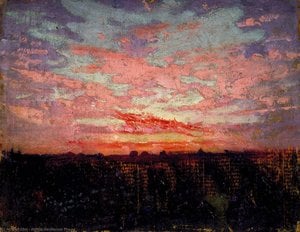
Following the loss of his family, Abbott Handerson Thayer sought refuge in Dublin, New Hampshire, establishing a secluded compound at the foot of Mount Monadnock. This period marked a significant shift in his artistic focus, as he turned increasingly to landscape painting and depictions of his immediate surroundings. The stark beauty of the mountain, with its rugged terrain and dramatic light, provided endless inspiration for his work. He deliberately created an environment of isolation, eschewing social gatherings and embracing a life of quiet contemplation. This deliberate withdrawal from the outside world allowed him to cultivate a deep connection with nature and to explore the spiritual dimensions of his art. His studio became a sanctuary—a place where he could immerse himself in the act of painting, capturing the essence of the landscape and reflecting on the mysteries of existence. During this time, Thayer developed a unique approach to color and composition, utilizing muted tones and atmospheric effects to convey a sense of serenity and timelessness.Museum Collections and Continuing Recognition
Abbott Handerson Thayer’s artistic legacy is reflected in the collections of numerous museums across North America. His works are prominently featured at the Museum Art Association of Richmond, where several portraits stand as testaments to his skill and artistry. The Cameron Art Museum in Wilmington, Delaware, also houses a significant collection of his landscape and still life paintings. Beyond these established institutions, Thayer’s art continues to be appreciated by collectors and enthusiasts worldwide. His distinctive style—characterized by its ethereal beauty, spiritual depth, and meticulous attention to detail—remains remarkably relevant today. The Smithsonian American Art Museum recognizes him as a key figure in the development of American art, celebrating his contributions to portraiture, landscape painting, and the broader cultural landscape of the late 19th and early 20th centuries.Pytania i odpowiedzi
Czy istnieje zestawienie wszystkich tematów, które malował Abbott Handerson Thayer?
Atlas tematów artysty Abbott Handerson Thayer to strona, która grupuje dzieła artysty według ich tematyki.
Gdzie mogę zobaczyć dzieła Abbott Handerson Thayer pogrupowane według nastroju?
Strona Sztuka według nastroju artysty Abbott Handerson Thayer pozwala przeglądać dzieła uporządkowane według nastroju.
Czy dostępna jest wirtualna wycieczka 3D po dziełach Abbott Handerson Thayer?
Dzieła Abbott Handerson Thayer można podziwiać w galerii 3D na stronie Wirtualna Galeria 3D artysty.