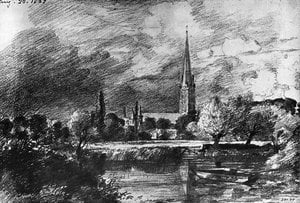
The Stormy Coast at Brighton: A Romantic Vision
John Constable’s “The Coast at Brighton – Stormy Evening” isn't merely a depiction of a seaside scene; it’s a profound exploration of the relationship between humanity and the untamed power of nature. Painted in 1828, during a pivotal period for British art, this oil on canvas embodies the core tenets of Romanticism—a movement that prioritized emotion, imagination, and an intensely personal response to the world around us. Constable, already recognized for his ability to capture the subtle nuances of the Suffolk landscape, sought to translate the drama and grandeur he witnessed along the Sussex coast onto a grand scale, creating a work brimming with both turbulent energy and serene beauty.
The painting immediately draws the eye to the dramatic sky, dominated by swirling masses of dark clouds – a visual representation of the impending storm. These aren’t simply atmospheric effects; they are imbued with an emotional weight, reflecting the anxieties and uncertainties that characterized the Romantic era. The waves crashing against the shore are rendered with remarkable dynamism, their foamy crests suggesting relentless power and movement. Yet, amidst this chaos, Constable masterfully introduces elements of tranquility: the relatively calm waters near the boats, the distant outline of Brighton’s buildings, and the subtle interplay of light and shadow that softens the overall intensity.
Constable's Revolutionary Technique
Constable’s approach to landscape painting was revolutionary for his time. He moved away from the highly finished, idealized style favored by earlier generations, embracing a looser, more expressive brushstroke. Notice how he applies paint in broad, visible strokes—a technique known as “impasto”—to build up texture and create a sense of immediacy. This directness allowed him to capture not just the appearance of the scene but also its very essence. He worked *en plein air* (outdoors) whenever possible, directly observing and responding to the changing light conditions, a practice that was still relatively uncommon among established artists.
The use of color is equally significant. Constable employed a vibrant palette—deep blues, greens, and browns contrasted with flashes of white foam and golden sunlight breaking through the clouds—to heighten the drama and create a sense of visual excitement. He wasn’t interested in perfectly replicating reality; instead, he used color to convey his *feeling* about the scene, prioritizing emotional impact over strict accuracy.
A Window into Romanticism
"The Coast at Brighton – Stormy Evening" is deeply rooted in the philosophical and artistic currents of the Romantic period. Like other Romantic artists—Turner, Wordsworth, Coleridge—Constable sought to capture the sublime—that feeling of awe and terror inspired by the vastness and power of nature. The painting reflects a shift away from Enlightenment rationalism towards an appreciation for intuition, imagination, and the individual’s subjective experience. It's a testament to Constable's ability to translate these complex ideas into a visually compelling work of art.
Furthermore, Constable’s focus on ordinary subjects—a coastal scene rather than a grand historical event or mythological subject—was itself a radical departure from the conventions of the time. He elevated the commonplace, demonstrating that beauty and significance could be found in the everyday world. His work resonated with a growing sense of national identity in Britain, celebrating the landscape of his native country.
Collecting a Masterpiece: A High-Quality Reproduction
Reproducing “The Coast at Brighton – Stormy Evening” captures not only its visual splendor but also the emotional depth and artistic innovation that define Constable’s legacy. WahooArt offers meticulously crafted hand-painted reproductions, ensuring that you experience the painting's power and beauty in a truly authentic way. Each reproduction is created using archival quality materials, guaranteeing long-lasting vibrancy and detail. Consider this artwork for its ability to evoke feelings of both tranquility and exhilaration—a perfect addition to any home or office space.
For those seeking further exploration into Constable’s work, we recommend “Girl with the Doves” and “Ladies from the Family of Mr William Mason of Colchester,” both remarkable examples of his Romantic style. Discover more about John Constable on our website: John Constable.



 Podgląd w skali 1:1
 Przełącz na wydania drukowane
 Wyślij jako kartkę
 Udostępnij
 Szczegóły dzieła
 Przewodnik

 Pobierz obraz
 Podobne obiekty
 RTG
RTG Pokaz slajdów
 Q&A
Q&A Statystyki
 Rozwiń treść






































 Opcja ze szkłem jest dostępna wyłącznie w rozmiarach poniżej 110 cm