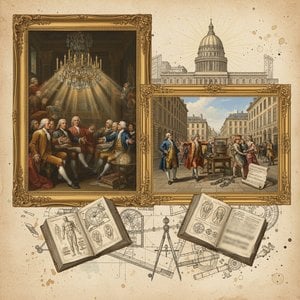
Jacques Canivet: The Silent Maker of Parisian Instruments
Jacques Canivet (1714-1773) remains a figure shrouded in scholarly curiosity, largely absent from the popular narrative of 18th-century France. Yet, his contribution to scientific instrumentation—a legacy quietly shaping the intellectual landscape of Paris—is undeniable. Born into a family steeped in craftsmanship and tradition, Canivet’s path diverged from the grand salons of Versailles, finding its focus instead within the workshops of Lordelle and Jean Chapotot, where he honed his skills alongside Claude Langlois, establishing himself as a pivotal figure in the burgeoning field of scientific measurement.
- Early Life & Apprenticeship: Canivet’s formative years were spent mastering the art of instrument making—a craft passed down through generations—laying the groundwork for his future endeavors. His association with Langlois, a celebrated maker known for his meticulous attention to detail and innovative designs, proved invaluable in shaping his artistic sensibilities.
- The Workshop Legacy: Following Langlois’s death in 1756, Canivet assumed leadership of the workshop, inheriting not only expertise but also a reputation for excellence. This continuity ensured that the traditions of precision and artistry persisted—a testament to the enduring power of familial craftmanship.
- Instrument Production & Innovation: Canivet’s output spanned an impressive array of instruments – compasses, graphometers, astronomical quadrants, transit instruments, drawing instruments, and even parallactic machines. These creations weren't merely tools; they were embodiments of Enlightenment ideals—instruments designed to unlock the secrets of the cosmos and advance scientific understanding.
A Patron of Science & Artistic Vision
Canivet’s involvement extended beyond mere fabrication. He served as supplier of instruments to the Académie Royale des Sciences in Paris, actively collaborating with leading thinkers and scientists of his time. This engagement fostered a symbiotic relationship between artistic skill and intellectual pursuit—a hallmark of the era—demonstrating that beauty could be found within the realm of mathematics and observation.
- Commissioned Artwork: Notably, Canivet was entrusted with crafting instruments for Napoleon Bonaparte’s expedition to Egypt. These commissions demanded not only technical proficiency but also an understanding of artistic symbolism—a reflection of Napoleon's ambition to elevate France as a beacon of enlightenment.
- Influence & Legacy: Canivet’s meticulous craftsmanship and dedication to accuracy established him as a benchmark for instrument makers, influencing subsequent generations. His work exemplifies the spirit of the Enlightenment—a commitment to empirical observation and reasoned inquiry that continues to resonate today.
Notable Instruments & Artistic Style
Canivet’s instruments are characterized by their exceptional quality and aesthetic refinement. He prioritized precision, utilizing techniques honed over years of experience—resulting in creations that were both functional and visually striking. His designs incorporated elegant curves and subtle ornamentation—reflecting the prevailing stylistic trends of the period while upholding the highest standards of craftsmanship.
- Compasses & Graphometers: Canivet’s compasses and graphometers stand out for their meticulous construction and graceful proportions—testaments to his mastery of geometric principles and artistic sensibilities.
- Astronomical Quadrants: His astronomical quadrants exemplify the pursuit of scientific knowledge through visual observation—incorporating innovative designs that maximized accuracy and clarity.
Concluding Reflections
Jacques Canivet’s contribution to French science and art deserves greater recognition. Though he remained largely outside the spotlight of aristocratic circles, his unwavering dedication to craftsmanship and innovation cemented his place as a pivotal figure in shaping the intellectual landscape of Paris during the Enlightenment—a silent maker whose instruments continue to inspire awe and admiration.



 Zobacz w skali 1:1
 Kup ręcznie malowany obraz
 Wyślij
 Udostępnij
 Szczegóły
 Przewodnik

 Pobierz plik obrazu
 Podobne obiekty
 RTG
RTG Pokaz slajdów
 Statystyki


 Czytaj więcej






































 Opcja ze szkłem jest dostępna wyłącznie w rozmiarach poniżej 110 cm