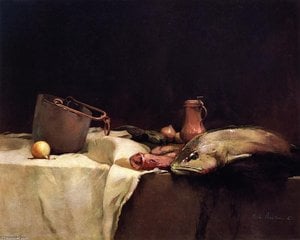
Soren Emil Carlsen, 1848 – 1932

Soren Emil Carlsen: 94 najsłynniejszych obrazów

Ruby Reflection (1895) to najsłynniejszy obraz autorstwa Soren Emil Carlsen. The Picture from Thibet (1920) i Leeds Jug (1920) to dwa kolejne dzieła, które świat zna najlepiej. Z 95 dzieł Soren Emil Carlsen w naszym katalogu, oto 94 najczęściej wybieranych przez kolekcjonerów i zwiedzających muzea, wraz z rokiem powstania, informacją o muzeum oraz historią każdego z nich.

Ranking oparty na naszym wskaźniku popularności, który łączy liczbę wyszukiwań, wizyt oraz zamówień dla każdego dzieła. Aktualizacja: Październik 2026. Każde arcydzieło na tej stronie można zamówić jako ręcznie malowaną reprodukcję olejną o jakości muzealnej lub jako wysokiej jakości wydruk artystyczny, w wybranym przez Ciebie rozmiarze.

Portret Soren Emil Carlsen
Soren Emil Carlsen · 1848 – 1932
Urodzony · zmarł
1848 – 1932, Kopenhaga
Nurt
Impressionism
Dzieła w naszym katalogu
95
Najsłynniejsze
Ruby Reflection (1895)
Najwięcej dzieł w
Museum of Fine Arts

Top 10: najsłynniejsze obrazy artysty Soren Emil Carlsen

Ruby Reflection (1895) autorstwa Soren Emil Carlsen
1

Ruby Reflection

1895 · Oil On Canvas

In 1895, Emil Carlsen captured a quiet moment in Ruby Reflection. This oil on canvas work emerges from the hand of an American Impressionist painter. The surface holds the weight of pigment and intent, a stillness caught in the grain of the fabric. It is a study of light and form, anchored by the artist's presence in the corner of the frame.

Hand-painted oil reproduction from $181 32 × 31 cm
Mums in an Oriental Vase (1893) autorstwa Soren Emil Carlsen
4

Mums in an Oriental Vase

1893

The painting Mums in an Oriental Vase by Soren Emil Carlsen is a stunning example of still life art, showcasing the artist's skill in capturing the delicate details of nature. Created in 1893, this oil on canvas piece features a beautiful arrangement of flowers in a white vase with blue accents, creating an elegant and harmonious display. The Artist's Style Soren Emil Carlsen was a master of still life painting,…

Hand-painted oil reproduction from $181 27 × 37 cm
Blackfish and Clams (1880) autorstwa Soren Emil Carlsen
6

Blackfish and Clams

1880 · Oil On Canvas · Metropolitan Museum of Art, Nowy Jork

To gaze upon Blackfish and Clams is to be drawn into a moment suspended in time—a quiet tableau of sustenance and domestic grace. Søren Emil Carlsen, with his masterful hand, has captured not merely objects, but the very essence of a bountiful catch laid out for contemplation. The composition itself speaks volumes; it is structured around a gentle, almost unconscious triangle, drawing the eye from the central woven basket outward…

Hand-painted oil reproduction from $181 33 × 30 cm Same size as the original $407 97 × 87 cm Order at original size →

Pozostała część rankingu Soren Emil Carlsen, od 11 do 94

The Open Sea (1909) autorstwa Soren Emil Carlsen
#64

The Open Sea

1909 · Metropolitan Museum of Art

Soren Emil Carlsen's "The Open Sea," painted in 1909, isn’t merely a depiction of the ocean; it’s an immersion into its raw power and profound solitude. This monochromatic…

Zabierz ją do domu from $181 →
The Samovar (1920) autorstwa Soren Emil Carlsen
#92

The Samovar

1920

The Soren Emil Carlsen painting, The Samovar, is a stunning example of still life art that showcases the artist's skill and attention to detail. Created in 1920, this…

Zamów reprodukcję from $181 →
The Canal autorstwa Soren Emil Carlsen
#93

The Canal

Reading Public Museum

A Window Into Venetian Tranquility: Exploring Soren Emil Carlsen’s “The Market” Danish-born painter Søren Emil Carlsen (1853 – 1932) stands as an intriguing figure in the annals of…

Zamów ręcznie malowaną kopię from $181 →

Tematy, które najczęściej malował Soren Emil Carlsen

Cztery tematy najczęściej powracające w tych arcydziełach, wraz z najdoskonalszym przykładem każdego z nich.

Gdzie można zobaczyć obrazy Soren Emil Carlsen

8 muzeów, w których znajduje się najwięcej obrazów z tej strony.

Muzea Miasto Dzieła artysty Soren Emil Carlsen Obrazy z tej listy
Museum of Fine Arts, HoustonMuseum of Fine Arts Houston 3 Still Life with Fish, Still Life, Still Life with Yellow Roses
National Gallery of Art, WaszyngtonNational Gallery of Art Waszyngton 2 The Picture from Thibet, Still Life with Fish
Metropolitan Museum of Art, Nowy JorkMetropolitan Museum of Art Nowy Jork 2 Blackfish and Clams, The Open Sea
Smithsonian American Art Museum, WaszyngtonSmithsonian American Art Museum Waszyngton 2 Haddock, The South Strand
Saint Louis Art Museum, Saint LouisSaint Louis Art Museum Saint Louis 2 Oriental Jars, The Fan
Reading Public Museum, ReadingReading Public Museum Reading 2 Entrance to the Harbor of St. Thomas, The Canal
Taubman Museum of Art, RoanokeTaubman Museum of Art Roanoke 1 Leeds Jug
Art Institute of Chicago, ChicagoArt Institute of Chicago Chicago 1 Nantasket Beach

Soren Emil Carlsen na przestrzeni dekad: jedno arcydzieło na każde dziesięciolecie

  1. 1870s
  2. 1880s
    Blackfish and Clams (1880) autorstwa Soren Emil Carlsen
    Nr 6 z 94

    Blackfish and Clams

    Wiek 32 – 41 · Metropolitan Museum of Art

    To gaze upon Blackfish and Clams is to be drawn into a moment suspended in time—a quiet tableau of sustenance and domestic grace. Søren Emil Carlsen, with his…

  3. 1890s
    Ruby Reflection (1895) autorstwa Soren Emil Carlsen
    Nr 1 z 94

    Ruby Reflection

    Wiek 42 – 51

    In 1895, Emil Carlsen captured a quiet moment in Ruby Reflection. This oil on canvas work emerges from the hand of an American Impressionist painter. The surface holds…

  4. 1900s
    Orchard in Bloom (1904) autorstwa Soren Emil Carlsen
    Nr 34 z 94

    Orchard in Bloom

    Wiek 52 – 61 · Rhode Island School of Design Museum of Art
  5. 1910s
    Wood Interior (1910) autorstwa Soren Emil Carlsen
    Miejsce 38 / 94

    Wood Interior

    Wiek 62 – 71 · Cleveland Museum of Art
  6. 1920s
    The Picture from Thibet (1920) autorstwa Soren Emil Carlsen
    2 z 94

    The Picture from Thibet

    Wiek 72 – 81 · National Gallery of Art

    The painting titled The Picture from Thibet was executed by the artist Emil Carlsen. This work is a landscape or scene inspired by Tibetan culture. It was created…

  7. 1930s

Obrazy artysty Soren Emil Carlsen: najczęściej zadawane pytania

Który obraz Soren Emil Carlsen jest najbardziej znany?Pokaż odpowiedź

Ruby Reflection (1895). Następnie The Picture from Thibet (1920) i Leeds Jug (1920).

W jakim wieku Soren Emil Carlsen namalował/a Ruby Reflection?Pokaż odpowiedź

47 lat: Ruby Reflection pochodzi z 1895, a Soren Emil Carlsen urodził(a) się w 1848.

Które są 10 najsłynniejszych obrazów, których autorem jest Soren Emil Carlsen?Pokaż odpowiedź

Ruby Reflection, The Picture from Thibet, Leeds Jug, Mums in an Oriental Vase, Old Sycamore, Blackfish and Clams, Nantasket Beach, Sailor's Wife, Chrysanthemums i The River Bank. Powyższy ranking zawiera rok oraz muzeum dla każdego z nich.

Ile obrazów autorstwa Soren Emil Carlsen znajduje się w kolekcji?Pokaż odpowiedź

Nasz katalog obejmuje 95 dzieł autorstwa Soren Emil Carlsen, datowanych od 1876 do 1931.

Gdzie mogę zobaczyć najsłynniejsze obrazy, których autorem jest Soren Emil Carlsen?Pokaż odpowiedź

Większość z nich znajduje się w Museum of Fine Arts (Houston), National Gallery of Art (Waszyngton) i Metropolitan Museum of Art (Nowy Jork). Powyższa tabela zawiera listę muzeów po kolei.

W jakim okresie Soren Emil Carlsen namalował swoje najsłynniejsze dzieła?Pokaż odpowiedź

W okresie 1890s: 15 z 94 dzieł na tej stronie pochodzi z tego czasu, w tym Ruby Reflection.

Jakie jest najwcześniejsze i najpóźniejsze słynne dzieło, którego autorem jest Soren Emil Carlsen?Pokaż odpowiedź

Najwcześniejszy na tej stronie to Nantasket Beach (1876), najpóźniejszy Still Life with Self-Portrait Reflection (1931).

Jakie tematy malował Soren Emil Carlsen?Pokaż odpowiedź

Life (17), Vase (7) i Still life (7), spośród 94 dzieł na tej stronie.

Na czym i czym malował Soren Emil Carlsen?Pokaż odpowiedź

Oil On Canvas: 4 z 94 dzieł na tej stronie.

Do jakiego nurtu należy twórczość Soren Emil Carlsen?Pokaż odpowiedź

Impressionism, co pokazują obrazy na tej stronie.

Jakie obrazy Soren Emil Carlsen znajdują się w zbiorach Museum of Fine Arts?Pokaż odpowiedź

Still Life with Fish, Still Life i Still Life with Yellow Roses to jedne z 3 dzieł na tej stronie znajdujących się w zbiorach Museum of Fine Arts, Houston.

Gdzie mogę kupić reprodukcję Soren Emil Carlsen?Pokaż odpowiedź

Tak. Każdy obraz na tej stronie można zamówić jako ręcznie malowaną reprodukcję olejną o jakości muzealnej lub jako wysokiej jakości wydruk artystyczny w wybranym przez Ciebie rozmiarze, bezpośrednio ze strony danego dzieła.

Soren Emil Carlsen: biografia

Soren Emil Carlsen (1848 or 53 - 1932): The American Chardin

  • Early Life and Artistic Foundations
  • Emigration to America and Impressionist Influences
  • The Mastery of Still Life: A Unique Style
  • Teaching Legacy and Shaping Future Artists
  • A Lasting Impact on American Art

Early Life and Artistic Foundations

Soren Emil Carlsen was born in Copenhagen, Denmark, on October 19, 1853 (though some records indicate 1848 or 1853), a fact that would later become central to his artistic identity. He descended from an artistic lineage; his mother practiced painting, and his cousin Viggo Johansen was a prominent Danish painter who profoundly impacted Carlsen’s worldview. Initially drawn to architecture at the Royal Academy in Copenhagen for four years—a discipline that instilled within him a meticulous understanding of structure and form—Carlsen swiftly recognized the allure of pure artistic expression. This formative period cemented his appreciation for visual harmony and geometric precision, elements that would subtly permeate his later landscapes and still lifes. His early training with Lauritz Holst, a marine artist celebrated for capturing the ethereal beauty of the Danish coastlines, further honed his observational skills and nurtured his fascination with light—a preoccupation that would become a defining characteristic of his artistic vision.

Emigration to America and Impressionist Influences

A transformative juncture arrived in 1872 when Carlsen embarked on an ambitious journey across the Atlantic, establishing himself in Chicago, Illinois – a burgeoning epicenter for artistic innovation. This relocation wasn’t merely geographical; it represented a profound intellectual shift. Leaving behind his architectural pursuits, he pursued art with renewed fervor, enrolling at the Royal Academy and immersing himself in the teachings of Holst. Simultaneously, he cultivated friendships with fellow artists who championed innovative approaches to painting—most notably Jean-Baptiste-Siméon Chardin, whose masterful depictions of everyday objects imbued with quiet dignity captivated Carlsen’s imagination. The Parisian encounter proved pivotal, exposing him to Chardin's distinctive tonalist aesthetic—characterized by muted palettes, subtle gradations of light, and an unwavering focus on mood and atmosphere. This influence would indelibly shape Carlsen’s artistic style, guiding him toward a contemplative exploration of texture, form, and the passage of time.

The Mastery of Still Life: A Unique Style

Carlsen quickly distinguished himself as “The American Chardin,” a testament to his unparalleled ability to transform commonplace objects into vehicles for poetic contemplation. His early works—often featuring copper pans gleaming softly, meticulously arranged game birds, and delicate flowers poised in vases—were deeply rooted in the tonalist tradition. He wasn’t merely replicating what he saw; rather, he sought to convey *how* he felt when observing it—a feat achieved through painstaking attention to detail and a masterful manipulation of light and color. This sensitivity to atmospheric conditions became his signature trait, setting him apart from many of his contemporaries who favored brighter hues and more dramatic compositions. He meticulously studied Chardin’s technique, adopting his approach to capturing the subtle nuances of light and texture—a decision that would propel Carlsen's artistic development toward a singular vision: one where beauty resided in simplicity and understated elegance.

Teaching Legacy and Shaping Future Artists

Carlsen’s influence extended far beyond his own canvases; he was a devoted educator who profoundly impacted generations of aspiring artists. He inaugurated the first instructor of drawing and painting at the Chicago Academy of Design, laying the groundwork for countless future creatives—a role that instilled in him a deep conviction about the importance of fostering artistic curiosity and nurturing individual expression. Later, he served as director of the California School of Design (now San Francisco Art Institute) from 1887 to 1889, shaping the artistic landscape of the West Coast. His pedagogical philosophy emphasized observation, technical proficiency, and a comprehensive understanding of artistic principles—a commitment that earned him numerous accolades, including the Samuel T. Shaw Purchase Prize, the Gold Medal at the Louisiana Purchase Exposition, and membership in the National Academy of Design. Among his most notable students was Guy Rose, who would become a prominent figure in California Impressionism—a testament to Carlsen’s enduring legacy as a mentor and innovator.

A Lasting Impact on American Art

Soren Emil Carlsen's artistic contribution solidified his position as one of America’s foremost painters. His distinctive style—characterized by tonalist palettes, meticulous attention to detail, and an unwavering devotion to capturing the ethereal beauty of light—continues to inspire artists today. He purchased a home in Falls Village, Connecticut in 1905, finding solace and inspiration in the Berkshire Mountains, where he painted numerous landscapes during his summers. His sales improved significantly after joining Macbeth Gallery, allowing him to live comfortably and pursue his artistic vision with unwavering dedication. Solo exhibitions at Macbeth Gallery throughout the 1910s and 1920s further cemented Carlsen’s reputation as a visionary artist—a figure whose paintings resonate with timeless elegance and profound emotional depth. His work resides in prominent museums across the United States, ensuring that his artistic legacy endures for generations to come.