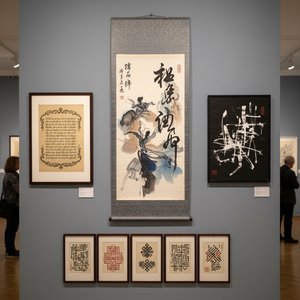
Xie Zhiguang: A Bridge Between Tradition and Modernity in Chinese Art
Xie Zhiguang (1900-1976) stands as a fascinating figure in the history of Chinese art, embodying a remarkable synthesis of traditional techniques with the burgeoning demands of a rapidly changing nation. Born into a period of significant social and political upheaval, Xie’s artistic journey reflects both the preservation of established aesthetics and an engagement with new visual languages – a duality that defines much of his compelling oeuvre. Initially trained in the rigorous traditions of the Shanghai Art Academy, he quickly distinguished himself through his mastery of ink wash painting, particularly his evocative depictions of rural life and meticulously rendered floral arrangements.
Xie’s early career was marked by a remarkable versatility. He wasn't confined to solely academic landscapes; instead, he embraced commercial art commissions – creating illustrations for calendars, advertisements, and magazine covers. This pragmatic approach provided him with invaluable experience in capturing the nuances of everyday life and adapting his style to diverse audiences. Crucially, this period also saw him working alongside Carl Crow, a prominent American journalist and collector who established a studio in Shanghai. Crow’s agency became a vital platform for Xie's development, exposing him to Western advertising techniques while simultaneously grounding him in the core principles of Chinese art.
The Influence of Zheng Xie and the Yangzhou Eight Eccentrics
Xie Zhiguang’s artistic lineage is inextricably linked to that of Zheng Xie (1708-1779), a pivotal figure within the “Yangzhou Eight Eccentrics” – a group of artists who challenged the established norms of the Qing dynasty. Like Zheng Xie, Xie Zhiguang possessed an exceptional ability to capture the essence of nature with remarkable realism and emotional depth. The Yangzhou Eight Eccentrics were celebrated for their individualistic styles and willingness to experiment, rejecting the rigid conventions of traditional painting in favor of a more expressive and personal approach. Zheng Xie’s focus on bamboo paintings, characterized by dynamic brushwork and a sense of movement, undoubtedly influenced Xie Zhiguang's own exploration of natural forms.
A Dualistic Career: From Traditional to Socialist Realism
Following the establishment of the People’s Republic of China in 1949, Xie Zhiguang’s artistic practice underwent a significant transformation. Initially, he continued to produce works rooted in traditional Chinese aesthetics – landscapes, floral paintings, and depictions of rural life—often imbued with a quiet elegance and profound appreciation for the natural world. However, as the new regime embraced socialist realism, Xie was tasked with creating propaganda art for posters and public displays. This shift saw him producing works celebrating the achievements of the revolution, often featuring idealized images of farmers, workers, and revolutionary heroes.
Despite this change in direction, Xie Zhiguang retained a remarkable degree of artistic freedom within these constraints. His later landscapes, such as “Landscape” (1970s), demonstrate a subtle yet persistent engagement with traditional motifs – mountains, rivers, and trees—while simultaneously incorporating elements of modern composition and technique. These works serve as a poignant reminder of his enduring commitment to the core principles of Chinese painting while acknowledging the evolving cultural landscape of China.
Key Works and Legacy
Xie Zhiguang’s artistic legacy is characterized by a remarkable synthesis of tradition and innovation. His paintings, particularly those depicting flowers (such as “Lady under the Plantain Leaves”) and rural scenes, offer intimate glimpses into the beauty and serenity of the Chinese countryside. His work also provides valuable insight into the social and political transformations that shaped 20th-century China. The ‘Lady under the Plantain Leaves’ exemplifies his ability to capture both the subject's likeness and the delicate details of her surroundings, showcasing a mastery of brushwork and composition. His contributions to commercial art further cemented his place as a pivotal figure in the development of visual culture during a period of dramatic change.
Xie Zhiguang’s paintings continue to be exhibited and studied today, serving as a testament to his artistic skill, cultural sensitivity, and enduring relevance. He remains an important bridge between the past and present, embodying the spirit of Chinese art's ongoing evolution.
Spørsmål og svar
Kan jeg bla gjennom Xie Zhiguang sine verk etter stemning?
Stemningsrom til Xie Zhiguang er en side som organiserer kunstnerens verk etter stemning.
Hvilke kunstverk av Xie Zhiguang har flest visninger?
Statistikk om Xie Zhiguang sine verk er tilgjengelig på kunstnerens Statistikk-side.
Hvordan finner jeg verk av Xie Zhiguang i en bestemt fargepalett?
Siden Etter fargepalett grupperer Xie Zhiguang sine kunstverk etter deres fargepaletter.