William Johnson, 1901 – 1970

William Johnson: De 100 mest kjente maleriene

Lincoln at Gettysburg III (1942) er det mest kjente maleriet av William Johnson. Street Life, Harlem (1940) og Going to Church (1941) er de to neste verkene verden kjenner best. Av de 564 verkene til William Johnson i vår katalog, er dette de 100 som samlere og museumsgjester studerer mest, inkludert årstall, museum og historien bak hvert verk.

Rangert etter vår popularitetsscore, som kombinerer søk, besøk og bestillinger for hvert verk. Oppdatert October 2026.

Portrett av William Johnson
William Johnson · 1901 – 1970
Født · død
1901 – 1970, Florence
Bevegelse
Harlem renaissance
Verker i vår katalog
564
Mest kjente
Lincoln at Gettysburg III (1942)
Flest verk hos
National Portrait Gallery

Topp 10: William Johnsons mest kjente malerier

Lincoln at Gettysburg III (1942) av William Johnson
1

Lincoln at Gettysburg III

1942 · Oil On Canvas

In this 1942 work, Lincoln at Gettysburg III, the artist William H. Johnson presents a stylized tableau of a significant historical moment. The composition avoids the literalism of traditional portraiture, opting instead for a theatrical arrangement that reimagines the gravity of the American consciousness. It is a quiet, deliberate staging of memory.

Street Life, Harlem (1940) av William Johnson
2

Street Life, Harlem

1940

The scene unfolds in 1940, captured through the hands of William H. Johnson. In this work, titled Street Life, Harlem, the artist uses oil on plywood to fix a specific moment in time. The texture of the wood provides a sturdy foundation for the figures and the urban environment they inhabit. It is a piece that belongs to the Smithsonian American Art Museum collection in Washington, D.C.

Going to Church (1941) av William Johnson
3

Going to Church

1941 · Oil

is a painting by the artist William H. Johnson. Created in 1941, the work depicts African-American life within the rural South during the 1940s. The composition focuses on a procession of figures moving through a landscape. A man is positioned at the front, guiding a mule, while other individuals follow behind in a wagon.

Marian Anderson (1945) av William Johnson
4

Marian Anderson

1945 · Oil On Canvas

In this evocative portrait of the legendary contralto Marian Anderson, the master of the Harlem Renaissance, William H. Johnson weaves a visual tapestry that transcends mere likeness to capture the very soul of an icon. Painted in 1945, the work serves as a profound tribute to a woman whose voice broke through the barriers of racial injustice to enchant the world. Johnson does not merely depict a singer; he constructs…

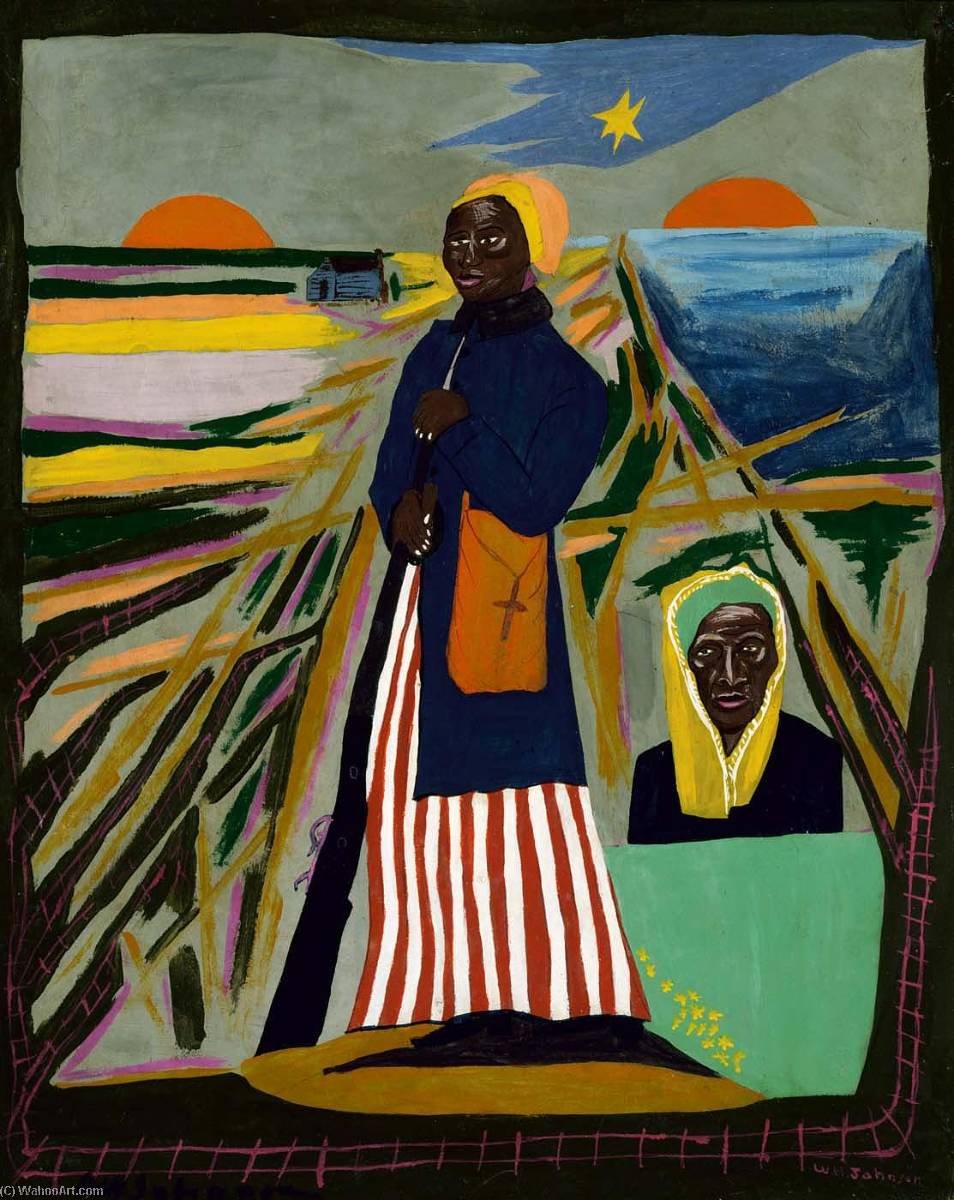
Harriet Tubman (1945) av William Johnson
5

Harriet Tubman

1945 · Oil On Paper

In this evocative portrait from 1945, the legendary William H. Johnson invites us into a dreamlike landscape where history and myth converge. The painting presents a striking composition featuring two figures standing resolutely upon a dusty, earthen road. While the title pays homage to the indomitable Harriet Tubman, the visual narrative expands into a symbolic tableau of companionship and vigilance. A man stands prominently in the foreground, his hand gripping…

Come Unto Me, Little Children (1944) av William Johnson
8

Come Unto Me, Little Children

1944 · Watercolor

This arresting piece, "Come Unto Me, Little Children," immediately draws the viewer into a scene steeped in profound spiritual resonance. It is not merely an illustration; it feels like a captured moment of communal grace, rendered with an almost visceral immediacy. The composition centers around an elevated figure whose outstretched arms suggest both blessing and welcoming embrace. Surrounding this focal point are figures depicted in postures of deep reverence—kneeling, attentive,…

Army Training (1944) av William Johnson
9

Army Training

1944 · Oil

In 1944, William H. Johnson produced Army Training, a work characterized by a flattened perspective and a rhythmic, horizontal arrangement of figures. A group of men is positioned in a single line across the canvas, their bodies rendered with geometric simplicity. The composition relies on strong, dark outlines to define the silhouettes of the soldiers against a background of warm, earthy tones. Deep yellows, rich browns, and resonant reds dominate…

Resten av William Johnson-rangeringen, fra 11 til 100

Sowing (III) (1941) av William Johnson
#16

Sowing (III)

1941

In the evocative masterpiece Sowing (III), created in 1941, the legendary American artist William H. Johnson invites us into a soulful moment of agricultural rhythm and communal strength.…

Off to Market (1941) av William Johnson
#17

Off to Market

1941

In the evocative masterpiece "Off to Market," painted in 1941, William H. Johnson invites us into a world that transcends mere landscape, offering instead a rhythmic, soulful window…

Taj, Agra (1880) av William Johnson
#18

Taj, Agra

1880

The Taj Mahal, built between 1632 and 1643 under the Mughal emperor Shah Jahan (reigned 1627–1658) for his favorite wife, Mumtaz Mahal, is one of the most photographed…

Art Class Three Men (1940) av William Johnson

In the evocative masterpiece Art Class Three Men, created in 1940, the legendary William H. Johnson invites viewers into a moment of profound creative communion. The painting captures…

Danish Street with Houses and Tree (1934) av William Johnson

This evocative black and white drawing, titled "Danish Street with Houses and Tree," transports the viewer to a moment suspended in quiet nostalgia. The composition is masterfully balanced,…

Mother and Child (1945) av William Johnson
#27

Mother and Child

1945

William Henry Johnson's "Mother and Child," created in 1945, is a deeply moving depiction of maternal love and familial connection. This artwork, housed within the Smithsonian American Art…

Fright (1942) av William Johnson
#29

Fright

1942 · Smithsonian American Art Museum
Paul Robeson's Relations (1945) av William Johnson

In the profound and visually arresting masterpiece Paul Robeson's Relations, created in 1945, William H. Johnson invites the viewer into a surreal, dreamlike landscape where the boundaries between…

Children's Dance (1941) av William Johnson
#49

Children's Dance

1941

The painting depicts a group of children playing in a lush, green outdoor setting. There are four primary figures in the scene: one child stands on the left,…

Lamentation av William Johnson

The composition centers on a stark silhouette of a cross, around which a gathering of figures converges in a shared ritual of grief. This scene captures a moment…

Barefoot Seated Woman in Green Jacket (1940) av William Johnson

In the quiet presence of William H. Johnson’s Barefoot Seated Woman in Green Jacket, one finds an intimate dialogue between the viewer and a moment of profound stillness.…

Volunteer Workers (1944) av William Johnson

In the vibrant, rhythmic brushstrokes of William H. Johnson’s 1944 masterpiece, Volunteer Workers, we are transported to the heart of a rural African American community, where the pulse…

Farm Couple at Work (1944) av William Johnson

In the evocative masterpiece Farm Couple at Work, created in 1944 by the legendary William H. Johnson, we are invited into a world that transcends mere rural documentation…

Nat Turner (1945) av William Johnson
#58

Nat Turner

1945

The air hangs thick and still around the central figure, a man suspended in a moment of profound, agonizing stillness. He wears a suit and tie, a formal…

Folk Scene Man with Banjo (1944) av William Johnson

In the evocative masterpiece Folk Scene Man with Banjo, created in 1944, the legendary William H. Johnson invites viewers into a soulful, rhythmic world where music and community…

Still Life Fruit, Bottles (1939) av William Johnson

The painting Still Life Fruit, Bottles is a work by the artist William H. Johnson. Created in 1939, this piece belongs to the genre of still life. It…

Sowing (1942) av William Johnson
#61

Sowing

1942 · Gibbes Museum of Art

William H. Johnson’s painting, Sowing (1942), transports the viewer into a sun-drenched tableau of rural existence. It is more than just a depiction of figures walking through the…

Bust of Man in Blue Jacket and Red Tie (1940) av William Johnson

In the captivating oil on canvas titled Bust of Man in Blue Jacket and Red Tie, we are invited into an intimate encounter with a figure that commands…

Study for Sun Setting, Denmark (1930) av William Johnson

In the quietude of 1930, William H. Johnson captured a moment of profound stillness in his work, Study for Sun Setting, Denmark. This evocative painting invites the viewer…

John Brown Legend (1945) av William Johnson

In the profound and evocative masterpiece John Brown Legend, created in 1945, William H. Johnson invites viewers into a dreamlike realm where history and folklore collide. This complex,…

Folk Family (1940) av William Johnson
#65

Folk Family

1940

In the 1940 painting Folk Family, three figures are positioned on a red chair against a neutral background. A man, a woman, and a child occupy the center…

Bearded Kneeling Male Nude (1940) av William Johnson

In the hauntingly evocative oil painting Bearded Kneeling Male Nude, created in 1940 by the visionary American artist William H. Johnson, we are confronted with a moment of…

Early Morning Work (1940) av William Johnson

The amber light of 1940 filters through a soft, morning haze, casting a warm glow over a scene of profound stillness in the American South. A man, a…

Trees, Fjord and Mountains, Norway (1938) av William Johnson

Gazing upon this watercolor, "Trees, Fjord and Mountains, Norway," one is immediately transported to a place of breathtaking, untamed grandeur. The scene unfolds with the delicate yet powerful…

Henry Lawson (1915) av William Johnson
#70

Henry Lawson

1915 · National Portrait Gallery

In this evocative portrait of Henry Lawson, we encounter more than just a likeness; we step into the soul of an Australian icon. Captured in a moment of…

Self Portrait with Pipe (1937) av William Johnson

In the profound depths of Self Portrait with Pipe, created in 1937, we encounter not merely a likeness, but a visceral manifestation of identity and creative spirit. This…

Jim (1930) av William Johnson
#72

Jim

1930

The young man sits within the quiet gravity of a room, his gaze fixed directly upon the viewer. He wears a red jacket, a bold weight of color…

Apple Blossoms, Norheimsund, Hardanger (1938) av William Johnson

In the evocative landscape of Apple Blossoms, Norheimsund, Hardanger, we are transported to a moment where the raw power of nature meets the delicate ephemeral beauty of spring.…

Any Person May Kill and Destroy Said Slaves (1798) av William Johnson
#74

Any Person May Kill and Destroy Said Slaves

1798 · The Kinsey African American Art - History Collection

In the profound and often unsettling depths of American history, few visual narratives command as much visceral attention as "Any Person May Kill and Destroy Said Slaves" by…

Family Portrait (1944) av William Johnson
#75

Family Portrait

1944

The painting titled Family Portrait was created by the artist William H. Johnson. This work is a portrait executed in 1944. It depicts a domestic scene involving a…

Historical Scene (1945) av William Johnson
#76

Historical Scene

1945

In the profound stillness of 1945, as the echoes of global conflict began to settle into the heavy atmosphere of a changing world, William H. Johnson captured something…

Kerteminde Landscape (1932) av William Johnson

In the delicate dance of watercolor and light, Kerteminde Landscape emerges as a breathtaking testament to the expressive power of early 20th-century modernism. Created in 1932 by the…

Portrait of a Boy (1938) av William Johnson

In the quiet, evocative strokes of Portrait of a Boy, we encounter one of the most profound voices of the Harlem Renaissance. Painted in 1938, this work serves…

Farm Couple (1940) av William Johnson
#79

Farm Couple

1940

In the evocative watercolor "Farm Couple," created in 1940 by the master of American folk modernism, William H. Johnson, we are invited into a world that breathes with…

Seated Female Nude in Landscape (1940) av William Johnson

In the evocative masterpiece Seated Female Nude in Landscape, the legendary William H. Johnson invites viewers into a world where the boundaries between the human spirit and the…

Crispus Attucks (1945) av William Johnson
#82

Crispus Attucks

1945

William H. Johnson’s depiction of Crispus Attucks is far more than a mere historical tableau; it is a vibrant, emotionally charged gathering that pulls the viewer into a…

Farewell (1942) av William Johnson
#83

Farewell

1942

In the evocative watercolor "Farewell," created in 1942 by the master of the Harlem Renaissance, William H. Johnson, we are transported to a pivotal moment in American history.…

Seated Man in Green Chair (1940) av William Johnson

In the quietude of 1940, William H. Johnson captured a moment of profound stillness that transcends the simple act of sitting. Seated Man in Green Chair is not…

Seated Semi Nude Woman in Purple Playsuit (1940) av William Johnson

In the evocative masterpiece Seated Semi Nude Woman in Purple Playsuit, created in 1940, we are invited into a private, introspective world. The painting centers on a woman…

Going to Market (1940) av William Johnson
#86

Going to Market

1940

William H. Johnson’s Going to Market, painted in 1940, immediately immerses the viewer into a scene bursting with kinetic energy and rich human activity. This is no mere…

Woman Ironing (1944) av William Johnson
#87

Woman Ironing

1944

A quiet domestic scene unfolds within a sunlit room, centered on a woman engaged in the rhythmic labor of ironing. She stands beside a bed, her presence anchored…

Henry Lawson (1915) av William Johnson
#88

Henry Lawson

1915 · National Portrait Gallery

Henry Lawson (1867–1922), one of Australia’s best-known authors, wrote short stories and ballads depicting the hardship of bush life. Lawson spent his childhood on a poor selection in…

Henry Lawson (1915) av William Johnson
#89

Henry Lawson

1915 · National Portrait Gallery

Henry Lawson (1867–1922), one of Australia’s best-known authors, wrote short stories and ballads depicting the hardship of bush life. Lawson spent his childhood on a poor selection in…

Seated Female Nude on Brown Chair (1940) av William Johnson

In the evocative masterpiece Seated Female Nude on Brown Chair, created in 1940, the viewer is immediately transported into a world where color breathes and form dances. This…

Portrait of Ilya Bolotowsky (1930) av William Johnson

In the quiet, introspective depths of William H. Johnson’s 1930 masterpiece, Portrait of Ilya Bolotowsky, we encounter more than just a likeness; we meet a profound psychological landscape.…

Bazaars behind Church, Oslo (1935) av William Johnson

Gazing upon William Henry Johnson’s "Bazaars behind Church, Oslo," one is immediately transported across the sea and into the vibrant heart of a Nordic port city. This watercolor…

Under Fire (1942) av William Johnson
#93

Under Fire

1942

In the evocative painting Under Fire, created in 1942 by the master William H. Johnson, we are transported to a pivotal moment of historical tension and human movement.…

Seated Woman in Green and Yellow Dress (1940) av William Johnson

In the quiet intensity of Seated Woman in Green and Yellow Dress, we encounter one of the most profound psychological portraits of the twentieth century. Painted in 1940,…

Seated Woman in Red Playsuit (1940) av William Johnson

In the evocative masterpiece Seated Woman in Red Playsuit, created in 1940, the legendary American artist William H. Johnson invites us into a world where modernism meets a…

Peace (1940) av William Johnson
#96

Peace

1940

In the quietude of 1940, William H. Johnson captured a scene that transcends the boundaries of time and medium. His work, Peace, serves as a profound meditation on…

Midnight Sun, Lofoten (1937) av William Johnson

In the evocative masterpiece Midnight Sun, Lofoten, created in 1937, the viewer is transported to a realm where the boundaries between reality and emotion dissolve into a breathtaking…

Jolster (1936) av William Johnson
#98

Jolster

1936

In the evocative landscape of William H. Johnson, nature is never merely a backdrop; it is a living, breathing protagonist. His 1936 masterpiece, Jolster, invites the viewer into…

Women Builders (1945) av William Johnson
#99

Women Builders

1945

In the profound landscape of American modernism, few voices resonate with as much rhythmic vitality and soulful depth as William H. Johnson. His 1945 masterpiece, Women Builders, serves…

Off to War (1944) av William Johnson
#100

Off to War

1944

Off to War is an oil on plywood painting by William H. Johnson. Created ca. 1942-1944, the work captures a specific moment of departure. The artist, William H.…

Motivene William Johnson malte mest av

De fire motivene som forekommer hyppigst blant disse mesterverkene, med det fremste eksemplet på hvert av dem.

Hvor du kan se maleriene til William Johnson

De 4 museene som innehar flest av maleriene på denne siden.

Museum By Verker av William Johnson Malerier fra denne listen
National Portrait Gallery, CanberraNational Portrait Gallery Canberra 3 Henry Lawson, Henry Lawson, Henry Lawson
Smithsonian American Art Museum, Washington, D.C.Smithsonian American Art Museum Washington, D.C. 3 Fright
The Kinsey African American Art - History Collection, Los AngelesThe Kinsey African American Art - History Collection Los Angeles 2 Any Person May Kill and Destroy Said Slaves
Gibbes Museum of Art, CharlestonGibbes Museum of Art Charleston 1 Sowing

William Johnson gjennom tiårene: et mesterverk for hvert tiår

  1. 1910s
    Henry Lawson (1915) av William Johnson
    Nr. 70 av 100

    Henry Lawson

    Alder 9 – 18 · National Portrait Gallery

    In this evocative portrait of Henry Lawson, we encounter more than just a likeness; we step into the soul of an Australian icon. Captured in a moment of…

  2. 1930s
  3. 1940s
    Lincoln at Gettysburg III (1942) av William Johnson
    Nr. 1 av 100

    Lincoln at Gettysburg III

    Alder 39 – 48

    In this 1942 work, Lincoln at Gettysburg III, the artist William H. Johnson presents a stylized tableau of a significant historical moment. The composition avoids the literalism of…

William Johnsons malerier: ofte stilte spørsmål

Hva er det mest kjente maleriet av William Johnson?Vis svaret

Lincoln at Gettysburg III (1942). Deretter følger Street Life, Harlem (1940) og Going to Church (1941).

Hvor gammel var William Johnson da Lincoln at Gettysburg III ble malt?Vis svaret

41 år gammel: Lincoln at Gettysburg III er fra 1942, og William Johnson ble født i 1901.

Hvilke er de 10 mest kjente maleriene til William Johnson?Vis svaret

Lincoln at Gettysburg III, Street Life, Harlem, Going to Church, Marian Anderson, Harriet Tubman, The Red Road, Kerteminde Harbor, Come Unto Me, Little Children, Army Training og Kerteminde, Denmark. Rangeringen ovenfor viser årstallet og museet for hvert av dem.

Hvor mange malerier av William Johnson finnes det?Vis svaret

Vår katalog inneholder 564 verk av William Johnson, datert fra 1915 til 1945.

Hvor kan jeg se de mest kjente maleriene til William Johnson?Vis svaret

De fleste av dem befinner seg i National Portrait Gallery (Canberra), Smithsonian American Art Museum (Washington, D.C.) og The Kinsey African American Art - History Collection (Los Angeles). Tabellen ovenfor lister opp museene ett etter ett.

I hvilken periode malte William Johnson sine mest kjente verk?Vis svaret

I 1940s: 70 av de 100 verkene på denne siden er fra denne perioden, inkludert Lincoln at Gettysburg III.

Hva er det tidligste kjente maleriet av William Johnson, og hva er det nyeste?Vis svaret

Det eldste på denne siden er Henry Lawson (1915), det nyeste Marian Anderson (1945).

Hvilke motiver malte William Johnson?Vis svaret

Portrait (16), African american (15) og Folk art (11), blant de 100 verkene på denne siden.

Hva malte William Johnson på, og med hva?Vis svaret

Oil On Canvas: 31 av 100 verk på denne siden.

Hvilken kunstretning tilhører kunsten til William Johnson?Vis svaret

Harlem renaissance og Modernism, som maleriene på denne siden viser.

Hvilke malerier av William Johnson har National Portrait Gallery i sin samling?Vis svaret

Henry Lawson, Henry Lawson og Henry Lawson er blant de 3 verkene på denne siden som er i National Portrait Gallery, Canberra sin samling.

William Johnson: biografi

En Pioner av Harlemrenessansen: William H. Johnsons Liv og Virke

William Henry Johnson (1901–1970) er en sentral skikkelse i amerikansk kunsthistorie, spesielt innenfor den pulserende veven av Harlemrenessansen. Født i Florence, Sør-Carolina, begynte hans kunstneriske reise midt i kompleksiteten av Jim Crow-Amerika, noe som formet hans verdensbilde og dypt påvirket hans særegne visuelle språk – en blanding av modernistisk abstraksjon og dype folketradisjoner som fortsetter å resonere den dag i dag. Johnsons formative år innga ham en dyp forbindelse til afroamerikansk kultur og spiritualitet. Han absorberte innflytelser fra gospelmusikk, historiefortellingstradisjoner nedarvet gjennom generasjoner, og ikonografien av Yoruba-religionen, elementer som ble integrert i hans kunstneriske prosess. Denne forankringen i muntlig tradisjon overførte seg til lerret fulle av symbolsk billedspråk – ånder, dyr og geometriske mønstre – som formidlet fortellinger om kamp, utholdenhet og åndelig transcendens. Hans kunstneriske utvikling utfoldet seg på tvers av kontinenter, fra Europa til Mexico, hvor han finpusset sine ferdigheter ved å eksperimentere med ulike medier, inkludert oljemaling, akvarell og collage. Han omfavnet teknikker som impasto – påføring av tykke lag med pigment – for å gi maleriene hans en håndgripelig tekstur og emosjonell intensitet. Denne tilnærmingen speilet den ekspressive gløden karakteristisk for ekspresjonismen, men Johnson opprettholdt en unik estetikk forankret i hans personlige arv.

Reisen gjennom Kontinenter: Formative År og Kunstnerisk Utvikling

Etter å ha fullført studiene ved National Academy of Design i New York City, søkte Johnson nye horisonter i Paris på 1920-tallet. Her ble han eksponert for avantgarde-bevegelser som kubismen og fauvismen, men fant raskt sin egen stemme, distinkt fra de dominerende europeiske stilene. Hans tid i Europa var preget av eksperimentering med form og farge, og en økende interesse for afrikansk kunst og kultur. Senere opphold i Mexico på 1930-tallet introduserte ham for veggmaleriets kraft og den levende folketradisjonen som gjennomsyrer meksikansk kunst. Disse erfaringene smeltet sammen til en unik stil som kombinerte modernistiske teknikker med et dypt rotfestet engasjement for afroamerikanske temaer.

Et Mangfold av Motiver: Portretter, Landskap og Spirituelle Visjoner

Johnsons oeuvre er preget av en fantastisk variasjon i motiver – portretter som fanger verdigheten og robustheten til afroamerikanere, landskaper som skildrer skjønnheten i det rurale Sør-Carolina, og fantastiske visjoner som utforsker temaer om mytologi og spiritualitet. Han malte ofte mennesker fra sitt lokalsamfunn, portretterende arbeidere, familier og religiøse figurer med en sårbarhet og verdighet som var uvanlig for sin tid. Arbeider som “The Black Christ” (1938), et monumentalt lerret infundert med Yoruba-symbolikk som kraftfullt kommuniserer tro og medfølelse, er sentrale eksempler på hans evne til å forene personlige erfaringer med universelle temaer. "The Great Spirit" (1964) legemliggjør Johnsons utforskning av sjamanistisk billedspråk og åndelig søken; og “Black Boy” (1937), en gripende skildring av ungdommelig uskyld som konfronterer motgang, er et annet bemerkelsesverdig verk.

Teknikk og Symbolikk: Impasto, Farge og Åndelig Betydning

Johnsons maleteknikk var like særegen som hans motivvalg. Han brukte ofte impasto – påføring av tykke lag med pigment – for å skape en taktil overflate som ga maleriene hans dybde og tekstur. Denne teknikken bidro til å formidle den emosjonelle intensiteten i verkene hans, og understreket deres kraftfulle budskap. Farge spilte også en viktig rolle i Johnsons kunst. Han brukte ofte sterke, levende farger for å skape en følelse av energi og bevegelse, og symbolikken i fargene han valgte var ofte knyttet til afrikansk kultur og spiritualitet. I tillegg til farge og tekstur, brukte Johnson også et rikt billedspråk fullt av symboler – ånder, dyr og geometriske mønstre – for å formidle komplekse ideer om kamp, utholdenhet og åndelig transcendens.

Et Varig Arv: Utdanning, Innflytelse og Historisk Betydning

Utover sine kunstneriske prestasjoner strekker William H. Johnsons arv seg til hans rolle som pedagog og mentor, fremme av talentene til yngre kunstnere som omfavnet lignende stilistiske utforskninger. Hans innflytelse kan sees i påfølgende generasjoner av afroamerikanske malere som søkte å artikulere opplevelser av identitet og kulturell arv gjennom innovative visuelle vokabularer. I dag er Johnsons malerier huset i prestisjetunge museer over hele verden – inkludert Smithsonian American Art Museum og Hampton University Museum – et testament til deres varige kunstneriske verdi og historiske betydning som symboler på Harlemrenessansens forpliktelse til å skildre svart liv med ærlighet og verdighet. Hans arbeid fortsetter å inspirere og utfordre oss til å reflektere over spørsmål om rase, identitet og den transformative kraften i kunsten.