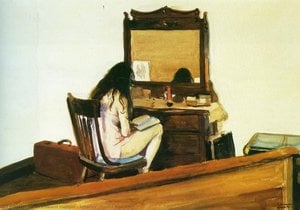
Edward Hopper, 1882 – 1967

The 100 Most Famous Paintings by Edward Hopper

The painting that made Edward Hopper famous is Natteugler, Kunstinstituttet i Chicago, Chica (1942); it hangs in the Art Institute of Chicago, Chicago. Automat (small) and Hus ved jernbanen (1925) follow it in the hearts of collectors and museum visitors. Of the 366 works by Edward Hopper in our catalogue, these 100 are the most admired, each presented with its date, its museum and what sets it apart.

Ranked by our popularity score, which combines the searches, visits and orders for each work. Updated October 2026.

Portrait of Edward Hopper
Edward Hopper · 1882 – 1967
Born · died
1882 – 1967, Upper Nyack
Movement
Samtidig realisme
Works in our catalogue
366
Most famous
Natteugler, Kunstinstituttet i Chicago, Chica (1942)
Most works at
MoMA - Museum of Modern Art

Edward Hopper: the ten masterpieces

Natteugler, Kunstinstituttet i Chicago, Chica (1942) by Edward Hopper
1

Natteugler, Kunstinstituttet i Chicago, Chica

1942 · Olje på lerret · Art Institute of Chicago, Chicago

Skapt i 1942, fanger dette ikoniske maleriet en sen nattscene inne i en døgnåpen diner, og har blitt et av de mest gjenkjennelige bildene i amerikansk kunst. Mer enn bare en fremstilling av urbant liv, er det en dyp utforskning av moderne fremmedgjøring og den stille ensomheten som finnes selv midt i pulserende bylandskap. Hoppers verk resonerer med oss fordi det berører noe universelt – følelsen av å være alene…

Automat (small) by Edward Hopper
2

Automat (small)

Acrylic On Canvas · Des Moines Art Center, Des Moines

Edward Hopper’s “Automat” (small), a deceptively simple depiction of a woman seated alone at a cafe table, is a masterclass in conveying the profound sense of solitude that characterized much of 20th-century American life. Painted during a period of rapid urbanization and social change, this work resonates with a quiet melancholy that speaks to the alienation inherent in modern existence. Hopper’s ability to capture fleeting moments of human experience –…

Hus ved jernbanen (1925) by Edward Hopper
3

Hus ved jernbanen

1925 · Olje på lerret · MoMA - Museum of Modern Art, New York City

Introduction to Edward Hopper and His Work Edward Hopper, a renowned American artist, is celebrated for his captivating oil paintings that often depicted modern life in the early 20th century. One of his most notable works is "House by the Railroad," which is currently housed at the Museum of Modern Art (New York, United States). This painting, created in 1925, showcases Hopper's unique style and ability to evoke a sense…

New York Movie (1939) by Edward Hopper
4

New York Movie

1939 · Akryl på lerret · MoMA - Museum of Modern Art, New York City

Maleriet "CITE>New York Movie" av Edward Hopper er et gripende oljemaleri på lerret fra 1939. Verket er i dag innlemmet i den prestisjetunge samlingen til Museum of Modern Art (MoMA) i New York City, USA. Dette mesterverket eksemplifiserer Hoppers unike evne til å fange essensen av det urbane livet, med et vedvarende fokus på temaer som isolasjon og ettertanke. Komposisjon og symbolikk Maleriet skildrer en kvinne som står alene foran…

untitled (5560) by Edward Hopper
5

untitled (5560)

Oil On Canvas · MoMA - Museum of Modern Art, New York City

Edward Hopper's untitled (5560) is far more than a mere depiction of a roadside service station; it is a distilled essence of the American experience, a moment frozen in time that speaks volumes about human connection and the profound weight of isolation. Painted during the transformative years between 1942 and 1945, this monochrome masterpiece captures a scene familiar to the mid-century traveler—the late-night glow of artificial light illuminating a sparsely…

Early sunday morning Whitney Museum of American (1930) by Edward Hopper
6

Early sunday morning Whitney Museum of American

1930 · Oil On Canvas · Whitney-museet for amerikansk kunst, New York

Early Sunday Morning: A Portrait of Quietude Edward Hopper’s “Early Sunday Morning,” painted in 1930, isn't merely a depiction of a New York City street; it’s an arresting distillation of the anxieties and aspirations inherent in the American psyche during the Depression era. Executed in oil paint on canvas, this iconic piece exemplifies Hopper’s signature style – American Scene Painting—characterized by stark realism combined with a palpable sense of solitude…

Automat (1927) by Edward Hopper
7

Automat

1927 · Olje på lerret

Edward Hoppers "Automat" fra 1927 er mer enn bare et maleri; det er en atmosfærisk skildring av amerikansk liv i begynnelsen av det 20. århundre, fylt med en underliggende følelse av ensomhet og introspeksjon. Bildet, som nå henger på Des Moines Art Center, inviterer oss inn i et dempet interiør – en automat, en type selvbetjeningsrestaurant populær på den tiden, hvor en kvinne sitter alene ved et rundt bord og…

Søndag (1926) by Edward Hopper
8

Søndag

1926 · Olje på lerret · The Phillips Collection, Washington, D.C.

Essensen av urban ensomhet Edward Hoppers "Søndag" fanger stillheten og introspeksjonen i en urban scene på det som ser ut til å være en søndag morgen. Maleriet viser en ensom mann som sitter på en trebenk foran lukkede butikkvinduer, noe som fremkaller en følelse av ensomhet og ettertanke som er karakteristisk for Hoppers arbeid. Dette verket er en mesterlig utforskning av den menneskelige tilstand, satt mot bakteppet av det tidlige…

Gass (1940) by Edward Hopper
9

Gass

1940 · Olje på lerret

Edward Hopper’s «Gas»: En stille refleksjon over amerikansk ensomhet Edward Hoppers «Gas» fra 1940 er mer enn bare et bilde av en bensinstasjon; det er et innblikk i den amerikanske psyken, et poetisk øyeblikk fanget i tid. Maleriet fanger essensen av ensomhet og nostalgi, og inviterer oss til å dele et stille møte med en verden som ofte føles både kjent og fremmed. Hopper var en mester i å skildre…

Chop Suey (1929) by Edward Hopper
10

Chop Suey

1929 · Olje på lerret

Edward Hoppers "Chop Suey", malt i 1929, er mer enn bare et bilde av en kafé; det er et vindu inn i hjertet av amerikansk liv på begynnelsen av 1900-tallet. Billedet fanger essensen av en tid preget av raske endringer og en følelse av ensomhet, noe Hopper var mester i å formidle gjennom sine arbeider. "Chop Suey" er et eksempel på hans signaturstil – en blanding av amerikansk realisme med…

More Edward Hopper masterpieces, 11 to 100

Kontor om natten (1940) by Edward Hopper
#11

Kontor om natten

1940

Et glimt inn i det amerikanske 1900-tallet Edward Hoppers «Kontoret om natten» (1940) er en mesterlig skildring av et kontormiljø fra midten av det 20. århundre. Dette maleriet…

Sommerstid (1943) by Edward Hopper
#12

Sommerstid

1943

Edward Hoppers “Summertime”, malt i 1943, er mer enn bare et bilde av en kvinne på trapper. Det er et innblikk i den amerikanske sjelen under krigens usikre…

Solglødskaféen (1958) by Edward Hopper
#13

Solglødskaféen

1958 · Yale University Art Gallery

Edward Hoppers Sunlight in a Cafeteria (1958) er en mesterlig skildring av urban ensomhet, gjengitt med den presisjonen og emosjonelle dybden som definerer hans ikoniske stil. Dette oljemaleriet…

Folk i solen (1960) by Edward Hopper
#14

Folk i solen

1960

Edward Hopper, et navn som er umiskjennelig knyttet til stillhet og subtil melankoli i det 20. århundrets amerikanske liv, var mer enn bare en maler av scener; han…

Cape Cod Morning (1950) by Edward Hopper
#15

Cape Cod Morning

1950

Et øyeblikk av stille refleksjon: Edward Hoppers mesterverk Scenen: En kvinne i kontemplasjon Edward Hoppers "Cape Cod Morning" fanger et fredfullt, men likevel fascinerende øyeblikk av ensomhet. Maleriet…

Rom for Turister (1945) by Edward Hopper
#16

Rom for Turister

1945 · Yale University Art Gallery

Edward Hopper's "Rooms for Tourists," painted in 1945, isn’t merely a depiction of a house; it’s an immersion into the quiet loneliness that often defines the American experience.…

nighthawks (1942) by Edward Hopper
#17

nighthawks

1942 · Art Institute of Chicago

A Window Into Loneliness: Exploring Edward Hopper’s Nighthawks Edward Hopper's "Nighthawks," completed in 1942 during the tumultuous backdrop of World War II, transcends mere representation; it embodies a…

Vogn C, Seksjon C by Edward Hopper
#18

Vogn C, Seksjon C

er et kroneksempel på Hoppers fascinasjon for ensomme skikkelser på gjennomreise. Maleriet skildrer en kvinne som sitter alene i en togkupé; ansiktet er vendt mot boken hennes, mens…

To Komikere (1965) by Edward Hopper
#19

To Komikere

1965

Edward Hopper’s 1965 maleri, «To Komikere», er ikke bare en skildring av to personer på en scene; det er en nøye konstruert meditering over ensomhet, den flyktige naturen…

New York Movie, MoMA, NY (1939) by Edward Hopper
#21

New York Movie, MoMA, NY

1939

Kunstverket skildrer et dunkelt opplyst rom – kanskje en hotellobby eller en storslått leilighet – befolket av en håndfull skikkelser. Komposisjonen er bevisst kompleks og skaper en følelse…

Summer Evening (1947) by Edward Hopper
#22

Summer Evening

1947

A Portrait of Quietude: Exploring Edward Hopper’s “Summer Evening” Edward Hopper's "Summer Evening" isn’t merely a depiction of a scene; it’s an exquisitely crafted meditation on human experience—a…

Hotel room (1931) by Edward Hopper
#23

Hotel room

1931

The Poignant Stillness of a Private Moment In Edward Hopper’s 1931 masterpiece, Hotel Room, the viewer is invited into a sanctuary of profound introspection. The scene is deceptively…

Excursion into Philosophy by Edward Hopper
#24

Excursion into Philosophy

A Quiet Drama: Unveiling Edward Hopper’s “Excursion into Philosophy” Edward Hopper's "Excursion into Philosophy" is a profoundly evocative work that encapsulates the core tenets of American Realism, offering…

The Cat Boat (1922) by Edward Hopper
#25

The Cat Boat

1922 · Smithsonian American Art Museum

Edward Hopper's “The Cat Boat,” created in 1922, stands as a quintessential emblem of American Modernism—a deceptively simple scene imbued with profound psychological depth. More than just depicting…

Rooms By The Sea (1951) by Edward Hopper
#26

Rooms By The Sea

1951

Rooms By The Sea: A Portrait of Quiet Contemplation Edward Hopper’s “Rooms by the Sea” transcends mere depiction; it's a distillation of mood, an embodiment of American Modernism’s…

Reclining Nude (1927) by Edward Hopper
#27

Reclining Nude

1927

Introduction Reclining Nude, a watercolour painting by Edward Hopper, is a quintessential example of the artist's unique style and contribution to the New Realism movement. Created in 1927,…

Rooms by the Sea (1951) by Edward Hopper
#28

Rooms by the Sea

1951

The Painting: A Representation of Serenity "CITE>Edward Hopper's 'Rooms by the Sea' (1951) is a masterpiece that embodies the essence of stillness and contemplation. The painting, available for…

House At Dusk (1935) by Edward Hopper
#29

House At Dusk

1935

The Painting: An Overview "CITE>Edward Hopper:CITE>'s House At Dusk, created in 1935, is a quintessential example of the artist's ability to capture the essence of American life through…

Apotek (1927) by Edward Hopper
#30

Apotek

1927 · Museum of Fine Arts

Et Stille Øyeblikk i Byen: En Utforskning av Edward Hoppers «Drug Store» (1927) «Drug Store,» malt i 1927 av den amerikanske mesteren Edward Hopper, er en rørende fremstilling…

Sun on Prospect Street (Gloucester, Massachusetts) (1934) by Edward Hopper
#31

Sun on Prospect Street (Gloucester, Massachusetts)

1934

Edward Hopper's "Sun on Prospect Street" isn't merely a depiction of a Gloucester street scene; it’s a distilled essence of early 20th-century American experience. Painted in 1934, during…

Woman in the Sun (1961) by Edward Hopper
#32

Woman in the Sun

1961

A Moment Frozen in Light: Edward Hopper’s “Woman in the Sun” Edward Hopper's "Woman in the Sun," painted in 1961, isn’t merely a depiction of a nude figure;…

Second Story Sunlight (1960) by Edward Hopper
#33

Second Story Sunlight

1960

A Moment Suspended: Unveiling Edward Hopper’s “Second Story Sunlight” Edward Hopper's 1960 oil on canvas, *Second Story Sunlight*, is a quintessential example of American Realism at its most…

Night Windows (1928) by Edward Hopper
#34

Night Windows

1928 · MoMA - Museum of Modern Art

A Window Into Solitude: Exploring Edward Hopper’s Night Windows Edward Hopper, a name synonymous with the quiet contemplation of modern existence, wasn't merely capturing landscapes; he was distilling…

New York Office (1962) by Edward Hopper
#35

New York Office

1962

Edward Hopper’s “New York Office,” painted in 1962, transcends mere depiction; it embodies the very essence of modern solitude—a feeling profoundly familiar to viewers grappling with the complexities…

Office in a Small City (1953) by Edward Hopper
#36

Office in a Small City

1953

In the vast gallery of American Realism, few works possess the haunting, cinematic stillness found in Edward Hopper’s 1953 masterpiece, Office in a Small City. To gaze upon…

Byens tak (1932) by Edward Hopper
#37

Byens tak

1932

Et stille øyeblikk av urban eksistens Edward Hoppers «City Roofs» (1932) er mer enn bare en skildring av et bylandskap; det er en gripende meditasjon over det moderne…

Self-Portrait (1930) by Edward Hopper
#38

Self-Portrait

1930

This oil on canvas painting depicts a man wearing a brown hat and a blue shirt. He is shown with a serious expression, looking directly at the viewer.…

Hus på Monhegan, Maine by Edward Hopper
#39

Hus på Monhegan, Maine

Introduksjon til amerikansk realisme Edward Hopper, en fremtredende amerikansk realistisk maler, er viden kjent for sine fengslende oljemalerier som skildrer både urbane og rurale scener. Hans unike stil…

Four Lane Road by Edward Hopper
#40

Four Lane Road

Edward Hopper's "Four Lane Road," painted in 1956, isn’t merely a depiction of a roadside scene; it’s a distilled essence of the American experience – a poignant meditation…

Woman at Cafe Table (1907) by Edward Hopper
#41

Woman at Cafe Table

1907 · Whitney-museet for amerikansk kunst

Woman at Cafe Table: A Portrait of Urban Isolation Edward Hopper’s “Woman at Cafe Table,” painted in 1906-1907, stands as a quintessential emblem of New Realism and embodies…

First Row Orchestra (1951) by Edward Hopper
#42

First Row Orchestra

1951 · Hirshhorn Museum and Sculpture Garden

A Portrait of Quiet Observation: Exploring Edward Hopper’s “First Row Orchestra” Edward Hopper's "First Row Orchestra," painted in 1951, transcends mere depiction; it embodies the very essence of…

House by the Railroad by Edward Hopper
#43

House by the Railroad

In his 1925 masterpiece, House by the Railroad, Edward Hopper presents a scene that captures a profound sense of isolation through a meticulously controlled interplay of light and…

untitled (3714) by Edward Hopper
#44

untitled (3714)

Edward Hopper's "Untitled (3714)," painted in 1942, isn’t merely a depiction of a diner interior; it’s a distilled essence of modern American loneliness. This deceptively simple scene—an elderly…

el palacio (1946) by Edward Hopper
#45

el palacio

1946

Edward Hopper’s 1946 painting, “El Palacio,” isn’t merely a depiction of a city street; it’s a carefully constructed tableau of urban solitude and the quiet anxieties of modern…

the city (1927) by Edward Hopper
#46

the city

1927

The City, painted by Edward Hopper in 1927, is a striking black and white depiction of early 20th-century American urban life. This artwork isn't merely a representation of…

rooms by the sea by Edward Hopper
#47

rooms by the sea

Edward Hopper’s Rooms by the Sea is a painting from 1951 that depicts an interior space with a doorway opening toward the ocean. The scene features a room…

The Camel's Hump (1931) by Edward Hopper
#49

The Camel's Hump

1931

Edward Hopper's "The Camel’s Hump," painted in 1931, isn’t merely a depiction of a mountain range; it’s a distilled essence of American loneliness and the quiet drama unfolding…

the el station by Edward Hopper
#50

the el station

In the quiet, heavy atmosphere of Edward Hopper’s “The El Station,” we are invited into a moment suspended in time, where the bustling energy of the American metropolis…

Dawn in Pennsylvania (1942) by Edward Hopper
#51

Dawn in Pennsylvania

1942

A Solitary Glimpse: Dawn in Pennsylvania by Edward Hopper Edward Hopper’s *Dawn in Pennsylvania*, painted in 1942, isn't merely a depiction of a railroad station; it’s a distilled…

Corn Hill (1930) by Edward Hopper
#52

Corn Hill

1930

Edward Hopper's "Corn Hill," painted in 1930, isn’t merely a depiction of a rural landscape; it’s a poignant meditation on isolation and the quiet dignity of human existence…

tramp steamer (1908) by Edward Hopper
#53

tramp steamer

1908

A Storm-Tossed Soul: Edward Hopper’s “Tramp Steamer” Edward Hopper's "Tramp Steamer," painted in 1908, isn’t merely a depiction of a ship at sea; it’s a profound meditation on…

Self Portrait, , Whitney Museum of American (1930) by Edward Hopper
#54

Self Portrait, , Whitney Museum of American

1930

Edward Hopper's "Self Portrait," painted in 1930, isn’t merely a depiction of an artist; it’s a distilled essence of the anxieties and quietude that defined much of early…

Rocks at the Fort Gloucester (1924) by Edward Hopper
#55

Rocks at the Fort Gloucester

1924

Edward Hopper's 1924 painting, “Rocks at the Fort Gloucester,” is more than just a landscape; it’s a quiet meditation on human presence within the vastness of nature and…

Morning sun, Columbus Museum of Art, Columbus, (1952) by Edward Hopper
#56

Morning sun, Columbus Museum of Art, Columbus,

1952

A Window into Quietude: Exploring Edward Hopper’s “Morning Sun” Edward Hopper's "Morning Sun," painted in 1952, isn’t merely a depiction of a room; it’s an encapsulation of the…

Study of a Seated Woman (1899) by Edward Hopper
#57

Study of a Seated Woman

1899

Edward Hopper's "Study of a Seated Woman," rendered in 1899, isn’t merely a depiction of a figure; it’s a distilled essence of late 19th-century American introspection. This intimate…

Portrait Of Orleans by Edward Hopper
#58

Portrait Of Orleans

WahooArt offers exquisite hand-painted reproductions of Edward Hopper's "Portrait of Orleans," allowing you to bring this iconic work of American art into your home or office. Each reproduction…

sun empty room by Edward Hopper
#59

sun empty room

Edward Hopper's "Sun in an Empty Room," painted in 1963, isn’t merely a depiction of a vacant room; it’s a distilled essence of modern American isolation and the…

The Long Leg (1930) by Edward Hopper
#60

The Long Leg

1930

A Quiet Drama on the Waves: Edward Hopper’s *The Long Leg* (1930) Edward Hopper's *The Long Leg*, painted in 1930, is more than just a seascape; it’s a…

Bridle Path (1939) by Edward Hopper
#61

Bridle Path

1939

Bridle Path: A Portrait of Quietude in Modern America Edward Hopper’s “Bridle Path,” painted in 1939, stands as a quintessential emblem of American Realism—a genre that sought to…

night windows by Edward Hopper
#62

night windows

In the quietude of a dimly lit room, where the boundaries between the interior soul and the external world begin to blur, lies the profound essence of Edward…

Hotel by a Railroad (1952) by Edward Hopper
#63

Hotel by a Railroad

1952

Edward Hopper's "Hotel by a Railroad," painted in 1952, isn’t merely a depiction of an interior scene; it’s a carefully constructed meditation on loneliness, isolation, and the subtle…

Queensborough-Bridge (1913) by Edward Hopper
#64

Queensborough-Bridge

1913

In the vast landscape of American modernism, few images capture the quiet tension of urban existence as poignantly as Edward Hopper’s Queensborough Bridge. Painted in 1913, this monumental…

paris street by Edward Hopper
#65

paris street

In the quiet corners of Edward Hopper’s “Paris Street,” we encounter more than just a cityscape; we find a profound meditation on the human condition. Painted in 1926,…

cape cod morning by Edward Hopper
#66

cape cod morning

In the quietude of an early summer morning, Edward Hopper captures a moment that feels both profoundly intimate and hauntingly distant. Cape Cod Morning is not merely a…

sunday by Edward Hopper
#67

sunday

The Painting and Its Context Sunday, a painting by Edward Hopper, is a quintessential representation of modern American life in the early 20th century. Created in 1926, this…

Evening Wind by Edward Hopper
#68

Evening Wind

Edward Hopper’s “Evening Wind,” executed in 1930, stands as a quintessential emblem of American Modernism—a deceptively simple image brimming with psychological depth and masterful artistic execution. More than…

uidentifisert (7523) by Edward Hopper
#69

uidentifisert (7523)

Født i 1882, vokste Edward Hopper opp i en periode preget av raske sosiale endringer i Amerika. Han ble påvirket av franske impresjonister som Édouard Manet og Edgar…

People in the Sun (1960) by Edward Hopper
#70

People in the Sun

1960

Edward Hopper's People in the Sun, completed in 1960, serves as a profound meditation on the human experience, capturing a sense of quietude and the pervasive feeling of…

The lee shore, private (1941) by Edward Hopper
#71

The lee shore, private

1941

Edward Hopper's "The Lee Shore," painted in 1941, isn’t merely a depiction of a coastal scene; it’s a distilled essence of American loneliness and the subtle anxieties simmering…

Rocks and Sea (1919) by Edward Hopper
#72

Rocks and Sea

1919 · Whitney-museet for amerikansk kunst

A Moment Frozen in Azure The sea air feels heavy and salt-laden as the eye meets the deep, blue expanse of this landscape. In this 1919 scene, the…

Selvportrett by Edward Hopper
#73

Selvportrett

Edward Hopper's 'Self Portrait,' painted between 1925 and 1930, isn’t merely a depiction of an artist; it’s a profound meditation on isolation, introspection, and the quiet dignity of…

Sheridan Theatre by Edward Hopper
#74

Sheridan Theatre

Edward Hopper’s Sheridan Theatre, painted in 1937, isn't merely a depiction of an interior scene; it’s a carefully constructed tableau of loneliness and unspoken narratives. The painting immediately…

Freight Car at Truro by Edward Hopper
#75

Freight Car at Truro

In the vast, sweeping landscape of American art, few images capture the heavy, cinematic silence of a moment quite like Edward Hopper’s Freight Car at Trurol. Painted in…

Lighthouse at Two Lights (1929) by Edward Hopper
#76

Lighthouse at Two Lights

1929

Edward Hopper’s Lighthouse at Two Lights, completed in 1929, presents a striking visual meditation on the interplay between light and shadow. The composition features a tall lighthouse situated…

summer interior (1909) by Edward Hopper
#77

summer interior

1909

Edward Hopper’s Summer Interior, painted in 1909, presents a scene of profound stillness within a domestic setting. The composition centers on a young woman positioned on the floor…

cape cod evening by Edward Hopper
#78

cape cod evening

In the quiet corners of American Modernism, few images resonate with as much profound, whispered intensity as Edward Hopper’s Cape Cod Evening. At first glance, the painting presents…

rooms for tourists by Edward Hopper
#80

rooms for tourists

A Quiet American Narrative: Exploring Edward Hopper’s “Rooms for Tourists” Rooms for Tourists, painted in 1945 by the master of American Realism, Edward Hopper, is a captivating study…

Sørlandsformiddag by Edward Hopper
#81

Sørlandsformiddag

Edward Hoppers “Sørlands Morgenvækkelse,” malet i 1955, er en hjerteskærende skildring af den afroamerikanske kvinde Dinah, der står foran sit hjem i Charleston, South Carolina. Denne olie på…

Intermission (small) by Edward Hopper
#82

Intermission (small)

Edward Hopper’s Solitary Stage: Unpacking “Intermission” Edward Hopper's "Intermission" (1963) isn’t merely a painting; it’s a distilled moment of American solitude, a poignant tableau captured with the artist’s…

untitled (7096) by Edward Hopper
#83

untitled (7096)

Edward Hopper’s “Untitled (7096),” a painting rendered in the twilight hours, isn’t merely a depiction of a pharmacy storefront; it’s a distilled essence of 20th-century American loneliness. Completed…

Eleven AM by Edward Hopper
#84

Eleven AM

Bring the contemplative spirit of Hopper's "Eleven AM" into your living space with a Galerie Mont-Blanc reproduction—a testament to artistic brilliance and timeless emotion.

New York Pavements, (1924) by Edward Hopper
#85

New York Pavements,

1924

Edward Hopper's "New York Pavements," painted in 1924, stands as a quintessential emblem of American Modernism—a deceptively simple depiction that speaks volumes about the anxieties and quiet contemplations…

Lighthouse and Building, Portland by Edward Hopper
#86

Lighthouse and Building, Portland

Edward Hopper’s Luminous Solitude: Exploring “Lighthouse and Building” Edward Hopper's "Lighthouse and Building," painted in 1927, isn’t merely a depiction of a coastal scene; it’s a masterful distillation…

Circle Theatre by Edward Hopper
#87

Circle Theatre

In the quiet, heavy atmosphere of Edward Hopper’s "Circle Theatre," we are invited to witness more than just a street corner in a bustling metropolis; we are invited…

Room in Brooklyn (1932) by Edward Hopper
#88

Room in Brooklyn

1932 · Museum of Fine Arts

Edward Hopper's "Room in Brooklyn," painted in 1932, isn’t merely a depiction of an interior space; it’s a distilled essence of American loneliness and the quiet contemplation that…

Seven A.M. (1948) by Edward Hopper
#90

Seven A.M.

1948

In the quiet, early hours of a mid-century morning, Edward Hopper’s "Seven A.M." invites us into a space where time seems to hold its breath. Painted in 1948,…

The City (1927) by Edward Hopper
#91

The City

1927

A Quiet Vision of Urban Life: Edward Hopper’s “The City” (1927) Subject and Composition: “The City” presents a strikingly composed street corner scene, a quintessential example of Edward…

First Row Orchestra (1951) by Edward Hopper
#92

First Row Orchestra

1951

A Moment Frozen in Time: Edward Hopper’s “First Row Orchestra” Edward Hopper's "First Row Orchestra," painted in 1951, isn’t merely a depiction of an evening at the theater;…

House with big pine by Edward Hopper
#93

House with big pine

The painting depicts a white house featuring a black roof and a large chimney positioned on its side. Two windows are visible within the structure. The setting includes…

Valley Of The Seine (1908) by Edward Hopper
#94

Valley Of The Seine

1908

Edward Hopper's "Valley Of The Seine," painted in 1908, isn’t merely a landscape; it’s a distilled essence of early 20th-century America – a poignant tableau of solitude and…

Ryder's House (1933) by Edward Hopper
#95

Ryder's House

1933

Edward Hopper’s “Ryder’s House,” completed in 1933, stands as a quintessential emblem of American Realism during the Depression era. More than just a depiction of a simple farmhouse…

Intermission by Edward Hopper
#96

Intermission

Edward Hopper’s Intermission, painted in 1963, isn't merely a depiction of a theater lobby; it’s a meticulously crafted tableau of human isolation and the poignant beauty of unspoken…

Gas, Moma, NY (1940) by Edward Hopper
#97

Gas, Moma, NY

1940

Edward Hopper’s “Gas,” painted in 1940 and currently residing at MoMA (Museum of Modern Art), isn't merely a depiction of a roadside gas station; it’s a masterful distillation…

Cape Cod Morning (1950) by Edward Hopper
#98

Cape Cod Morning

1950

In the vast landscape of American modernism, few images resonate with as much profound stillness as Edward Hopper’s 1950 masterpiece, Cape Cod Morning. This striking canvas serves as…

Room for tourists, Yale University Art Gallery, (1945) by Edward Hopper
#99

Room for tourists, Yale University Art Gallery,

1945

A Quiet American Night: Exploring Edward Hopper’s “Room for Tourists” “Room for Tourists,” painted in 1945 by master realist Edward Hopper, is more than just a depiction of…

Eleven A.M. (1926) by Edward Hopper
#100

Eleven A.M.

1926

Edward Hopper’s “Eleven A.M.” (1926) is more than just a depiction of a woman in a room; it’s a meticulously crafted meditation on the quiet loneliness inherent within…

Edward Hopper's paintings by period

The subjects Edward Hopper painted most

The four subjects that return most often among these masterpieces, with the finest example of each.

Where to see Edward Hopper's paintings

The 8 museums that hold the most of the paintings on this page.

Museum City Works by Edward Hopper Paintings from this list
MoMA - Museum of Modern Art, New York CityMoMA - Museum of Modern Art New York City 4 Hus ved jernbanen, New York Movie, untitled (5560)
Whitney-museet for amerikansk kunst, New YorkWhitney-museet for amerikansk kunst New York 10 Early sunday morning Whitney Museum of American, Woman at Cafe Table, Rocks and Sea
Art Institute of Chicago, ChicagoArt Institute of Chicago Chicago 3 Natteugler, Kunstinstituttet i Chicago, Chica, nighthawks, Interior (Model Reading)
Yale University Art Gallery, HartfordYale University Art Gallery Hartford 3 Solglødskaféen, Rom for Turister
Museum of Fine Arts, BostonMuseum of Fine Arts Boston 3 Apotek, Room in Brooklyn
Hirshhorn Museum and Sculpture Garden, Washington, D.C.Hirshhorn Museum and Sculpture Garden Washington, D.C. 3 First Row Orchestra
Smithsonian American Art Museum, Washington, D.C.Smithsonian American Art Museum Washington, D.C. 2 The Cat Boat
Des Moines Art Center, Des MoinesDes Moines Art Center Des Moines 1 Automat (small)

Edward Hopper, decade by decade: the defining painting of each

  1. 1890s
    Study of a Seated Woman (1899) by Edward Hopper
    No. 57 of 100

    Study of a Seated Woman

    Age 8 – 17

    Edward Hopper's "Study of a Seated Woman," rendered in 1899, isn’t merely a depiction of a figure; it’s a distilled essence of late 19th-century American introspection. This intimate…

  2. 1900s
    Woman at Cafe Table (1907) by Edward Hopper
    #41 of 100

    Woman at Cafe Table

    Age 18 – 27 · Whitney-museet for amerikansk kunst

    Woman at Cafe Table: A Portrait of Urban Isolation Edward Hopper’s “Woman at Cafe Table,” painted in 1906-1907, stands as a quintessential emblem of New Realism and embodies…

  3. 1910s
    Queensborough-Bridge (1913) by Edward Hopper
    No. 64 of 100

    Queensborough-Bridge

    Age 28 – 37

    In the vast landscape of American modernism, few images capture the quiet tension of urban existence as poignantly as Edward Hopper’s Queensborough Bridge. Painted in 1913, this monumental…

  4. 1920s
    Hus ved jernbanen (1925) by Edward Hopper
    #3 of 100

    Hus ved jernbanen

    Age 38 – 47 · MoMA - Museum of Modern Art

    Introduction to Edward Hopper and His Work Edward Hopper, a renowned American artist, is celebrated for his captivating oil paintings that often depicted modern life in the early…

  5. 1930s
    New York Movie (1939) by Edward Hopper
    Rank 4 / 100

    New York Movie

    Age 48 – 57 · MoMA - Museum of Modern Art

    Maleriet "CITE>New York Movie" av Edward Hopper er et gripende oljemaleri på lerret fra 1939. Verket er i dag innlemmet i den prestisjetunge samlingen til Museum of Modern…

  6. 1940s
    Natteugler, Kunstinstituttet i Chicago, Chica (1942) by Edward Hopper
    No. 1 of 100

    Natteugler, Kunstinstituttet i Chicago, Chica

    Age 58 – 67 · Art Institute of Chicago

    Skapt i 1942, fanger dette ikoniske maleriet en sen nattscene inne i en døgnåpen diner, og har blitt et av de mest gjenkjennelige bildene i amerikansk kunst. Mer…

  7. 1950s
    Solglødskaféen (1958) by Edward Hopper
    #13 of 100

    Solglødskaféen

    Age 68 – 77 · Yale University Art Gallery

    Edward Hoppers Sunlight in a Cafeteria (1958) er en mesterlig skildring av urban ensomhet, gjengitt med den presisjonen og emosjonelle dybden som definerer hans ikoniske stil. Dette oljemaleriet…

  8. 1960s
    Folk i solen (1960) by Edward Hopper
    No. 14 of 100

    Folk i solen

    Age 78 – 85

    Edward Hopper, et navn som er umiskjennelig knyttet til stillhet og subtil melankoli i det 20. århundrets amerikanske liv, var mer enn bare en maler av scener; han…

Edward Hopper's masterpieces: questions and answers

Which painting is Edward Hopper best known for?Show the answer

Natteugler, Kunstinstituttet i Chicago, Chica (1942), Art Institute of Chicago, Chicago. Next come Automat (small) and Hus ved jernbanen (1925).

How old was Edward Hopper when painting Natteugler, Kunstinstituttet i Chicago, Chica?Show the answer

60 years old: Natteugler, Kunstinstituttet i Chicago, Chica dates from 1942 and Edward Hopper was born in 1882.

What are Edward Hopper's ten greatest paintings?Show the answer

Natteugler, Kunstinstituttet i Chicago, Chica, Automat (small), Hus ved jernbanen, New York Movie, untitled (5560), Early sunday morning Whitney Museum of American, Automat, Søndag, Gass and Chop Suey. The ranking above gives the year and the museum of each.

How many works did Edward Hopper paint?Show the answer

Our catalogue lists 366 works by Edward Hopper, dated from 1899 to 1965.

In which museums can I see Edward Hopper's masterpieces?Show the answer

Most of them are in MoMA - Museum of Modern Art (New York City), Whitney-museet for amerikansk kunst (New York) and Art Institute of Chicago (Chicago). The table above lists the museums one by one.

When did Edward Hopper paint the masterpieces?Show the answer

In 1920s: 15 of the 100 works on this page date from then, among them Hus ved jernbanen.

What are the first and last famous paintings of Edward Hopper?Show the answer

The earliest on this page is Study of a Seated Woman (1899), the latest To Komikere (1965).

What were Edward Hopper's favourite subjects?Show the answer

Solitude (46), Isolation (40) and Urban landscape (24), among the 100 works on this page.

Which technique did Edward Hopper favour?Show the answer

Oil On Canvas: 34 of the 100 works on this page.

What art movement is Edward Hopper part of?Show the answer

Samtidig realisme and American realism, as the paintings on this page show.

Which masterpieces by Edward Hopper hang at the MoMA - Museum of Modern Art?Show the answer

Hus ved jernbanen, New York Movie and untitled (5560) are among the 4 works on this page held by the MoMA - Museum of Modern Art, New York City.

The life of Edward Hopper

Den amerikanske scenens stillhet

Edward Hopper ble født i Upper Nyack, USA. Hans tidlige år ble tilbrakt med å observere verden med et stødig blikk, en vane som startet med barndomsskisser som var møysommelig datert og signert. Selv om foreldrene hans foreslo en praktisk karriere innen kommersiell illustrasjon, forble hans fokus rettet mot finkunsten. Han studerte ved New York School of Art under William Merritt Chase og Robert Henri. Disse årene lærte ham den tekniske ferdigheten som kreves for å skildre verden usminket og ærlig. Han søkte ikke de flyktige penselstrøkene til impresjonistene han møtte i Paris. I stedet utviklet han en måte å se på som favoriserte et øyeblikks stillhet fremfor folkemengdens bevegelser.

Hans arbeid sentrerer ofte rundt det hverdagslige. Han betraktet hus, spisesteder, kontorer og hotellrom. Han skrellet bort unødvendige detaljer for å finne den underliggende emosjonelle sannheten i en scene. I House by the Railroad (1925) avslører en enkel komposisjon en følelse av mystikk og isolasjon. Han brukte lys og skygge ikke bare for å beskrive et rom, men for å skape en stemning. Den presise gjengivelsen av en skygge på en vegg, eller måten lyset treffer et vindu på, ble hans måte å kommunisere motivenes psykologiske tilstand på.

Lys og det urbane interiøret

Måten lyset trenger inn i et rom på, er en sentral karakter i hans malerier. I Nighthawks (1942) skjærer det skarpe lyset fra lysrørene i en nattåpen diner gjennom mørket i en forlatt urban gate. Figurene på innsiden er fysisk nær hverandre, men virker fortapt i egne tanker, frakoblet hverandre. Denne følelsen av anonymitet i en overfylt by ble et tilbakevendende tema. Han fanget spenningen ved å være alene på et offentlig sted, en følelse som gjenklinger i verk som Automat og Office in a Small City. Han var fascinert av hvordan kunstig lys samhandler med nattens naturlige mørke.

Hans kone, Josephine Nivison Hopper, var en konstant tilstedeværelse. Hun var selv kunstner og fungerte ofte som hans modell. Hennes nærvær kan merkes i karakteriseringen av mange av hans kvinnelige figurer. Sammen levde de et beskjedent liv, og tilbrakte ofte somrene i New England, noe som påvirket landskapene han malte. Hans skildringer av det amerikanske landskapet, både det rurale og det urbane, fremhever ofte en viss råhet eller tomhet. Enten det er en bensinstasjon langs veien i Gas (1940) eller et stille rom på et hotell, er motivet alltid skjæringspunktet mellom et fysisk sted og en privat, indre opplevelse.

En arv av observasjon

Hoppers innflytelse strekker seg inn i det visuelle språket i både film og litteratur. Hans evne til å skape en følelse av psykologisk spenning gjennom komposisjon har blitt lagt merke til av mange som studerer hvordan historier fortelles gjennom bilder. Hans malerier finnes i store museer verden over, i samlinger som Whitney Museum of American Art og Museum of Fine Arts i Boston. Han etterstrebet ikke de store historiske narrativene. Han fant sitt motiv i de stille hjørnene av dagliglivet, og forvandlet et enkelt vindu eller en forbipasserende fremmed til en studie av menneskets tilstand. Hans arbeid forblir en utforskning av stillheten som eksisterer mellom mennesker.

All 366 works by Edward Hopper →