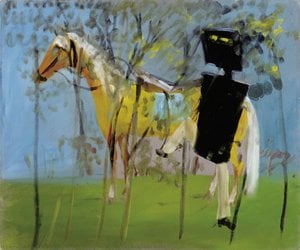
A Life Painted in Myth and Landscape
Sir Sidney Robert Nolan, born in Melbourne in 1917, stands as a monumental figure in 20th-century Australian art. His journey was not one of conventional artistic training but rather an explosive emergence from the working-class streets of St Kilda into a world of vibrant imagination and relentless experimentation. Nolan wasn’t simply a painter; he was a visual storyteller, a mythmaker who wrestled with Australia's history, its landscapes, and its very identity. From his early days as a runner for an illegal betting ring to his eventual acclaim on the international stage, Nolan’s life was marked by a restless energy and a refusal to be confined by artistic norms. He absorbed influences from diverse sources – the poetry of Rimbaud, the spatial innovations of Cézanne, the raw emotion of Danila Vassilieff – yet forged a style uniquely his own, one that resonated with a distinctly Australian sensibility. His early exposure to the harsh realities of Melbourne life and the allure of its underbelly would profoundly shape his artistic vision, imbuing his work with a sense of both defiance and vulnerability.The Shaping of an Iconoclast
Nolan’s formative years were steeped in intellectual ferment. The Heide Circle, centered around patrons John and Sunday Reed, proved pivotal. This haven for artists and writers fostered a spirit of radical experimentation and provided Nolan with crucial support during his developing phase. It was at Heide that he encountered kindred spirits – Albert Tucker, Joy Hester, Arthur Boyd – all grappling with the challenge of creating a distinctly Australian modernism. The influence of modernist literature, particularly the Symbolist poets, cannot be overstated. Rimbaud’s call for a “systematic derangement of the senses” became a guiding principle for Nolan, liberating him from representational constraints and encouraging him to explore the emotional power of color, form, and symbolism. His early works demonstrate this influence, often featuring fragmented figures and dreamlike landscapes that hint at deeper psychological truths. He wasn’t interested in merely depicting reality; he sought to capture its essence, its underlying emotions, and its hidden narratives. This period also saw Nolan experimenting with various media, from stage design for the Ballet Russes to commercial art, each experience contributing to his growing technical prowess and artistic vocabulary.Early Life and Influences
Sidney Nolan was born in Carlton, Melbourne, at that time an inner working-class suburb of Melbourne, on 22 April 1917. He was the eldest of four children. His parents, Sidney (a tram driver) and Dora, were both fifth generation Australians of Irish descent. Nolan later moved with his family to the bayside suburb of St Kilda. He attended Brighton Road State School and then Brighton Technical School and left school aged 14. He enrolled at the Prahran Technical College (now part of Swinburne University of Technology), Department of Design and Crafts, in a course which he had already begun part-time by correspondence. In 1933, at the age of 16, he began working for Fayrefield Hats, Abbotsford, producing advertising and display stands with spray paints and dyes for six years. This early experience instilled in him a meticulous attention to detail and an understanding of visual communication—skills that would prove invaluable throughout his artistic career. He was particularly drawn to the ideas expressed by Klee, whose approach deliberately undermined accepted boundaries of art through experimentation and a range of techniques, media and juxtaposition of subject matter. Nolan’s fascination with Surrealism stemmed from Rimbaud's poetic vision of a world unbound by logic and reason—a perspective that profoundly shaped his artistic sensibility.The Heide Circle and Artistic Collaboration
Nolan’s association with the Heide Circle was transformative. Surrounded by fellow artists who shared his ambition to forge a uniquely Australian modernism, he engaged in stimulating dialogues and collaborative projects that fueled his creative development. The Circle's ethos—characterized by openness to experimentation and a rejection of academic conventions—provided Nolan with an environment where he could freely explore new ideas and techniques. He worked closely with Albert Tucker, Joy Hester, Arthur Boyd, and John Perceval, fostering a dynamic exchange of perspectives and inspiring each other’s artistic endeavors. These collaborations resulted in groundbreaking artworks that captured the spirit of their time and cemented Nolan's reputation as one of Australia’s foremost modernist painters.The Iconic Ned Kelly Series
Nolan’s magnum opus—the Ned Kelly series—represents a pinnacle of Australian art history. Beginning in 1946, he embarked on an ambitious project to depict the legend of Ned Kelly, the charismatic outlaw who defied Victorian law and became a symbol of defiance against authority. Nolan approached this subject matter with unparalleled psychological depth and artistic innovation, transforming Kelly’s armor into a monumental visual device—a stylized representation of his impenetrable spirit and unwavering conviction. The series consists of 26 paintings that explore various facets of Kelly's life and legend, employing a distinctive technique characterized by flattened planes of color and simplified forms. Nolan deliberately eschewed traditional realism, prioritizing emotional impact over accurate depiction—a stylistic choice that resonated deeply with audiences and established Kelly as an enduring emblem of Australian identity. The Ned Kelly series remains one of the most celebrated artworks of the 20th century, continuing to inspire artists and scholars alike. ## Legacy and Enduring Influence Sir Sidney Nolan’s legacy extends far beyond his artistic output. He championed a radical vision of art—one that prioritized emotion, imagination, and experimentation—challenging established conventions and paving the way for future generations of Australian artists. His unwavering commitment to exploring Australian mythology and landscape solidified his place as a national icon. His influence can be seen in the work of countless contemporary artists who continue to draw inspiration from his innovative techniques and his profound understanding of the human condition. Nolan’s paintings are held in major museums and collections around the world, ensuring that his artistic vision—and its enduring power—will continue to captivate audiences for years to come.Spørsmål og svar
Hvilke farger brukte Sir Sidney Robert Nolan oftest?
Fargeprofilen til Sir Sidney Robert Nolan sine verk vises på kunstnerens Palettens genom-side.
Hvor og når ble Sir Sidney Robert Nolan født?
Sir Sidney Robert Nolan ble født i Melbourne i 1917.
Hvor kommer Sir Sidney Robert Nolan fra?
Sir Sidney Robert Nolan ble født i Australia.
Kan jeg bla gjennom Sir Sidney Robert Nolan sine verk etter stemning?
Sir Sidney Robert Nolan sine verk kan utforskes etter stemning på artistens Stemningsrom-side, som organiserer kunstverkene etter deres tilhørende stemninger.
Hvilken by og hvilket land er Sir Sidney Robert Nolan født i?
Sir Sidney Robert Nolan ble født i Melbourne i Australia.
Kan jeg utforske verkene til Sir Sidney Robert Nolan etter nøkkelord?
For å finne verk av Sir Sidney Robert Nolan innen et spesifikt tema, kan du bruke kunstnerens Etter nøkkelord-side, som grupperer kunstverkene etter nøkkelord.
Hvor mange kunstverk av Sir Sidney Robert Nolan er tilgjengelige for gjennomgang?
Du kan bla gjennom 63 kunstverk verk av Sir Sidney Robert Nolan på siden Alle kunstverk.