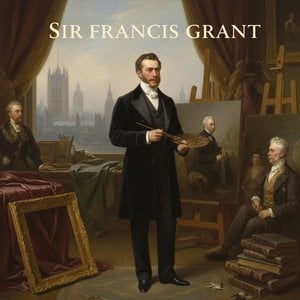
A Life Dedicated to Portraiture and the Academy
Sir Francis Grant, a name synonymous with refined portraiture and dedicated service to the British art establishment, emerged as one of the most sought-after artists of his era. Born in 1803 into a landed family in Perthshire, Scotland, young Francis initially seemed destined for a career in law. However, the allure of artistic expression proved too irresistible to resist. Though largely self-taught, he briefly studied under Alexander Nasmyth in Edinburgh, laying an early foundation before forging his own distinctive path. This path wasn’t immediately apparent; Grant's initial successes came with sporting scenes, capturing the energy and vibrancy of rural life – subjects that would initially define his reputation. A pivotal moment arrived through his marriage, granting him access to the exclusive world of Melton Mowbray’s hunting set. There, he honed his skills under John Ferneley, a master of equestrian art, and began to specialize in depictions of horses and hounds – endeavors that showcased an exceptional eye for detail and composition.From Sporting Scenes to Aristocratic Likenesses
Grant's artistic evolution wasn’t merely a shift in subject matter; it was a refinement of style. His early sporting scenes, like the celebrated *Melton Breakfast* (1834), demonstrated an astute understanding of light and color, mirroring the Impressionists’ burgeoning fascination with capturing fleeting moments. Yet, it was his burgeoning talent for portraiture that truly propelled him to prominence. He possessed a remarkable ability to capture not just physical likeness but also the character and social standing of his sitters – a skill particularly valuable in an era obsessed with status and image. This dedication to portraying individuals authentically distinguished him from many contemporaries who prioritized mere representation over psychological insight. Commissions flowed in from the British aristocracy and political elite, including the ultimate accolade: portraits of Queen Victoria herself. His portrait of Lady Glenlyon (1842) served as a watershed moment, solidifying his position among the leading portraitists of the day; it exemplifies Grant’s masterful blending of Neoclassical elegance with subtle Romantic influences – a technique that subtly elevates the image beyond mere likeness. He skillfully employed chiaroscuro—the dramatic interplay of light and shadow—to convey emotion and depth, mirroring the stylistic innovations championed by artists like Rembrandt. His portraits captured not just appearances but also inner qualities, reflecting Victorian ideals of dignity and refinement.Influences and Artistic Development
Grant’s artistic journey was shaped profoundly by his mentors – Alexander Nasmyth, whose atmospheric landscapes instilled in him a sensitivity to tonal variation; and John Ferneley, who imparted invaluable expertise in equestrian art and compositional balance. Ferneley's influence is evident in Grant’s meticulous depictions of horses and hounds, reflecting the aristocratic fascination with horsemanship during Victorian Britain. These formative experiences cultivated Grant’s distinctive artistic voice – one characterized by precision, restraint, and a profound appreciation for beauty. He absorbed lessons from artists like Thomas Lawrence, whose opulent portraits established standards of grandeur and elegance, tempering Lawrence's flamboyant style with Grant’s own understated grace. This careful assimilation of stylistic elements contributed to his enduring legacy as a portraitist who elevated the genre beyond mere likeness.Presidency and Legacy: Shaping the Royal Academy
The pinnacle of Grant’s career arrived in 1866 with his election as President of the Royal Academy, following the death of Charles Eastlake – an honor that recognized not only his artistic achievements but also his respected standing within the art world. This prestigious position signaled a culmination of decades dedicated to honing his craft and championing artistic innovation. During his tenure, Grant instituted a groundbreaking practice: the holding of major loan exhibitions—a bold step that expanded the Academy’s reach and influence, attracting wider public engagement and fostering dialogue about art history and contemporary aesthetics. He wasn't merely preserving tradition; he actively sought to broaden its horizons – mirroring the spirit of reform prevalent in Victorian Britain. Grant’s leadership solidified the Royal Academy as a cornerstone of British cultural life, ensuring that his vision would continue to inspire generations of artists. His influence extended beyond his own work, impacting artists such as Martin Archer Shee and Solomon Alexander Hart.Notable Works
- Melton Breakfast (1834): An early triumph showcasing Grant’s mastery of tonal harmony and atmospheric perspective.
- The Meeting of His Majesty's Staghounds on Ascot Heath: A dynamic composition capturing the energy and excitement of a hunting event with remarkable accuracy.
- Portrait of Lady Glenlyon (1842): Considered Grant’s masterpiece, embodying Neoclassical elegance infused with Romantic sensitivity—a testament to his artistic skill.
- Equestrian Portraits of Queen Victoria and Prince Albert: Demonstrations of Grant's exceptional talent in portraying both regal dignity and noble steeds – capturing the grandeur of Victorian royalty.
- Portraits of the Marchioness of Waterford, the Marchioness of Bristol, and Mrs Markham (Daisy Grant): Acclaimed portraits reflecting Grant’s ability to convey character and social standing with subtlety and grace.
Spørsmål og svar
Hvilke pseudonymer eller andre navn er Sir Francis Grant kjent under?
Sir Francis Grant opptrer under de alternative navnene Francis Grant.
Hvor er Sir Francis Grant sine kunstverk gruppert etter nøkkelord?
Siden Etter nøkkelord for Sir Francis Grant grupperer kunstnerens verk etter deres nøkkelord.
Kan jeg besøke et virtuelt museum med verkene til Sir Francis Grant?
Et virtuelt besøk er mulig: siden 3D-museum til Sir Francis Grant presenterer kunstnerens verk i et tredimensjonalt galleri.
Hvilke farger brukte Sir Francis Grant oftest?
Sir Francis Grant sin fargebruk i verkene oppført på denne nettsiden kan studeres på kunstnerens Palettens genom-side.
Hvilken by og hvilket land er Sir Francis Grant født i?
Sir Francis Grant ble født i Edinburgh i Storbritannia.
Hvor kommer Sir Francis Grant fra?
Sir Francis Grant ble født i Storbritannia.
Hvordan kan jeg følge Sir Francis Grant sitt arbeid år for år?
Det finnes en tidslinje over Sir Francis Grant sine verk: kunstnerens Tidslinje for kunstverk-side sorterer kunstverkene etter produksjonsdato.
Kan jeg bla gjennom verkene til Sir Francis Grant etter kunstretning?
Siden Alle retninger grupperer Sir Francis Grant sine kunstverk etter kunstretning.