A Transnational Vision: The Life and Art of Ruby Onyinyechi Amanze
Ruby Onyinyechi Amanze, born in 1982 in Port Harcourt, Nigeria, embodies a fascinating artistic journey shaped by migration, cultural hybridity, and a profound exploration of identity. Her work transcends simple categorization, existing as a captivating blend of drawing, collage, and mixed media that invites viewers into a dreamlike realm populated by fragmented figures and ethereal landscapes. Amanze’s early life was marked by movement; after spending her formative years in Nigeria, she relocated to the United Kingdom at the age of thirteen before eventually settling in the United States to pursue higher education. This experience of displacement—of existing between worlds—became a foundational element of her artistic practice, fueling a desire to articulate the complexities of belonging and the fluidity of cultural boundaries. She earned a Bachelor of Fine Arts degree *summa cum laude* from Tyler School of Art at Temple University in Philadelphia (2004), followed by a Master of Fine Arts degree from Cranbrook Academy of Art in Bloomfield Hills, Michigan. These academic experiences provided her with a strong technical foundation and the space to develop her unique visual language.
The Language of Displacement: Themes and Techniques
Amanze’s artistic process is deeply rooted in drawing, a medium she has returned to repeatedly throughout her career. Her large-scale works on paper are characterized by intricate graphite lines, delicate washes of ink, and the incorporation of photographic elements—often fragmented portraits or architectural details. These layers create a sense of depth and ambiguity, evoking memories, dreams, and imagined spaces. The figures that populate her compositions are often chimeric beings—hybrids of human, animal, and abstract forms—that seem to float in a state of perpetual transition. This deliberate blurring of boundaries reflects Amanze’s interest in challenging fixed notions of identity and exploring the possibilities of cultural fusion. Her work is not simply about representing displacement; it's about *feeling* it—the sense of longing, alienation, and the search for belonging that accompanies a life lived between cultures. The manipulation of space itself becomes a central theme, functioning as a poetic alternative to fixed geographies and offering a visual metaphor for the fluidity of identity.
Influences and Artistic Development
Amanze’s artistic lineage is rich and diverse, drawing inspiration from both Nigerian art traditions and contemporary Western practices. She frequently cites the influence of Nigerian artists who have explored themes of cultural hybridity and post-colonialism, acknowledging a deep connection to her heritage. Beyond this, she has been influenced by textile design, photography, printmaking, and architecture—all mediums that inform the layered complexity of her work. Initially focusing on photography and textiles during her college years, Amanze eventually returned to drawing as her primary mode of expression, recognizing its unique capacity for nuance and ambiguity. This return wasn’t a rejection of other forms but rather an integration of them; the photographic elements and textile-inspired patterns that appear in her drawings serve to enrich their narrative depth and visual texture. Her Fulbright Scholarship at the University of Nigeria, Nsukka (2012-2013) proved pivotal, allowing her to reconnect with her roots and further explore the artistic traditions of her homeland.
Major Achievements and Recognition
Amanze’s work has garnered significant recognition in recent years, establishing her as a leading voice in contemporary art. She completed two-year residencies at the Queens Museum and the Drawing Center’s Open Sessions Program in New York, providing invaluable opportunities for artistic growth and experimentation. Her solo exhibitions include “there are even moonbeams we can unfold” (2018) at Goodman Gallery in Cape Town, South Africa, and “Salt Water” (2015) at Goodman Gallery in Johannesburg, South Africa. She has also participated in numerous group exhibitions internationally, including the Armory Show Focus (2016). Her work is held in prominent collections such as Deutsche Bank in London, The Jewish Museum and The Studio Museum in Harlem in New York, and the Microsoft Collection. These achievements underscore her growing influence within the art world and her ability to connect with audiences on a deeply emotional level.
Historical Significance and Legacy
Ruby Onyinyechi Amanze’s work occupies an important space within contemporary discourse surrounding post-colonial identity, cultural hybridity, and the complexities of migration. Her evocative drawings challenge viewers to reconsider fixed notions of belonging and embrace the fluidity of cultural boundaries. By creating a visual language that is both personal and universal, she offers a powerful commentary on the experience of existing between worlds—a reality shared by millions across the globe. Amanze’s legacy lies not only in her stunning artistic creations but also in her ability to articulate the nuances of displacement with sensitivity and grace, paving the way for future generations of artists to explore these themes with greater depth and complexity. Her work is a testament to the power of art to transcend borders and connect us through shared human experiences.
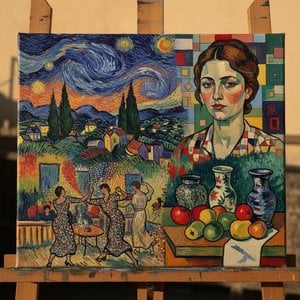
Discover the profound emotional depth of Post-Impressionist landscapes. Explore how masters like Van Gogh revolutionized art through vibrant color, textured impasto, and symbolic expression in this expert guide to the movement that redefined modern art history.
Unveil the profound revolution of Post-Impressionism. Explore how masters like Van Gogh and Cézanne utilized bold colors and emotional depth to transcend mere representation, laying the foundation for modern art. A sophisticated journey through history's most emotive brushstrokes.
Explore the transformative era of Post-Impressionism. Discover how masters like Cézanne and Matisse revolutionized color and form, moving beyond Impressionism to shape modern art history through structural innovation and expressive emotion.